This online copy is presented for educational purposes only. For all official purposes, the formal publication in PDF format prevails.
The questions below are the ones supervisors, central bankers and bankers raise most often. Each is answered from the law, the standards and the economics that already govern banking, because the Alkaimi Ecosystem™ was built to operate inside that existing framework.
4.1 Isn’t the DTA just another crypto token?
No: every regulator’s definition of a cryptoasset turns on a kind of ledger the DTA™ does not use.
The Basel Committee defines cryptoassets as private digital assets that depend on cryptography and distributed ledger or similar technologies, and places dematerialized securities kept on centrally administered electronic registers outside the chapter’s scope (Basel Framework, SCO60). The European Union’s crypto-asset is transferred and stored using distributed ledger or similar technology (Regulation (EU) 2023/1114, Article 3(1)(5)). The United States tax definition requires a record on a cryptographically secured distributed ledger (26 U.S.C. 6045(g)(3)(D)). A DTA’s ownership is recorded and changed only on one centrally administered ledger under bank supervision, and no DTA is listed, quoted or traded on any market (Section 2, item 2.3).
The FATF definition of a virtual asset excludes financial assets already covered elsewhere in the FATF Recommendations (FATF Glossary). Every DTA is held and moved by member institutions that are already obliged institutions under FATF Recommendations 10 to 21, as implemented in each member institution’s own jurisdiction (Section 2, item 2.1).
4.2 What happens if the asset’s market price falls?
The holder does not carry the loss: the DTA is issued below the recognized value, and the shortfall is underwritten.
Banking already meets collateral price risk with haircuts: the Basel framework reduces the value credited to collateral so the exposure stays covered when the collateral’s market value falls (Basel Framework, CRE22). The DTA applies the same principle at issuance. The underwriter signs 0.90 of the recognized value and the Mint issues 0.80, so a balance of the recognized value stands unreleased in the Alkaimi™ ledger as cover (The Alkaimi Financial Ecosystem in Function, Terms; pegisai.com, Underwriting on the platform, in depth).
The underwriter’s signature is a contract of suretyship, a class of non-life insurance that authorized insurers write (Directive 2009/138/EC, Annex I, class 15). A surety is bound to perform when the principal obligor does not (Restatement (Third) of Suretyship and Guaranty, 1996). The signature warrants the existence, title, quantity and recoverability of the asset at the floor at which the value was recognized (pegisai.com, Underwriting on the platform, in depth).
The DTA issuer must also maintain the asset for as long as the DTAs are outstanding. An issuer that fails the asset maintenance requirements has the DTAs the issuer issued frozen, and the DTAs the issuer holds from other sources are liquidated to cover the issuer’s obligations to other holders. On default, holders are paid from the DTAs the issuer took in payment first, then by the underwriter as surety, to the full issued value (pegisai.com, Part 2 and Underwriting on the platform).
4.3 Who checks Pegisai? Isn’t the ecosystem certifying itself?
No: three independent checks stand outside the administration.
First, every member institution answers to the member institution’s own regulator, and bank supervisors review a bank’s management of every third-party relationship as part of standard supervision (Interagency Guidance on Third-Party Relationships: Risk Management, 6 June 2023).
Second, the underwriters sign 0.90 of every recognized value and carry the surety on every stack, so a party outside the administration puts the underwriter’s own balance sheet behind each recognized value (pegisai.com, Underwriting on the platform, in depth).
Third, the ecosystem is independently audited and attested under recognized professional assurance standards. The reports are disclosed to an institution under contract, a non-disclosure agreement and fees, because the reports reveal the ecosystem’s internal intellectual property.
4.4 Where does the currency come from when many holders transmute at once?
From the member institution’s own operating retail bank, with the central bank’s standing facilities behind the member institution, as for any bank.
The desk is the member institution’s own currency operation, regulated as the member institution’s currency operations are regulated today, outside the walled garden (pegisai.com, The Model). A DTA the member institution takes in at the desk stays whole, and the member institution can pledge the DTA at the member institution’s central bank, the repo route, once that central bank accepts the pledge under the central bank’s own collateral rules, an approval in process (Section 2, item 2.2; pegisai.com, Platform).
Central banks already lend to banks against good collateral through standing facilities: the Federal Reserve through the discount window (Regulation A, 12 C.F.R. Part 201) and the Eurosystem through the marginal lending facility (Guideline (EU) 2015/510). The principle is the oldest in central banking: in a panic, lend freely, at a high rate, against good collateral (Bagehot, Lombard Street, 1873). A holder who does not transmute holds the whole value throughout, because the holding is not a currency deposit and is a claim on no one (Overview, item 9).
4.5 Why isn’t the ecosystem designated a systemically important utility?
Designation follows systemic importance, and the ecosystem is at the first, wholesale stage of the ecosystem’s existence.
In the United States, the Financial Stability Oversight Council designates a financial market utility after weighing the aggregate value of the transactions the utility processes, the utility’s exposure to counterparties, the utility’s interdependencies with other utilities, and the effect the utility’s failure would have on markets and institutions (12 U.S.C. 5463). Each of those measures grows with scale, and the ecosystem is metered by sequence: wholesale settlement first, by the members’ own embargo (Overview). Non-designation is a stage, not a finding against the ecosystem.
At every stage, every operation on the Alkaimi ledger is conducted by member institutions under the member institutions’ own regulators, and supervisory classification of member operations rests with each member’s own regulator (Pegisai Global Holdings, 1 October 2026).
4.6 What law governs a DTA?
The law of England and Wales, the law that has governed bearer instruments since 1882 and now gives documents in electronic form the effect of paper.
The design separates the property from the contract. The asset is the client’s property, held in custody under the client’s own title, and the asset does not move. The DTA is the bearer instrument, a contract in electronic form that carries the recognized value, the surety and the holder’s drawing right into a recognized asset class, and the DTA moves by delivery on the Alkaimi ledger (Terms Used In This Document).
English law has treated an instrument payable to bearer as passing by delivery since the Bills of Exchange Act 1882 (section 31(2)). Since 2023, English law has given trade documents in electronic form the same effect as paper, and a person may possess, indorse and part with possession of an electronic trade document (Electronic Trade Documents Act 2023, section 3). The law of England and Wales governs the DTA and the agreements under which a DTA is created, held and moved. Disputes under those agreements go to arbitration (Arbitration Act 1996), and arbitral awards are enforceable under the 1958 New York Convention (Section 2, item 2.3).
4.7 Does this weaken monetary policy?
No: each channel of monetary policy holds, and the credit channel tightens.
Economists trace monetary policy to the economy through the interest rate channel, the exchange rate channel, the credit channel and asset prices (Mishkin, Journal of Economic Perspectives, 1995). The interest rate channel holds: lending from rented DTAs, when offered, is funded by the central bank’s own advance, priced at the central bank’s own rate (Section 3, item 3.3). The exchange rate channel holds: currency meets value only at a member institution’s desk, under the nation’s own exchange and reporting rules (Section 2, item 2.3).
The credit channel tightens. In the bank lending channel, policy reaches the economy through banks’ deposits and loans (Bernanke and Gertler, Journal of Economic Perspectives, 1995), and today a bank creates a deposit whenever the bank makes a loan (McLeay, Radia and Thomas, Bank of England Quarterly Bulletin, 2014). A loan funded by the central bank’s advance creates no deposit, so the funding of new credit passes through the central bank’s own lending decision. The IMF’s modeling of the Chicago Plan, which separates money from credit in the same way, found much better control of credit cycles, and found that steady state inflation can fall to zero without posing problems for the conduct of monetary policy (Benes and Kumhof, IMF Working Paper 12/202, 2012). The issue of currency stays with the sovereign: Pegisai™ issues no currency, licenses no currency and prices nothing in any currency (Section 1).
4.8 Does the model change how a central bank sets rates under the Taylor rule, or any policy rule?
No: the central bank keeps the rule and sets the rate, and the model improves every condition on which the rule depends. That is the strongest reason a central bank has to want the model deployed.
What the rule asks of a central bank. The Taylor rule turns a central bank’s mandate into a policy rate. In John Taylor’s 1993 form, the policy rate equals a neutral real rate of interest plus inflation, plus half the gap between inflation and the inflation target, plus half the output gap (Taylor, Carnegie-Rochester Conference Series on Public Policy, 1993). The Federal Reserve reports the Taylor rule and the rule’s variants in the Federal Reserve’s Monetary Policy Report. Every rule that prescribes a level for the policy rate requires an estimate of the neutral real interest rate: the real rate consistent, in the longer run, with maximum employment and stable inflation (Board of Governors of the Federal Reserve System, Monetary Policy Report, February 2018). A policy rule is a benchmark against which a central bank sets and explains the rate. The rule is not a constraint, and the central bank keeps the decision.
Where the Taylor rule breaks. The Taylor rule assumes that the policy rate reaches borrowers through stable spreads. In 2008 the spreads broke, and John Taylor proposed subtracting a smoothed Libor-OIS spread, the measure of interbank stress, from the rate the rule would otherwise prescribe. Cúrdia and Woodford showed that the neutral rate of interest falls when credit spreads rise, and that a spread-adjusted rule can improve on the standard rule, with an adjustment smaller than the full spread (Cúrdia and Woodford, Journal of Money, Credit and Banking, 2010). The Libor-OIS spread prices the credit and liquidity risk of unsecured claims between banks (Federal Reserve Bank of St. Louis, Monetary Trends, November 2008). Taylor and Williams attributed the 2008 widening chiefly to counterparty risk (Taylor and Williams, American Economic Journal: Macroeconomics, 2009), the risk item 1.1 counts: the claims left by correspondent chains, the 10 percent of foreign exchange that settles gross and bilateral, fully exposed, and the counterparty risk that produced roughly two-thirds of the crisis’s counterparty credit losses through credit valuation adjustments (Section 1, item 1.1). The subject of this publication is therefore the rule’s weak point.
The neutral rate, through credit spreads: operating today. A settlement on the Alkaimi ledger opens no claim between the paying and the receiving institution, so the settlement leaves no counterparty exposure for a spread to price (Section 1, item 1.2). Each institution that settles on the Alkaimi ledger removes settlement claims from the interbank market, and a spread shock of the 2008 kind finds fewer claims to price. The rule’s intercept then needs less emergency adjustment, and the central bank has fewer occasions to depart from the rule. This channel runs at today’s wholesale scale and grows with the settlement volume that moves onto the Alkaimi ledger (Section 3, item 3.2).
The neutral rate, through the supply of safe assets. Economists at the Federal Reserve Bank of New York found that United States interest rates are low mostly because the premium for safety and liquidity has risen since the late 1990s, and that the rise in that premium explains up to one percentage point of the trend decline in the natural rate of interest (Del Negro, Giannone, Giannoni and Tambalotti, Brookings Papers on Economic Activity, 2017). A DTA is a claim on no one, with value fixed in UVUs, posted as a Level 1 high-quality liquid asset on Pegisai’s published position (Section 2, item 2.2). As DTAs reach balance sheets, the supply of safe assets grows, liquid through the desk and the central bank’s pledge rather than through a market, the premium for safety has less scarcity to price, and the neutral rate gains support.
The neutral rate, through lower debt. A loan funded by the central bank’s advance creates no deposit, so money creation no longer requires simultaneous debt creation, the fourth of Irving Fisher’s claims for separating money from credit (Benes and Kumhof, IMF Working Paper 12/202, 2012; Section 3, item 3.1). Kumhof’s 2026 presentation of the IMF work lists lower interest rates, due to lower debt levels, among the advantages of that separation (Kumhof, 2026).
The two forces on the neutral rate run in opposite directions. A larger supply of safe assets supports a higher neutral rate, and lower debt supports a lower one, so the net effect is an empirical matter. The central bank re-estimates the neutral rate as the model scales. Re-estimation is ordinary work: the Federal Reserve already treats the neutral rate as uncertain and revises the estimate over time (Monetary Policy Report, February 2018).
The inflation gap and the output gap. The rule moves when inflation or output leaves target. Today a bank creates a deposit whenever the bank makes a loan (McLeay, Radia and Thomas, Bank of England Quarterly Bulletin, 2014), so a credit boom creates money and a credit bust destroys money. In the model, the old deposits run off as the old loans repay, and lending from rented DTAs creates no deposit (Section 3, item 3.1). Client value held in custody cannot be run, because the member institution never owed the value (Overview). The IMF’s modeling of the same separation found support for much better control of a major source of business cycle fluctuations: sudden increases and contractions of bank credit and of the supply of bank-created money (Benes and Kumhof, 2012). Smaller swings in inflation and output mean smaller moves in the rate the rule prescribes.
The reach of the rate. The rule prescribes a rate, and the rate must still reach borrowers. A loan from the product book is funded by the central bank’s advance, priced at the central bank’s own rate (Section 3, item 3.3). The member institution still chooses each borrower and carries the borrower risk (Section 3, item 3.2). The central bank sets the price and the amount of the advance, as the central bank does at the discount window (Regulation A, 12 C.F.R. Part 201). Kumhof found that the rate on public credit has a much stronger effect on credit, and thereby on activity, than the conventional policy rate (Kumhof, 2026). Each move the rule prescribes then does more work.
A second instrument. The advance rate can sit at a spread to the policy rate. The central bank can then steer credit through the advance while the policy rate keeps the policy rate’s place in the rule. In the IMF model of the separation, policy controls three tools rather than one (Kumhof, 2026).
The inflation target and the lower bound. The adjusted forms of the rule recognize that the policy rate cannot be reduced materially below zero (Monetary Policy Report, February 2018). The IMF’s modeling found that steady state inflation can drop to zero without posing problems for the conduct of monetary policy (Benes and Kumhof, 2012). A central bank gains room to hold a lower inflation target with less exposure to the lower bound.
What the central bank keeps, gains and sheds. Today the central bank influences credit indirectly, and stands behind money the central bank does not create. Under the model, the central bank prices and funds new credit directly, and stands behind the money the central bank issues: more influence, with less exposure.
| The central bank keeps | The central bank gains | The central bank sheds |
|---|---|---|
| The issue and management of the nation’s currency | Direct pricing of new credit: the advance rate is the central bank’s own rate | The implicit guarantee behind money that banks create |
| The national settlement system | Direct funding of new credit: each advance is the central bank’s own lending decision | Run-driven emergency lending and rescues of the AIG kind |
| The policy rate and the policy rule | A second instrument: the advance spread | Spread shocks that force a departure from the rule |
| The role of lender of last resort | Collateral that is a claim on no one, behind every advance | |
| A banking system with fewer open claims, and fewer crises to fight |
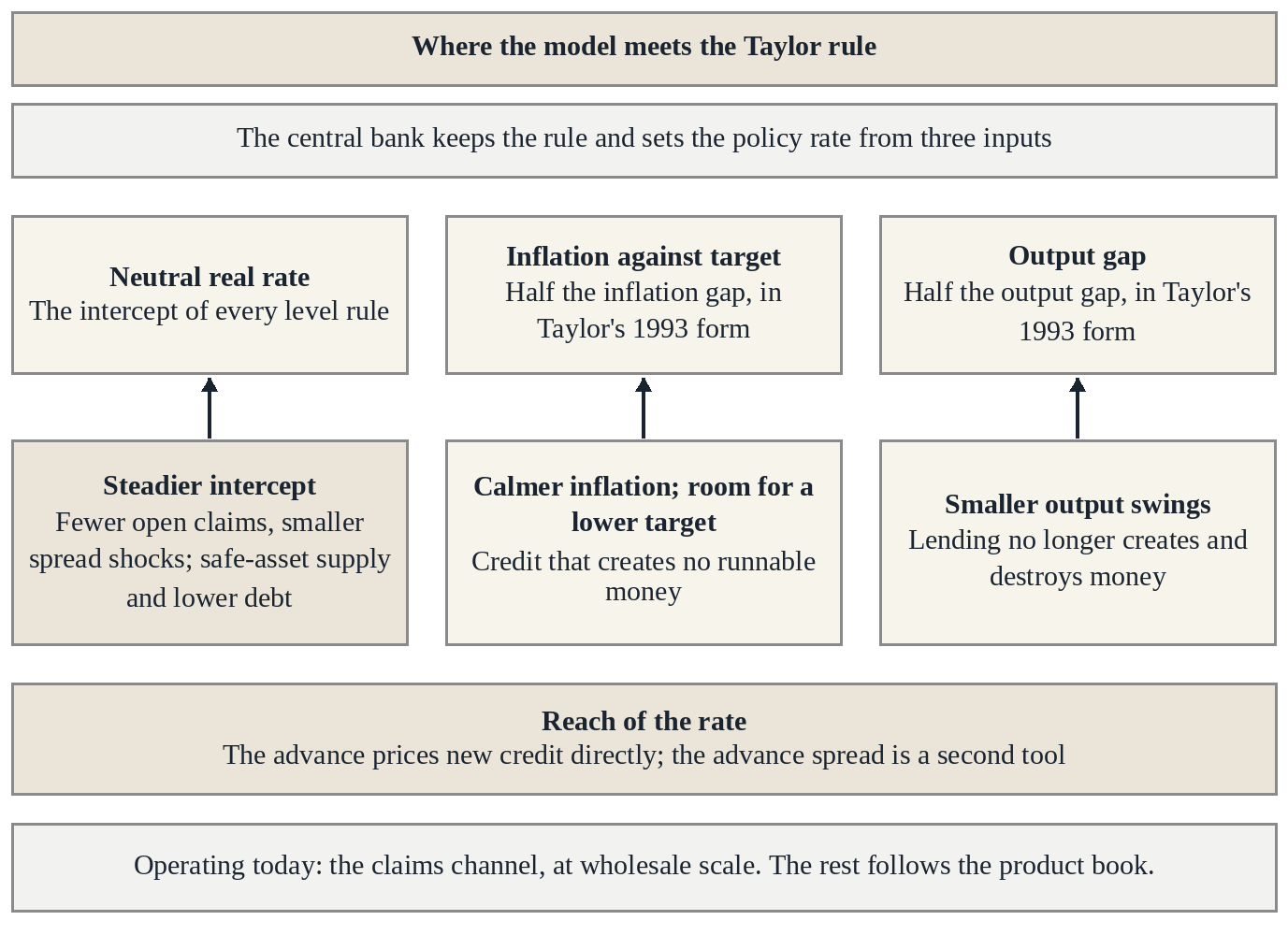
Where each effect stands today. The claims channel operates now, at wholesale scale. The reach of the rate, the second instrument and the effect of lower debt follow the product book, a planned operation, and the run-off of the old deposit books (Section 3, items 3.1 and 3.3). Each effect is a possibility that grows with adoption, not a promise (Legal Notice).
The reason a central bank wants the model deployed. The Federal Reserve Act directs the Federal Reserve toward maximum employment, stable prices and moderate long-term interest rates (section 2A). The Treaty on the Functioning of the European Union makes price stability the primary objective of the European System of Central Banks, and directs the System to contribute to financial stability (Article 127). The Bank of England Act gives the Bank of England a financial stability objective (section 2A). The model serves each objective through the rule. Steadier spreads and calmer gaps serve stable prices and maximum employment. Lower debt supports moderate long-term rates. Direct pricing and funding of new credit, and a second instrument, strengthen the conduct of policy. Fewer open claims serve financial stability. The central bank keeps the rule and the rate, and gains the conditions the rule needs to work.
4.9 The swaps sit with four large banks. How does this change anything?
Swaps hedge claims, the Alkaimi ledger opens none, and the effect grows with every institution that settles on the ledger.
Four large banks held 80.2 percent of the 300.5 trillion dollars of derivative notional at United States banks at 30 June 2026 (OCC, Quarterly Report on Bank Trading and Derivatives Activities, Second Quarter 2026). Under the Basel CVA framework, a bank capitalizes the risk that a counterparty’s credit quality falls, and under the basic approach the only eligible hedges are credit default swaps (Basel Framework, MAR50). Demand for the swaps therefore follows the counterparty exposure that claims create.
A settlement on the Alkaimi ledger opens no claim between the paying and the receiving institution (Section 1, item 1.2). Each institution that settles on the ledger stops opening the claims a swap would hedge, and the large banks that write and buy the swaps hold those claims against the same institutions. Today’s member institutions are regional institutions in wholesale settlement, so the effect on the swap market grows with the settlement volume that moves onto the Alkaimi ledger (Section 3, item 3.2).
4.10 Is the DTA a deposit? Is the DTA insured?
The DTA is not a currency deposit, and the law’s own definitions of a deposit say why.
In the United States, a deposit is the unpaid balance of money, or the equivalent of money, received or held by a bank, for which the bank has given or is obligated to give credit (12 U.S.C. 1813(l)). In the European Union, a deposit is a credit balance that a credit institution is required to repay (Directive 2014/49/EU, Article 2(1)(3)). A member institution receives no money for a DTA and owes no repayment of a DTA: the value is the client’s own, held in custody under the client’s title (Overview, item 9).
Value held on the Alkaimi Ecosystem’s ledger is held under a custodial agreement. Held value is not a currency deposit and is not insured by deposit insurance or by a government agency such as the FDIC. The settlement mechanisms used in the licensed model are themselves individually insured (Pegisai Global Holdings, 1 October 2026). Ordinary currency deposits taken by a member institution are insured or guaranteed as that member institution’s own deposit insurance regime provides (alkaimi.com, Regulatory Position).
4.11 Can a DTA be frozen, or used to evade a sanction?
A DTA is frozen whenever the law requires, and a DTA cannot be used to evade a sanction.
Sanctions attach to persons and entities.
The FATF standard requires every country to freeze without delay the funds or other assets of designated persons (FATF Recommendations 6 and 7). The United States administers sanctions under the International Emergency Economic Powers Act (50 U.S.C. 1701 to 1708), the European Union under the Council’s sanctions regulations, and the United Kingdom under the Sanctions and Anti-Money Laundering Act 2018.
Every holder is identified and screened against the applicable sanctions lists before the holder is admitted to the Alkaimi ledger, and every movement is screened again at the instant the movement is instructed. A member institution honors a lawful sanction by freezing what the sanction requires frozen, and the ledger’s own rules freeze the DTAs of a barred holder (alkaimi.com, Sanctions). A currency never enters the ledger, every holder is known, and every movement is recorded, so the ledger offers no route around a sanction (Section 2, item 2.3).
4.12 What happens if Pegisai fails?
No holder’s value is exposed, and the service Pegisai provides is a third-party relationship each member institution manages under the member institution’s own regulator.
Pegisai Global Holdings holds no client value, executes no client settlements and conducts no banking (Pegisai Global Holdings, 30 September and 1 October 2026). Pegisai is a contracted service provider, paid by the member institutions, carrying no credit risk and no market risk, so no holder’s DTA can sit in Pegisai’s estate.
The continuity of a service provider is already a supervised matter. United States bank supervisors expect a bank to manage a third-party relationship through the relationship’s whole life cycle, from due diligence to termination (Interagency Guidance on Third-Party Relationships: Risk Management, 6 June 2023). The European Union regulates the information and communication technology risk of financial entities, including the risk carried by third-party providers (Regulation (EU) 2022/2554). The Basel Committee sets principles for banks to keep critical operations running through disruption (Principles for Operational Resilience, March 2021).
4.13 Why should a central bank accept a DTA pledge?
Because the pledge serves the central bank’s own charter, and the central bank decides under the central bank’s own collateral rules.
The Federal Reserve Act directs the Federal Reserve toward maximum employment, stable prices and moderate long-term interest rates (section 2A).
The Treaty on the Functioning of the European Union makes price stability the primary objective of the European System of Central Banks and directs the System to contribute to financial stability (Article 127).
The Bank of England Act gives the Bank of England a financial stability objective (section 2A). A pledge of recognized value that no one owes adds collateral that is a claim on no one, and settlement on the Alkaimi ledger leaves fewer uncollateralized claims inside the banks the central bank supervises (Overview).
Each central bank sets the collateral the central bank accepts and the terms on which the central bank lends: the Federal Reserve under Regulation A (12 C.F.R. Part 201), the Eurosystem under Guideline (EU) 2015/510. Good collateral is the condition of central bank lending since Bagehot (Lombard Street, 1873).
The DTA is posted as a Level 1 high-quality liquid asset on Pegisai’s published position, item 2.2 sets out the criteria the DTA meets, and the central bank’s acceptance of the pledge is an approval in process (pegisai.com, Platform).
4.14 Isn’t the DTA just an electronic receipt for an asset held somewhere else?
No: the law defines a receipt by three features, and the DTA has none of the three.
A warehouse receipt is a document of title.
A document of title is a record treated as evidencing that the person in possession or control of the record is entitled to receive, control, hold and dispose of the record and the goods the record covers, and the record is issued by or addressed to a bailee and covers goods in the bailee’s possession (UCC 1-201(b)(16)). A bailee is a person that, by the document, acknowledges possession of goods and contracts to deliver the goods (UCC 7-102(a)(1)). When a negotiable document of title is duly negotiated, the holder acquires title to the document and title to the goods (UCC 7-502). English law gives electronic warehouse receipts and bills of lading the same effect as paper (Electronic Trade Documents Act 2023). A receipt therefore has three features: a bailee issues the record, the record covers specific goods in the bailee’s possession, and transfer of the record passes title to those goods.
The DTA has none of the three.
First, no bailee issues a DTA. The Mint issues the DTA, and the custodian holds the asset for the client, under the client’s own title, and issues nothing to a holder (Legal Notice, What a DTA holds).
Second, a DTA covers no goods in anyone’s possession. The holder’s drawing right runs to a member institution’s desk and to a recognized asset class, and the holder takes delivery of an asset of that class, not of the asset in custody (Terms Used In This Document, Drawing right).
Third, no transfer of a DTA passes title to the asset. Title moves only if the issuer defaults on the asset maintenance requirements, and then only to the underwriter, as the surety’s recourse (Legal Notice, What a DTA holds).
Nor is the drawing right a delivery order, the record that directs a warehouse or a carrier to deliver goods (UCC 7-102(a)(5)). The holder exercises the drawing right through a member institution, into a class of asset, and directs no warehouse and no carrier.
The test also runs the other way.
The holder of a receipt owns the goods, and the receipt is worth what the goods and the bailee’s promise to deliver the goods are worth. A DTA holder holds three contractual values: the recognized value, held whole in the DTA; the surety; and the drawing right. On an issuer’s default, the surety pays every holder of that stack’s DTAs in full, to the full issued value (Section 4, item 4.2). The DTA holder’s value does not depend on reaching any asset held elsewhere.
The protection sits at the level of the item.
Each DTA stack is segregated from every other stack in risk and in lien, and nothing is pooled (Section 2, item 2.3). The surety covers the issued value of one stack, and on that stack’s default the surety pays every holder of that stack’s DTAs in full. A failure is therefore bounded by the stack in which the failure occurs, and no claim reaches another stack, another member institution or the system.
The protections on which the existing system relies sit at the level of a bank or of the system: a correspondent chain, a counterparty’s swap book, a central bank’s backstop (Section 1, item 1.1). The DTA’s protections sit at the level of the item, the stack and the holder. As DTAs grow from wholesale settlement to system scale, the same bound holds at every size: a shock of the kind that widened the 2008 spreads and forced departures from the Taylor rule finds no chain of claims along which to travel (Section 4, item 4.8).
The FATF asks countries to read a virtual asset by function, not by label (FATF, Updated Guidance for a Risk-Based Approach to Virtual Assets and Virtual Asset Service Providers, October 2021). By function, the DTA represents nothing held elsewhere: the DTA holds the recognized value whole, the protection travels with the item, the DTA’s movement is the payment itself, and only obliged institutions hold and move a DTA (Section 2, item 2.3).
A regulator who reads the DTA as a receipt must find a bailee, goods covered and title passing. None of the three is there to find.