The 100% Whole Reserve™ model is the product Pegisai Global™ licenses to banks. This page states what the product is, whose reserve the model holds, how a bank converts to the model, how a licensed bank earns, how DTA™ rental funds a product book, where the desk between currency and value sits, and how a bank licenses the model.
1. What the product is.
Alkaimi™ calls the model 100% Whole Reserve because no licensed bank borrows against a client’s held value. In Alkaimi’s model the value is what moves in the system, not a liability or a claim. Each DTA issued is a whole value, and the DTA is what moves inside the Alkaimi Ecosystem™’s ledger.
Alkaimi’s Digitized Tangible Asset™, the DTA, holds the recognized value of one specific asset. It is built using Pegisai™’s digitization technology as a bearer settlement item for use inside the regulated banking system. A DTA is not a blockchain token, it is not a cryptocurrency, it is a defined monetary mechanism.
Alkaimi’s value recognition method locks value within each DTA created, which allows the DTA to be used as an absolute payment mechanism. Alkaimi’s 100% reserve model uses a new value separation model called stacking, which means assets are no longer pooled, as they are in other financial models.
In the 100% reserve model, each DTA stack is unique from other DTA stacks, so each DTA stack’s locked-in value comes from asset sources independent of other DTA stacks. These assets are segregated and segmented in the value recognition process and become locked to each unique DTA in the stack. This enables each DTA within each unique DTA stack to act as its own independent settlement item. Because of this each DTA settles a payment on its own: when the DTA moves, the payment obligation is extinguished by that movement. That is the absolute payment standard to which the Bank for International Settlements holds settlement systems, and the DTA met it in 2022.
2. Understanding the “reserve”.
In both of the traditional reserve models, banks take possession of a client’s assets or currencies as a deposit, which is then placed on the bank’s individual ledger. These ledgered deposits are then considered the bank’s reserve, and that bank then makes loans against these deposits and provides other products from them.
Alkaimi’s 100% reserve model is different.
Alkaimi’s model takes the power of a deposit and puts it back into the hands of the depositor. Essentially, in the Alkaimi model the “whole reserve” is the client’s, not the bank’s.
Each DTA stack is one recognized asset, segmented from the rest of that asset class and segregated from every other DTA, and held whole. Nothing is pooled and nothing is lent. The client’s reserve is the sum of the client’s individual DTA holdings, and any number of the client’s individual DTAs can settle at any time. The bank’s ledger holds client DTAs in custody.
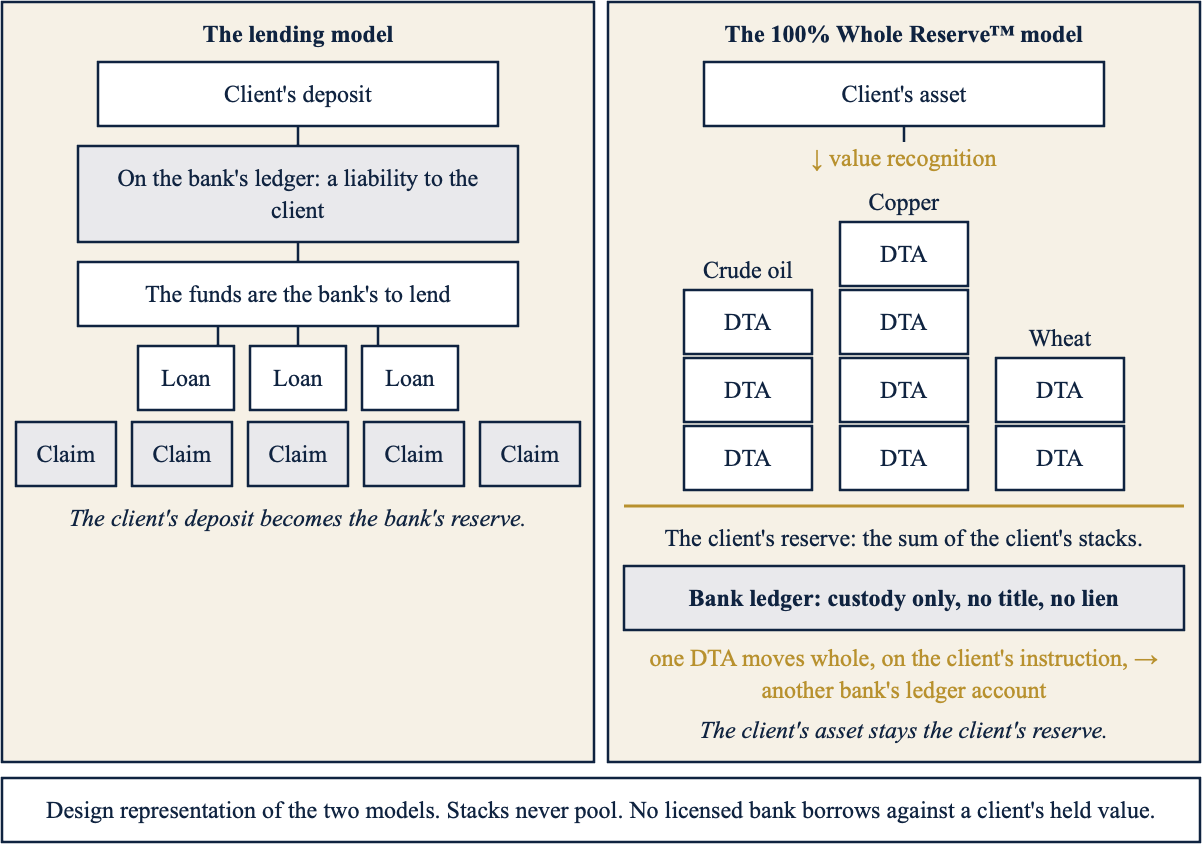
Figure 1. The lending model and the 100% Whole Reserve model, from the client’s deposit and the client’s asset. Design representation.
3. How a bank converts to the model, and sheds liabilities.
A bank enters the 100% Whole Reserve model in the course of ordinary business. A newly licensed bank may put its own assets through Alkaimi’s value recognition method, and the DTAs created are the bank’s own. As DTAs can be classified as Basel 3+ compliant HQLA capital, these converted holdings can be used as the bank’s capital position under the model, and posted on the bank’s books accordingly.
As the licensed bank’s clients do the same, the value the bank once carried as deposit liabilities leaves its balance sheet and becomes the clients’ own DTAs, held in the bank’s custody. With each client conversion the bank sheds a liability and gains a custody relationship. Nothing is forced and no loss is booked. A licensed bank converts one asset at a time: its own, and its clients’ under agreement. At the end of it the bank owes its clients nothing on the ledger. What is on the Alkaimi ledger is the client’s liquid assets.
The bank holds the client’s DTAs in custody. It places no lien on them, pledges none of them for its own account and creates no claim against them. The model bars it and the Alkaimi operating license enforces this prohibition.
For the client, that custody is the product.
Debasement no longer reaches their held value. The bank’s balance sheet no longer reaches that value, because the value is the client’s and not a claim on the bank. Nothing is done with the client’s DTAs behind the client’s back. The DTAs are liquid at any time, whole, without a sale or a conversion. A DTA settles anywhere in the ring with no currency in the movement. A DTA can be moved back into currency at the desk whenever the client wants currency. A DTA can be rented under a separate agreement, and the client is paid for that. And the held value keeps its purchasing power while every currency the value is later measured against loses some, which the client sees as a gain against that currency. Ledgered value is, in the reader’s words, inflation resistant.
Custody of whole value changes the business of a licensed bank.
A licensed bank does not bid for deposits with savings rates and certificate rates. A licensed bank offers value retention as the service, movement between value and currency at the desk, and an income stream on DTAs held in custody through rental. That income stream belongs to the client, and the bank can underwrite ordinary unsecured credit against the client’s income stream, on the currency side of the desk, with the DTA never pledged for the credit. Which brings the fees.
4. How a licensed bank earns.
In the traditional deposit model, a bank’s income is the spread on credit the bank creates against deposits, and every unit of that income carries a deposit liability behind the income. In the Alkaimi model the bank creates no credit and incurs no liability to earn. The bank is paid fees, and the fees are paid in DTAs onto the bank’s own ledger account.
The walkthrough.
A client brings an asset or currency to the desk, and the bank is paid for recognition when the asset or currency becomes DTAs. The bank holds the client’s DTAs, and the bank is paid for custody while the DTAs are held. A DTA moves from the client’s account to another account, and the bank is paid for settlement. A holder crosses the desk the other way, taking currency or an asset for a DTA, and the bank is paid for the transmutation. A client rents out a DTA under a separate agreement, and the bank is paid for arranging and administering the rent agreement. Five fees, all earned on service, all received in whole value, none a liability. The bank’s own holdings grow with every fee, and none of that growth is a claim on anyone.
5. DTA rental: the one way a licensee may use a client’s DTA.
A licensee may put a client’s DTA to work in one way only, under a separate rent agreement with that client. The process runs in this order.
Under the rent agreement the client’s DTA leaves the client’s ledger account for the term and moves into the bank’s custodial rental account. Title stays with the client and the DTA stays on the ledger. The bank pledges all or a portion of that custodial account to the central bank as Level 1 HQLA, and against the pledge the bank draws a low-rate currency line. That currency backs a product reserve on the currency side of the desk: a credit card book first. The same reserve can back mortgages the bank originates and sells into the secondary market to REITs, insurers and the other buyers.
Income on the product book comes in monthly.
The bank pays the income out monthly in a fixed order: the central bank’s fees first, then costs, then a loss provision. From what remains the bank pays each DTA owner a monthly stipend against the program’s annual earned income, and the bank keeps the balance. At term the DTA moves back from the custodial account to the client’s account, whole.
Losses on the product book are the bank’s.
The bank’s own DTAs absorb those losses first, the currency line is drawn below the value of the pledged reserve, and the loss provision is taken ahead of the owners’ stipends. The DTA owner’s principal never enters the product book. The owner’s exposure is to the size of the monthly stipend in a bad year, never to the DTA.
Rental is a bilateral commercial agreement outside the 100% Whole Reserve model.
For the client, rental is an income stream on value that stays whole and returns whole. For the bank, rental funds a product reserve at the window rate instead of at deposit rates, and that funding is the reason a licensed bank does not compete for deposits.
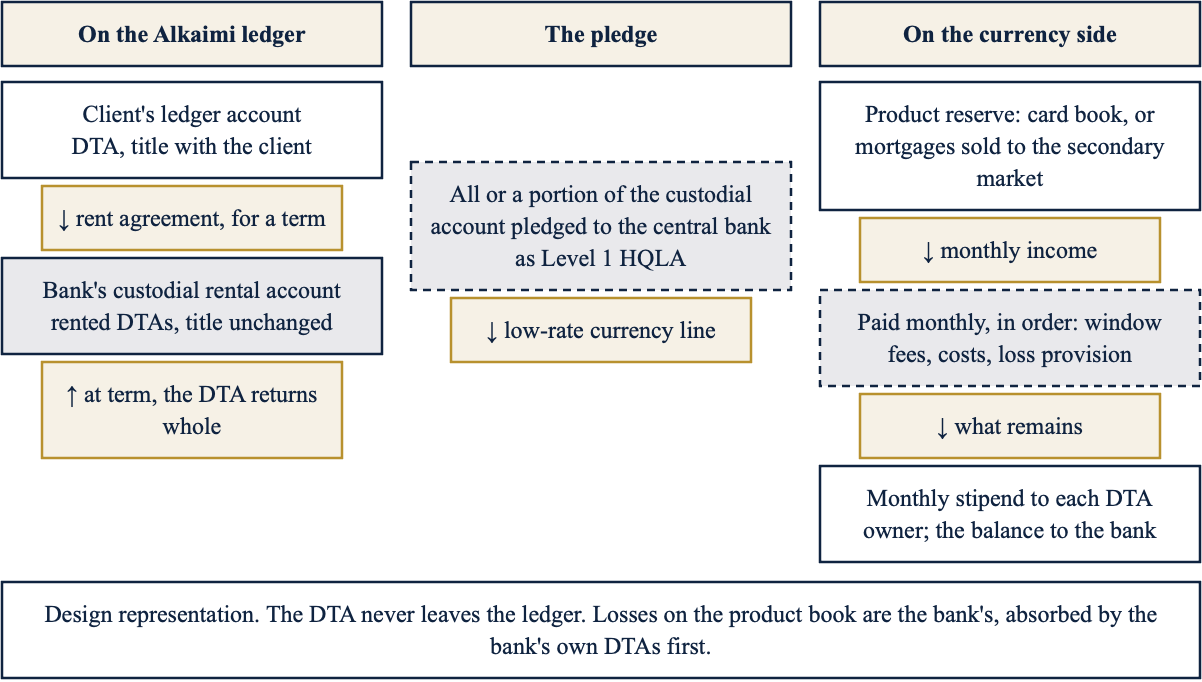
Figure 2. DTA rental. The DTA moves to the bank’s custodial rental account for the term, the account is pledged at the central bank, the currency line funds the product book, and the DTA returns whole. Design representation.
6. Conversion: any holder, any currency, any asset class.
A DTA is transmuted at the licensee’s desk, on the holder’s instruction, into any currency or into any recognized asset class. That right belongs to every holder, the bank included. A bank that has taken in DTAs as fees can settle them out into commodities, such as gold bullion, or into any currency it needs on the day, at its own desk. Value comes in as fees and goes out as whatever the bank chooses to hold.
7. The transition zone: currency operations and DTA operations.
A licensed bank runs two operations, and the line between them is its own desk.
On one side are currency operations: the deposits clients bring in currency, the accounts, the lending and every other product the bank offers today, regulated as they are today, outside the walled garden.
On the other side are DTA operations: value recognition, custody and settlement of whole value, inside the walled garden, on the ledger.
The desk is where the two meet. A client who brings currency and wants whole value transmutes the currency there; a holder who wants currency for a DTA transmutes the DTA there. Currency never enters the Alkaimi walled-garden network, and a DTA never leaves the Alkaimi ledger.
One bank, two operations, one clear line.
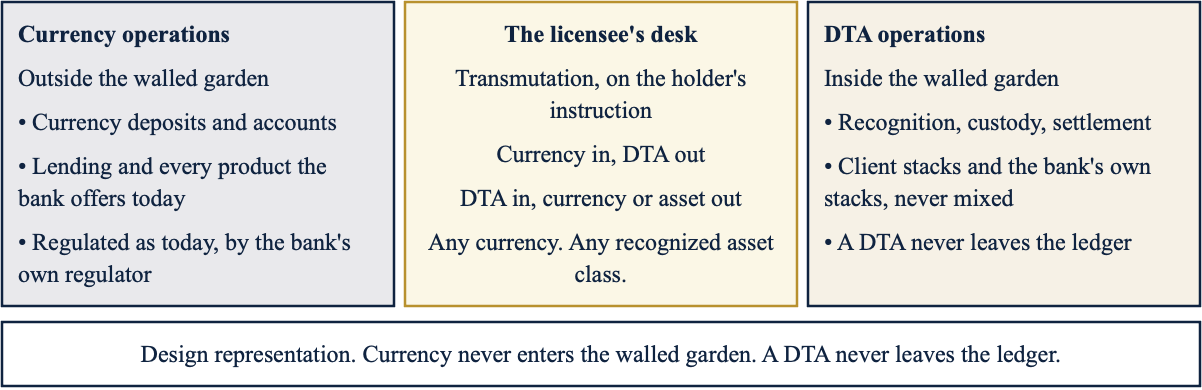
Figure 3. The transition zone. Currency operations, the licensee’s desk, DTA operations. Design representation.
8. The product, and who may license it.
Central banks supply retail banks with one product, currency, and the issuer of that currency dilutes it with every deficit. Clients have shown that they want an alternative; the growth of stablecoins and cryptocurrencies is the evidence. Alkaimi’s 100% Whole Reserve model supplies retail banks with a second product: whole value with a count set at creation, held in a custodial relationship, liquid at any time, and able to produce income for the client through rental. The model lowers the licensee’s risk and liability profile.
The model is licensed to qualifying bank holding companies under the Alkaimi model operating license. Operations are currently restricted to wholesale settlement, with consumer retail operations targeted for 2028. For licensing and business inquiries: inquiry@pegisai.global.
The published record: The Alkaimi Financial Ecosystem in Function: Granular Value on a Neutral Rail.
This page contains some forward-looking statements. Read Pegisai’s statement on forward-looking statements.