Why insurance and reinsurance pools bid for the line, why issuer default is unlikely, and how a pool engages
Every DTA™ is underwritten, and the underwriting is a line that insurance and reinsurance pools bid for in a commons administered by Pegisai™.
Lower risk than the majority of what a pool does now
The risk an underwriter takes on a DTA is the recognition, and nothing else: that the asset exists, is owned, and delivers at the floor. The DTA itself carries no price, rate or currency exposure, because the recognized value is set at recognition and never moves, and the holder relies on no counterparty to pay, because the DTA is the holder's property, custodial held, by Alkaimi Financial Ecosystem members only, as a digitized bearer instrument, on the Alkaimi Financial Ecosystem ledger. The first twenty points of any shortfall never reach the underwriter, because the Mint issues 0.80 under a signature at 0.90.
A default call is a purchase, not a loss.
Before the underwriter pays, the ledger has liquidated the issuer's estate: the DTAs the issuer took in payment are seized and applied to the holders, the issuer's own unused issuance is frozen, and the drawing right on the asset is in the receiver's hands.
The underwriter pays the remainder owed to holders and takes the drawing right on the full recognized value to the extent paid, a saleable right inside the commons on value recognized at 1.00. Loss arises only where the drawing right itself fails, and on a sovereign-owned asset that is a state repudiating a right the state itself granted.
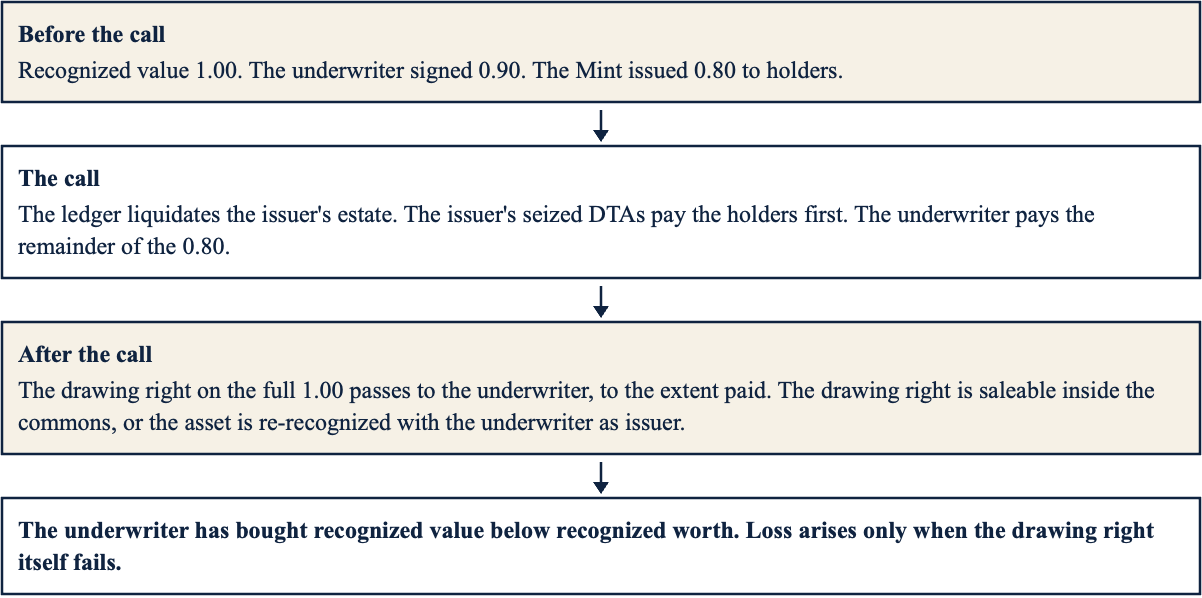
Figure A. A call is a purchase.
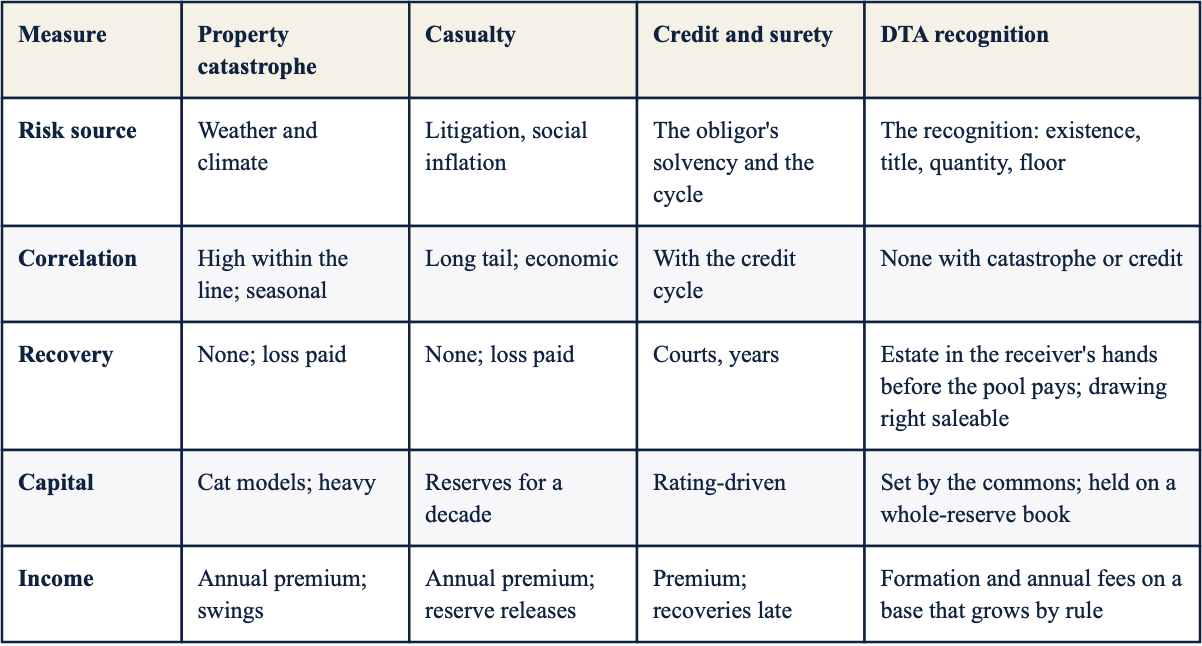
Figure B. The lines a pool carries today beside the DTA recognition line, on the pool's own measures.
Profitable, on a base that grows by rule
Every stack recognized on the platform needs an underwriter's signature, so the fee base is the recognized value on the ledger, built to reach the world's under-utilized and non-utilized asset reserve of about 4 quadrillion dollars. The underwriter earns a formation fee at recognition and an annual fee for the standing signature, paid whether a call ever comes, set at the value unit level and paid in any currency at a licensed bank's desk.
The line has no season and no cycle.
Global reinsurance capital stood at a record 790 billion dollars at 31 March 2026 while premium fell to 86 percent of capital in 2025 and buyers took price cuts of 15 to 40 percent at the mid-year 2026 renewals (Aon; Gallagher Re); the composite's combined ratio was 88.5 percent in 2025, and 147 billion dollars of third-party capital is already paying for non-correlating risk.
A pool whose capital has outrun the pool's premium needs a line that is not property catastrophe, and the DTA line is uncorrelated with catastrophe and with the credit cycle by construction.
Why issuer default is unlikely
On the platform a default is a choice, not a circumstance.
A DTA position carries no coupon and no principal wall: the settlement date rolls by reissue in the ordinary course, and the issuer's only recurring obligation is a maintenance fee, small, set at the value unit level, paid in any currency at the desk out of liquidity created from an asset that was immobile the day before.
An issuer short of a particular currency is never short of the means to pay, because the currency comes from the issuer's own value at the issuer's licensee’s own desk.
The penalty on default is a liquidation of the issuer's estate on the ledger, in days, against a defined estate: the seized receipts pay the holders, the surety pays the rest, the drawing right passes to the extent paid, and the residual is held for cure within a stated period.
Set beside a bond default, the platform's regime is faster, bounded and self-executing, and the regime is what makes every holder on the ledger always solvent; every issuer is a holder too.
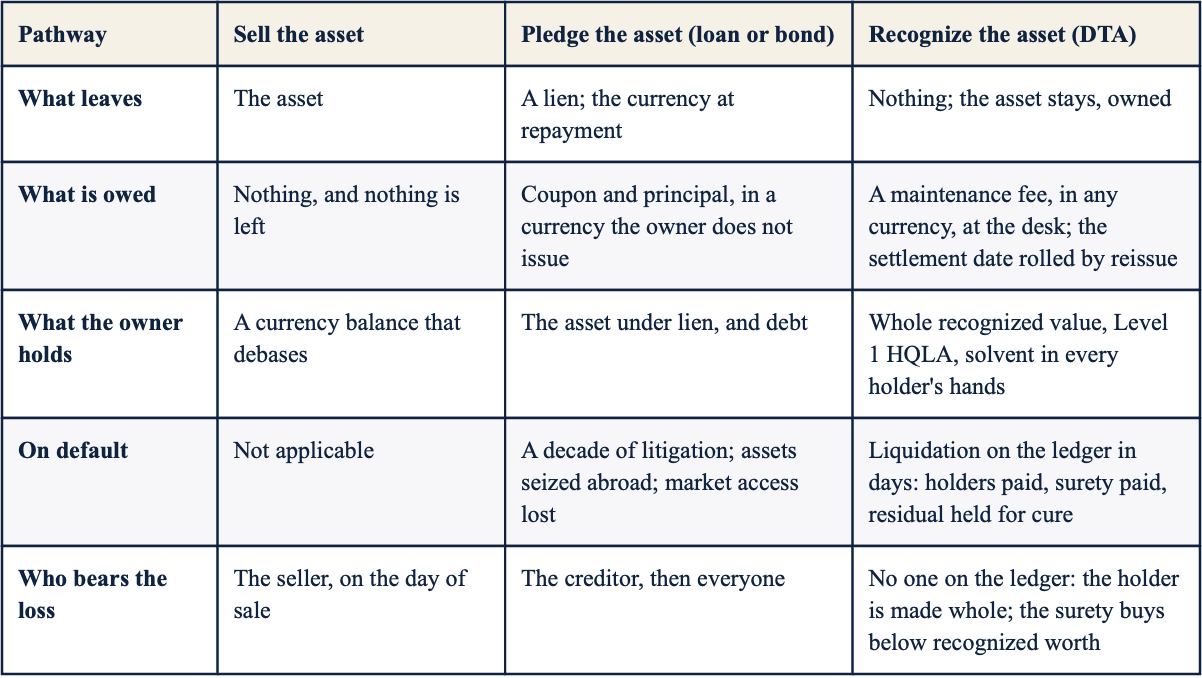
Figure C. Why an asset owner recognizes rather than sells or pledges.
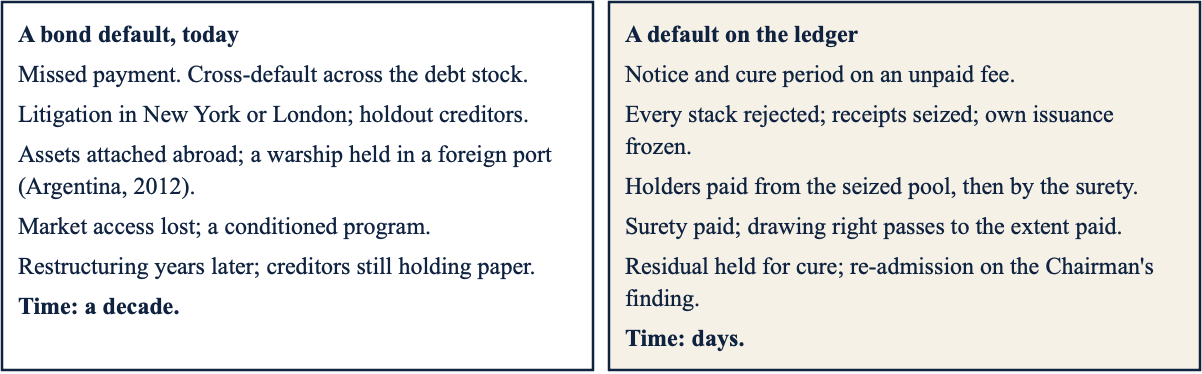
Figure D. A bond default beside a default on the ledger.
Why pools compete for the line
One signature stands behind each stack, and the signatures are allocated by bid in the commons. Demand is structural, because every recognition needs a signature by rule, and rises with the ledger.
Supply is finite, because a pool without an allocation has none of the fee. The first pools in take the sovereign tier, the lowest-risk and largest stacks, and set the standards the later pools follow. Every call adds to the pool a drawing right bought below recognized worth, and every recognition adds proprietary knowledge of the world's asset reserves, asset by asset. The cost of staying out is not the fee forgone; the cost is the position.
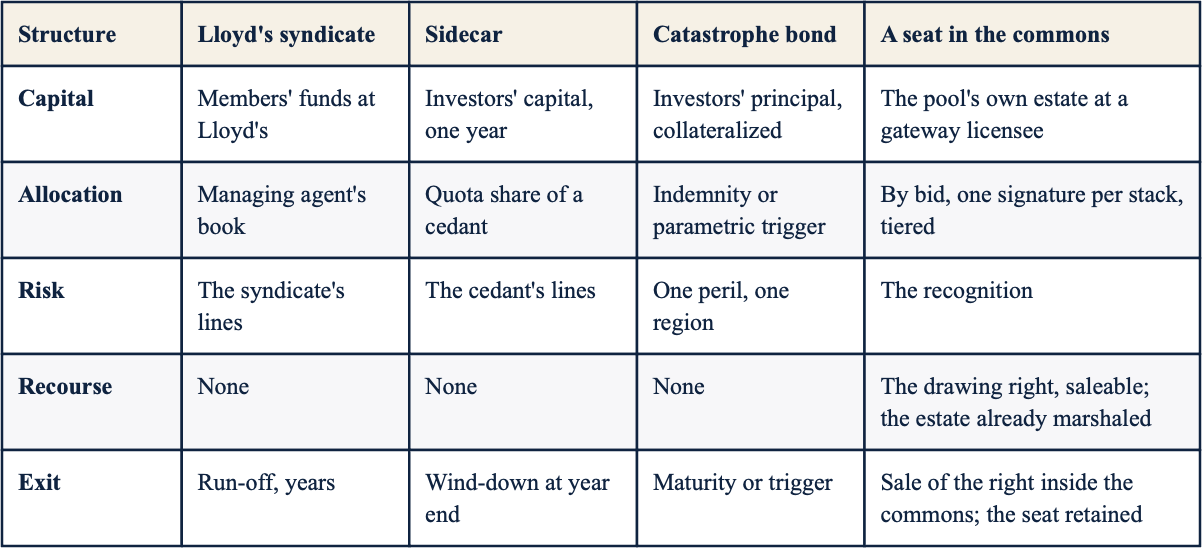
Figure E. Reinsurance structures a pool already uses, beside a seat in the commons.
How a pool engages
A reinsurance pool engages by opening an account at a gateway licensee and bidding in the commons.
The gateway licensee account is the settlement condition: fees, calls and the sale of drawing rights settle on the licensee's managed ledger, and the pool's capital and fee income sit on a whole-reserve book, held rather than owed, so no run can form against it.
The underwriting contract is a warranty of the recognition, suretyship in form, reinsurable by any authorized reinsurer, and the pool's own supervisor's rules apply throughout.
The mechanism and the arithmetic are on the page Underwriting on the platform, in depth; the legal position is on the page The legal position of underwriting on the platform. Inquiries: inquiry@pegisai.global.
NOTICE:
A DTA is not a security, not an investment product and not a speculative item. No DTA is listed, quoted or traded on any exchange or open market, and no DTA moves outside the Alkaimi™ ledger. Nothing on this page is an offer, a solicitation or a public offering, and nothing on this page is legal, financial or investment advice.
This page contains some forward-looking statements. Read Pegisai’s statement on forward-looking statements.