The mechanism, the arithmetic, the default regime and the fee mechanics, for an underwriter's risk manager and a finance minister
What the underwriter signs
The underwriter signs 0.90 of the recognized value of a stack, and the Mint issues 0.80. The signature warrants the recognition: the existence, title, quantity and recoverability of the asset at the floor at which the value was recognized. The signature warrants no price, rate or currency, because the recognized value never moves, and no counterparty's payment, because the DTA™ is the holder's property, custodial held, by Alkaimi Financial Ecosystem members only, as a digitized bearer instrument, on the Alkaimi Financial Ecosystem ledger. The ten points between the signature and the issuance are the underwriter's first cushion; the ten points between the signature and the recognized value are the recognition's own.
The tiers of risk
The risk ranks by the asset owner, with sovereign-owned assets lowest. Rated sovereigns defaulted three times in 2024, all selective, all speculative-grade emerging and frontier issuers (S&P Global Ratings, 2024 Annual Global Sovereign Default and Rating Transition Study, 24 March 2025); over 1983 to 2024 the investment-grade sovereign default rate was 1.8 percent against 24 percent for speculative grade (Moody's).
A repudiation of a drawing right the state itself granted is rarer than a debt default, and for a foreign underwriter is an expropriation under investment treaties.
Investment-grade corporate producing assets rank next; single production fields and speculative-grade owners rank last. Fees are set by tier in the commons.
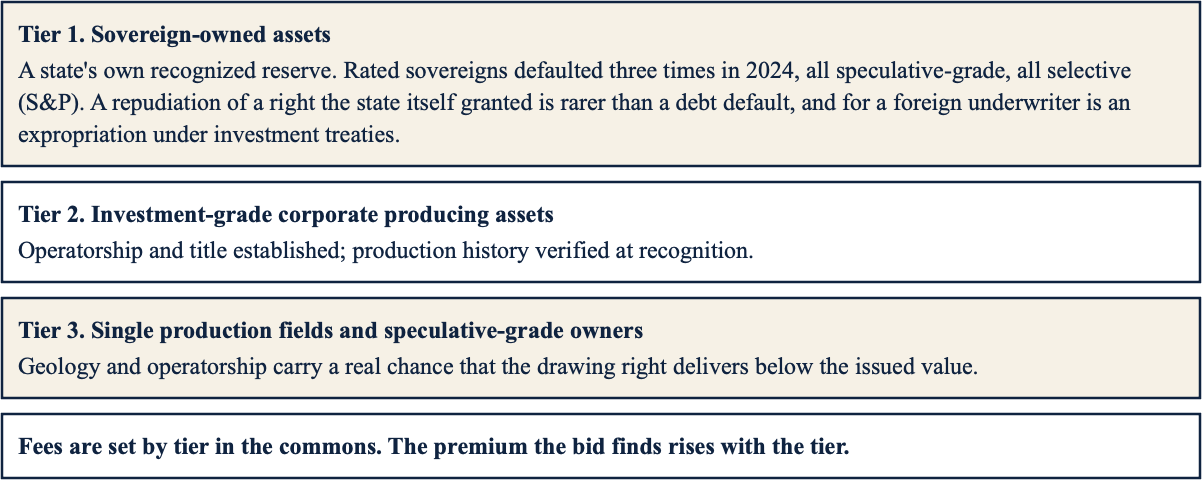
Figure F. The tiers of risk.
A call is a purchase
On a call the underwriter pays the issued value to the holders and takes the drawing right on the full recognized value. The arithmetic, per 1.00 of recognized value, with the assumptions named:
Outlay = 0.80 − S, where S is the seized pool applied to the holders first
Recovery = D × (1 − d), where D = 1.00 is the drawing right and d is the discount at sale inside the commons
Result on an ordinary call = Recovery − Outlay
Expected annual result = p × (1 − q) × Result − p × q × Outlay, where p is the call probability and q the share of calls in which the drawing right itself fails
Net margin = formation fee spread over the recognition life + annual fee + expected annual result − expense
Illustration on stated assumptions, not a schedule: with no seized pool, a sale discount of 5 percent and an ordinary call, the result is 15 points of recognized value to the underwriter; with the seized pool at 30 percent of issued value, the outlay falls to 0.56 and the result rises to 39 points.
Loss arises only in the q term, and on the sovereign tier q is a repudiation. On those assumptions the line's combined ratio runs well under the reinsurance composite's 88.5 percent, and the return on capital is set by the capital the commons requires behind a signature, which Pegisai™ sets.
Default is a liquidation on the ledger
A default on the ledger is a liquidation of the issuer's estate, self-executing, with the ledger as the court and Pegisai as the receiver.
The triggers: failure to settle at the stack's final settlement date or avoidance of settlement; failure of the asset maintenance requirements; an unpaid fee after notice and the cure period; nefarious conduct on the Chairman's finding; repudiation of the drawing right.
The estate is marshaled on the ledger on day one, with no court order and no cross-border enforcement: every stack of the issuer is rejected, the DTAs the issuer took in payment are seized, the issuer's own unused issuance is frozen and canceled, and the drawing right on the asset passes to the receiver.
The creditors rank in this order: the holders of the issuer's DTAs, paid from the seized DTAs first and then by the underwriter as surety, to the full issued value; the underwriter, for unpaid fees as a creditor in the underwriter's own right and for the underwriter's outlay by subrogation to the extent paid; the ledger's costs of the liquidation. The residual, the balance of the drawing right after every creditor is paid, is held by the ledger for cure within a stated period and forfeited after the period runs. Re-admission is the Chairman's finding.
Nothing owed by the issuer reaches the value a holder holds, and the pool's recourse is a right the receiver is already holding.
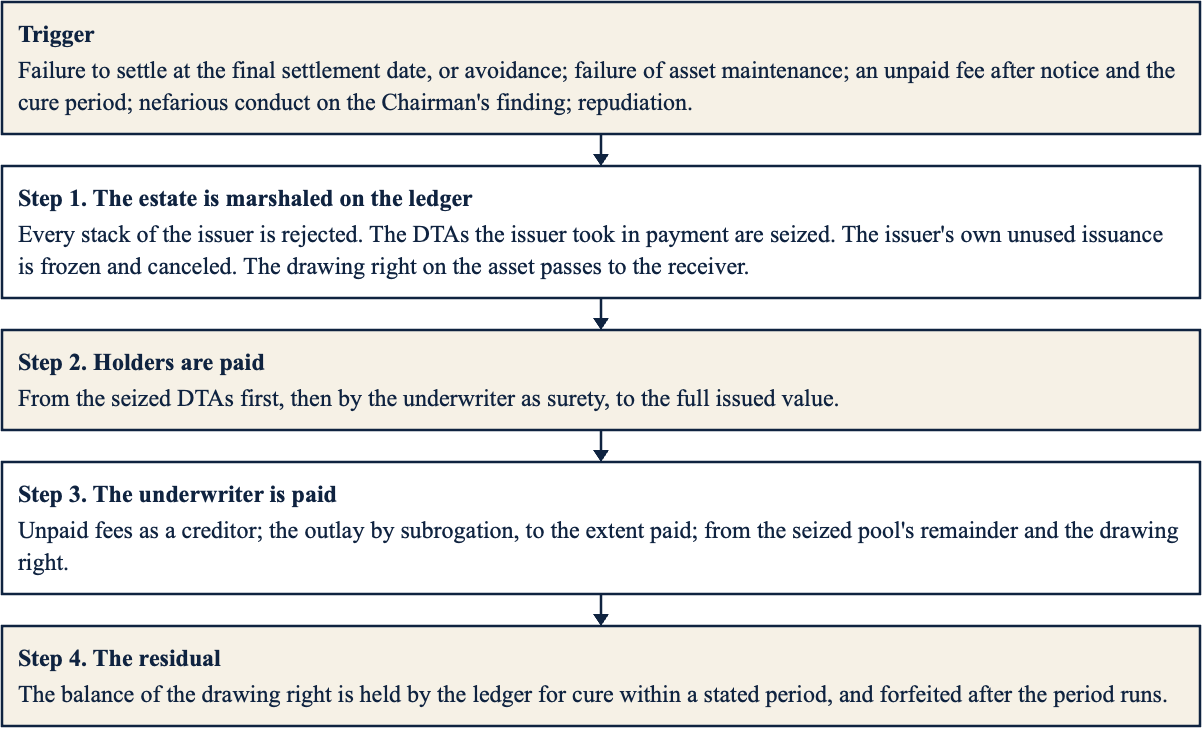
Figure G. The liquidation on the ledger, in order.
Fees
The formation and annual underwriting fees are set at the value unit level and paid in any currency at a licensed bank's desk: the issuer pays in the currency of the issuer's choice, the desk converts at the transmutation reference point (TRP) reading, and the underwriter receives the fee in the currency of the underwriter's choice, in the underwriter's account at a gateway licensee.
The fee is a currency ledger event on the licensee's own books and a deposit into the underwriter's account, outside the walled garden; no fee is ever taken from the recognized value inside the walled garden.
New issuance may cover forward expenses of the asset and may not cover maintenance. A renter of DTAs, a pool or an access-licensee bank, carries the maintenance on the rented DTAs for the rental period.
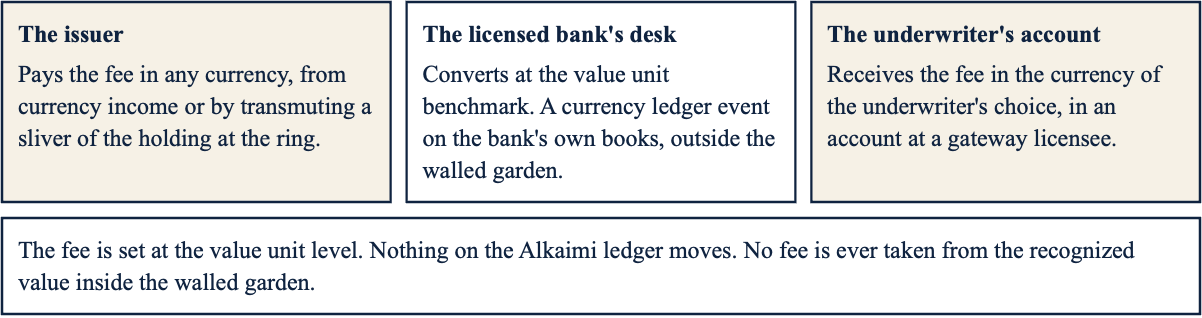
Figure H. The fee through the desk.
The treasury on both sides
A national treasury is the lowest-risk issuer in the commons and an underwriter in the commons at once.
As issuer, the treasury's recognized reserve draws the lowest tier's fee.
As underwriter, a treasury pledging parked DTAs as surety earns the formation and annual fees, takes calls that are purchases below recognized worth, and turns an idle reserve into a fee stream with no sale, no pledge outside the platform and no currency raised.
The parked DTAs are treasury assets, not official reserve assets in the balance-of-payments sense, and a sovereign surety capacity needs statutory authority and a cap; both points are set out on the legal page.
DTAs in the pool
An underwriter comes to hold DTAs in the pool through five doors.
Recovery by re-recognition: after a call the defaulted stack is canceled, the asset stands unencumbered with the underwriter as right-holder, and the asset is recognized again with the underwriter as issuer.
Recovery in kind from the estate: the receiver pays the underwriter's fees and outlay in the seized DTAs, account to account.
Receipt in settlement: premiums, the sale of a drawing right, any settlement from a counterparty on the ledger, paid in DTAs.
Recognition of the reinsurance pool's own assets: currency never becomes a DTA, but currency buys an asset and the asset is recognized.
Rents: the underwriter rents DTAs from a holder under an agreement Pegisai regulates, holds them in the underwriter's custodial rental account for the period, pays the stipend and the maintenance, and returns the rented DTAs at the end; recourse runs against the renter, never the holder. A pool holding DTAs may rent them to a licensed bank and take the stipend, so the pool's float earns on the bank's product book without credit risk or duration.
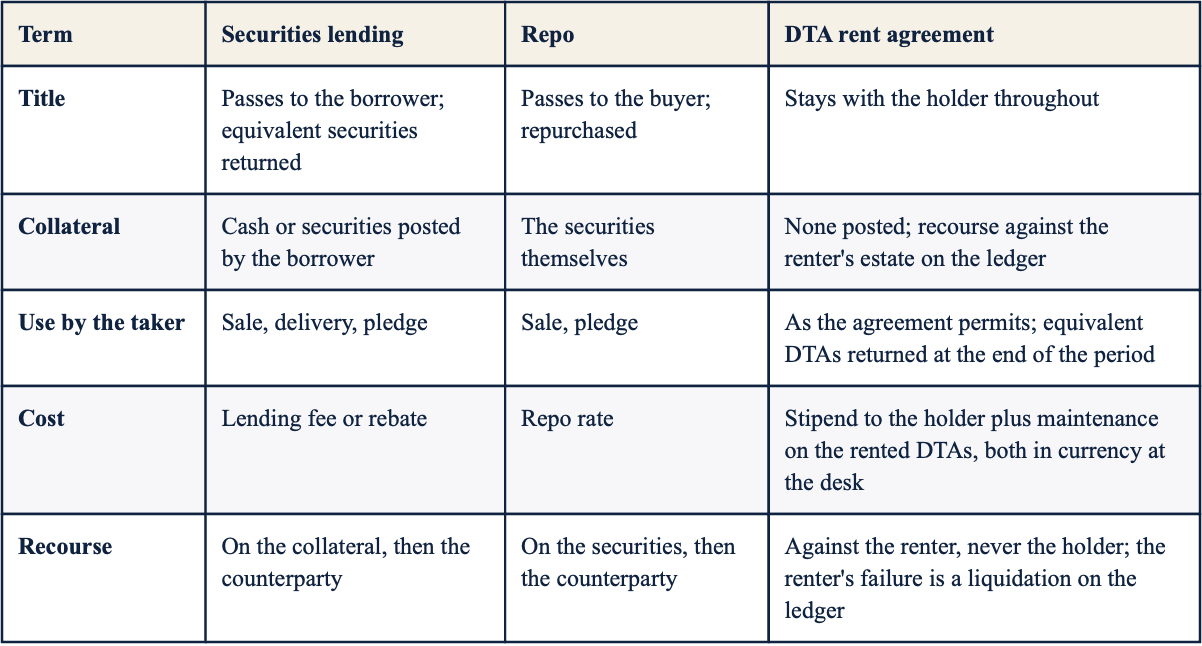
Figure I. The rent agreement beside securities lending and repo.
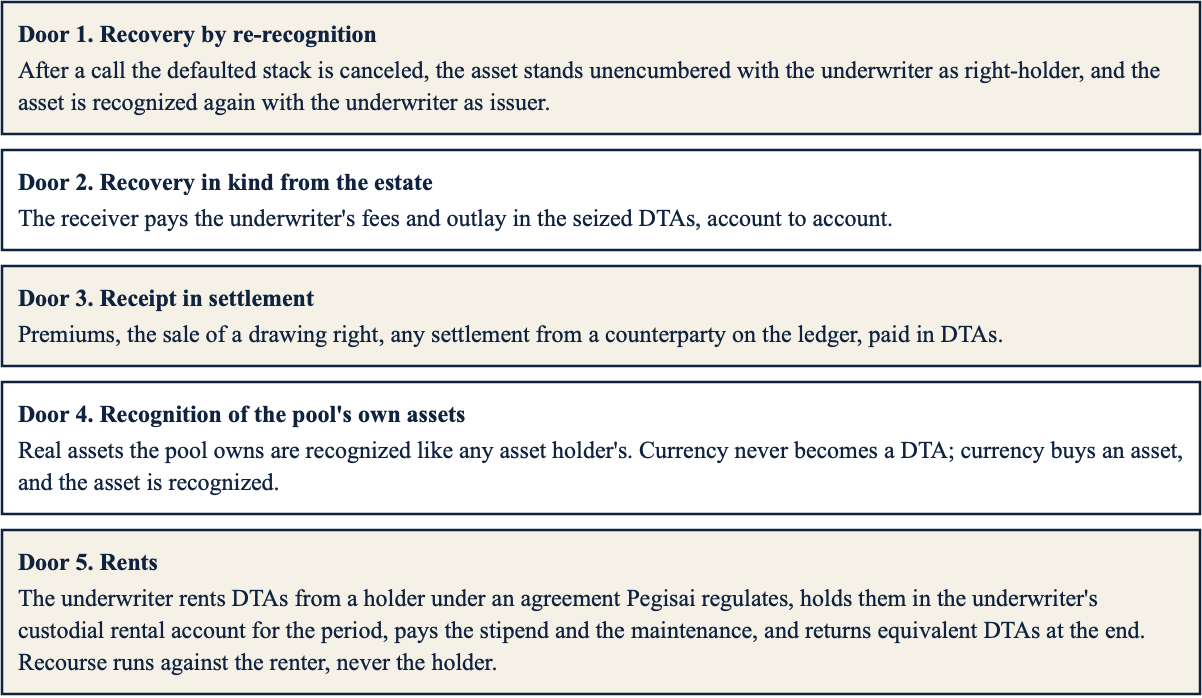
Figure J. Five doors to DTAs in the pool.
Capital behind a signature
What stands behind a signature is the pool's own estate: the DTAs the pool owns, the pool's currency balances at the gateway licensee, and the value the pool holds from prior recoveries.
Rented DTAs do not stand behind a signature; a DTA itself cannot be in default, because if a pool fails a call the pool is the party in default under the rent agreement, the pool's estate is liquidated on the ledger, and the holder whose DTAs were out on rent is a creditor of the pool's estate for the return of DTAs of equivalent value.
The capital the commons requires behind a signature is set by Pegisai in the underwriting agreement and the rules of the commons; the pool's own supervisor's capital rules apply in addition.
Conditions to bid
A pool bids in the commons from an account at a gateway licensee, with the pool's supervisor's authorization for suretyship, the capital the commons requires behind a signature, and a tier. Rules governing the transfer of drawing rights on sovereign-owned assets inside the commons are published with the commons. The legal position of every element on this page is on the page The legal position of underwriting on the platform.
Sources: Aon, Reinsurance Market Dynamics, mid-year 2026. Gallagher Re, Reinsurance Market Report, full-year 2025 (May 2026) and half-year 2026 (September 2026). S&P Global Ratings, 2024 Annual Global Sovereign Default and Rating Transition Study, 24 March 2025. Moody's, sovereign default rates by rating category, 1983 to 2024. Pegisai Global Holdings, The Alkaimi Financial Ecosystem in Function: Granular Value on a Neutral Rail.
Nothing on this page is an offer, a solicitation or a public offering, or legal, financial or investment advice.
This page contains some forward-looking statements. Read Pegisai’s statement on forward-looking statements.