The Alkaimi Financial Ecosystem™ is the licensed banks, the Alkaimi ledger, and the administration that connects the banks to the Alkaimi ledger. Inside the ecosystem a licensed bank holds, moves and settles recognized asset value as DTAs, without currency, under the banking license the bank already holds.
What moves inside the walled garden
The only thing that moves inside the walled garden is the Digitized Tangible Asset™ (DTA™). A DTA carries the recognized value of a client's own asset: a mineral deposit, a producing field, a bullion holding, or another form of commodity, or recognized transactable asset.
Through Alkaimi’s value recognition process, value is set, uvus are assembled and individual DTA’s are created. This process locks in value, removes all currency pressure and other speculative measurement forces from that value. Therefore, the whole-value is stabilized and every UVA in the stack is a DTA, so equal values transact between accounts in settlement. This whole-value is what moves, as any number of the stack’s DTAs, counted in UVU.
The DTA moves from one client's DTA holding account to another client's DTA holding account on the Alkaimi ledger, and the move is transacted as a final settlement.
For clarity, every DTA is measured in the Universal Value Unit™ (UVU) and no DTA, or portion thereof is priced in a currency. Currency is met only at the ring, at a licensed bank's own desk, and only when a client asks for currency. Currencies are read against the transmutation reference point (TRP) within the calibrated conversion / transmutation system, in a similar manner as forex operations are conducted.
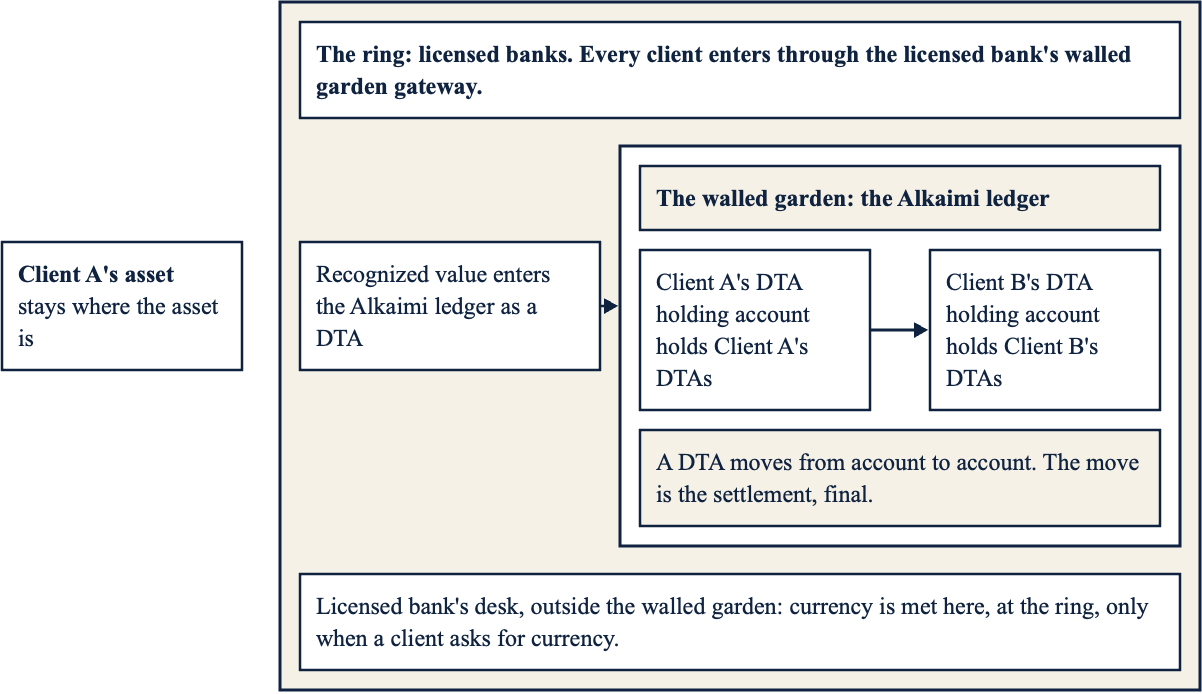
Figure 1. What moves inside the walled garden: the DTA, account to account, with currency met at the ring only.
What a DTA is
A Digitized Tangible Asset (DTA) is tangible asset value, custodial held, by Alkaimi Financial Ecosystem members only, as property, as a digitized bearer instrument, on the Alkaimi Financial Ecosystem ledger, with associated drawing rights and recognition surety. The DTA is neither a bank's promise nor a nation's note. A licensed bank posts a DTA as a Level 1 high-quality liquid asset under Basel III+ without a discount. A DTA never leaves the Alkaimi ledger. No DTA is listed, quoted or traded on any exchange or open market, and no DTA is offered to the public.
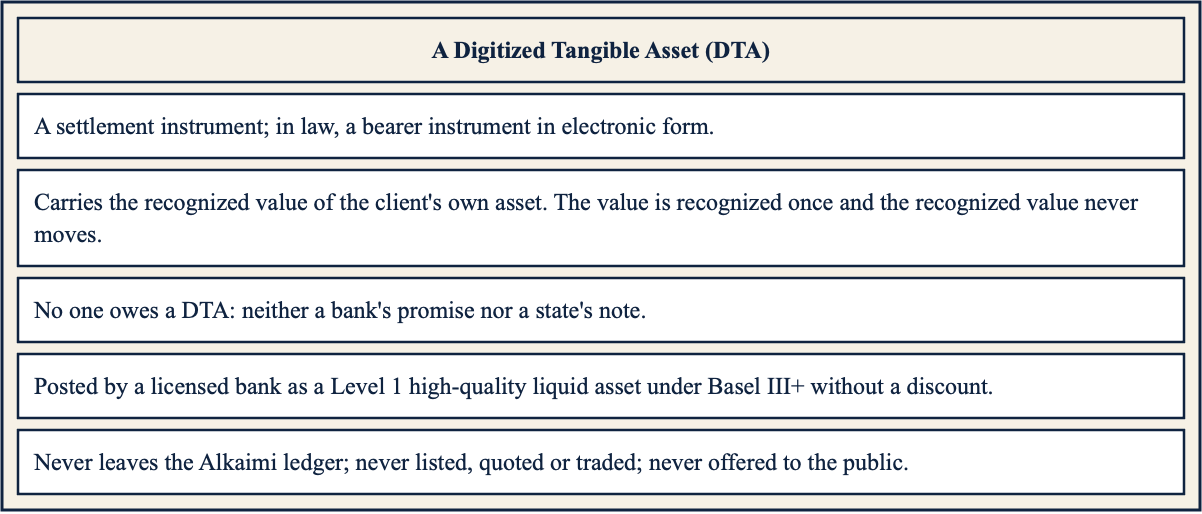
Figure 2. The DTA in five lines.
What the Alkaimi Financial Ecosystem is
The Alkaimi Ecosystem™ has three parts: the administration, the ring of licensed banks, and the Alkaimi ledger. Pegisai Global Holdings issues the licenses, and Pegisai Network Services runs the global network under the license, as part of the license and as a security feature of the walled garden.
The licensed banks form the ring: every client reaches the Alkaimi ledger through the licensed bank’s walled garden gateway, and every currency event happens at a licensed bank's desk outside of the walled garden.
The Alkaimi ledger holds every DTA, managed by the licensed bank held in the client's own DTA holding account, and no DTA is a deposit in bank claim form.
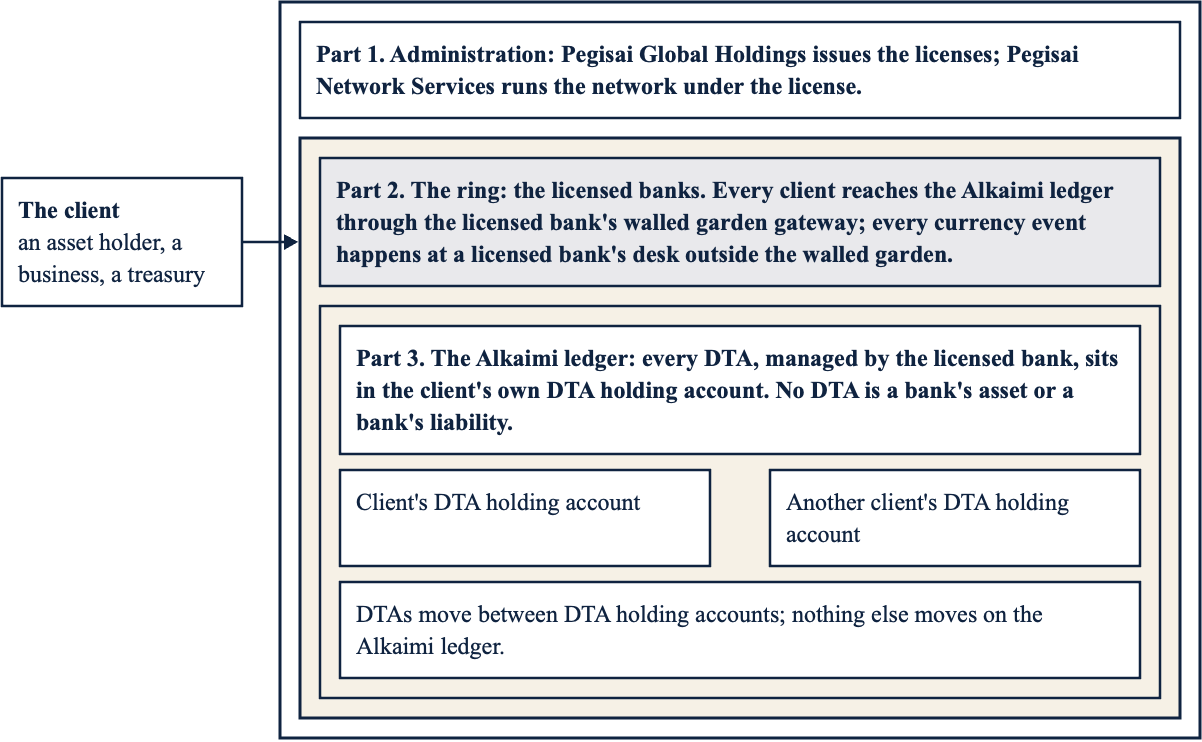
Figure 3. The three parts of the system, with the client entering through a licensed bank.
The business a licensed bank does today
A licensed bank runs four operations inside the ecosystem, and each of the four sits within the powers of the banking license the bank already holds.
Custody. The bank holds the client's DTAs in the client's own DTA holding account, off the bank's balance sheet.
Wholesale settlement. The bank moves DTAs from the client's DTA holding account to the counterparty's DTA holding account, and the move is final.
The rent agreement. The client rents DTAs to the licensed bank under the client's own agreement, for a stated rental period, and the DTAs remain the client's asset in title and form throughout. During the rental period the rented DTAs are held in the bank's custodial rental account and may be pledged by the bank only as the agreement permits. All income payable to the client during the rental period is paid in accordance with the rental agreement.
On completion of the rental period, any pledge given by the bank is released and the rented DTAs are returned, unencumbered, to the client's DTA holding account. The bank's performance during the rental period, including the bank's obligations on any pledge and on return, is governed by the terms and conditions of the rental agreement under the law of the licensee's jurisdiction. The rented DTAs remain the client's property, held in custody off the bank's balance sheet, and are at no time an asset of the bank.
The product book. The bank pledges the rented DTAs to the central bank for a secured advance and writes loans from the advance; the loans create no deposit.
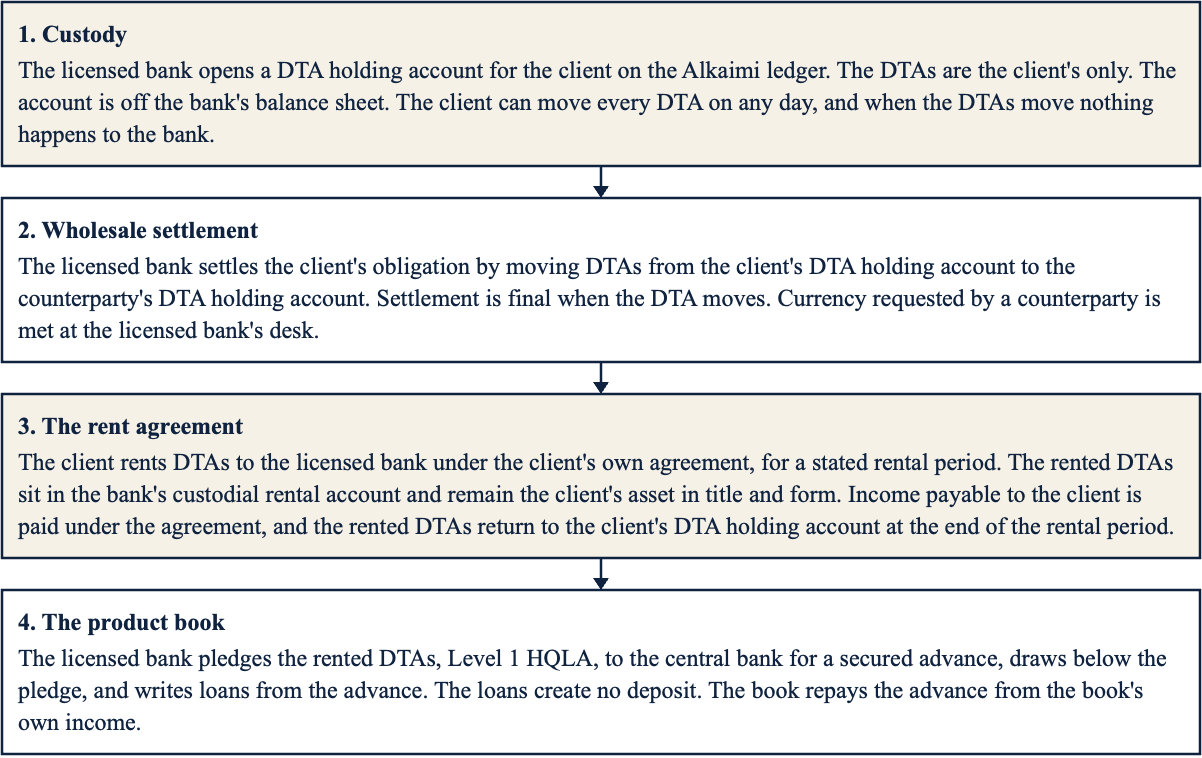
Figure 4. The four operations of a licensed bank inside the ecosystem.
No operation of the four needs a new banking license. Custody, settlement and the rent agreement are ordinary bank powers. The Level 1 classification of the DTA and the central bank's acceptance of the DTA as collateral follow each supervisor's and each central bank's existing rules, and a supervisor may ask for reporting. What the bank adds is the technology, the DTA and the ecosystem, under license. The funding arithmetic of the product book is worked in the four-part series on the Home page, Why the Alkaimi Model is Better.
What a DTA is not
A banker's first response to a new instrument is to name the class into which the instrument falls and apply that class's law. The DTA falls into none of the classes below; each answer applies the law's own test to the facts of the DTA.
Not a security.
A security is a negotiable claim on an issuer bought for a return from the efforts of others (Howey, 328 U.S. 293 (1946); MiFID II, Article 4(1)(44)). A DTA is held as property, not as a negotiable claim on an issuer, and returns nothing on the DTA itself.
Not a note.
A note is a promise to pay (Reves v. Ernst & Young, 494 U.S. 56 (1990)). The DTA promises nothing: it is custodial held, by Alkaimi Financial Ecosystem members only, as property, as a digitized bearer instrument, on the Alkaimi Financial Ecosystem ledger, and no issuer is obligated to redeem it at a fixed currency amount.
Not a crypto-asset.
The crypto-asset definitions and the Basel cryptoasset standard turn on distributed ledger technology or similar technology (MiCA, Article 3(1)(5); Basel SCO60). The Alkaimi ledger is one custodial ledger under bank supervision, with no distributed ledger and no blockchain.
The FATF position.
The FATF definition of a virtual asset turns on use, not technology. Every DTA is held and moved by a licensed bank, an obliged institution under the bank's own anti-money-laundering regime, so no virtual asset service provider question arises.
Not a derivative.
A derivative references an underlying and settles in the future (7 U.S.C. 1a(47); MiFID II, Annex I, Section C). A DTA references nothing outside itself and has no counterparty.
Not electronic money.
Electronic money is a claim on an issuer, issued on receipt of funds and redeemable at par (Directive 2009/110/EC, Articles 2(2) and 11). A DTA is held as property rather than as a claim on an issuer, and creates no issuer obligation to redeem at a fixed currency amount.
Not a currency deposit.
A deposit is money received by a bank on terms of repayment (12 U.S.C. 1813(l); Regulation (EU) No 575/2013, Article 4(1)(1)). The bank receives no money for a DTA, and owes the client no payment on the DTA, because the client holds the DTA as property.
Not a stablecoin.
A stablecoin holds a value pegged to a specified asset and is redeemed by an issuer (GENIUS Act of 2025, section 2(22); MiCA, Titles III and IV; Hong Kong Stablecoins Ordinance 2025). A DTA references nothing outside itself, and no issuer redeems a DTA at a fixed currency amount.
Not a currency.
Currency is the nation's note and coin, issued under the nation's own law. Pegisai™ creates no currency and prices nothing in any currency; a DTA is the recognized value of an asset the client already owns.
For a deeper legal review, class by class under the international standards and the reference law of the European Union, the United Kingdom, the United States and Asia, see The legal position of the DTA.
Final analysis:
In each jurisdiction the classification rests with the licensed bank's supervisor under that jurisdiction's law, confirmed by the licensee's counsel.
A DTA is not a security, not an investment product and not a speculative item. No DTA is listed, quoted or traded on any exchange or open market, and no DTA moves outside the Alkaimi ledger. Nothing on this page is an offer, a solicitation or a public offering, and nothing on this page is legal, financial or investment advice.
How the roll-out proceeds
The ecosystem operates in wholesale settlement first.
Under Alkaimi’s deployment plan, the DTA, new instrument, enters the global banking system in the wholesale segment, operates in that segment, and the operating rules follow as supervisors ask.
Licensed banks in multiple countries have been operating in wholesale settlement on the platform since 1 September 2026. See also Alkaimi Ecosystem, Current Operations. Consumer products in those banks come in the next phase.
The ring holds a limited number of walled garden licenses, each held by a bank with the capacity to operate a gateway to a global asset network at that scale. A second class of license, an access license, is open ahead of the consumer phase, for regional retail banks that engage in parts of the model through a walled garden licensee.
Figure 5. The roll-out in three stages.
Where to read further
The published testing record, The Alkaimi Financial Ecosystem in Function: Granular Value on a Neutral Rail, is available for download from this site. Licensing terms are on the Licensing page. Inquiries: inquiry@pegisai.global.
This page contains some forward-looking statements. Read Pegisai’s statement on forward-looking statements.