This online copy is presented for educational purposes only. For all official purposes, the formal publication in PDF format prevails.
This publication sets out what the Alkaimi Ecosystem™ does in operation today, and how those operations reduce the claims banks carry against one another and the credit default swaps banks buy to hedge those claims. Section 1 summarizes the case. Section 2 is written for central banks and supervisors. Section 3 is written for the Alkaimi Ecosystem's member financial institutions. Section 4 answers the questions supervisors, central bankers and bankers raise most often.
Unique theories, technologies, attributes and capabilities
The Alkaimi Ecosystem rests on two theories, four technologies, three attributes and two capabilities. Each is defined here, before this publication shows the ecosystem in operation.
Theories
1. Grain theory. Grain theory benchmarks value to the grain. Every currency, every commodity and every asset capable of being a marketable and in-demand item is benchmarked to the grain, and the question asked of each is how many grains the thing takes, never what a grain is worth (Pegisai Global Holdings). The grain is a value position, never a price: the grain does not move, is not priced and has no currency value at any point in the grain's life (The Alkaimi Financial Ecosystem in Function, Terms).
2. Granular Value™. Granular Value is a pricing method. Alkaimi™'s value recognition method counts an asset's whole value in grains, once, at creation on the Alkaimi ledger, and holds the value in universal value units, never in a currency. From that instant, the asset's worth is a quantity rather than an opinion (The Alkaimi Financial Ecosystem in Function, Terms). No new grain is created against the grains already held, so a value unit does not shrink (pegisai.com, Part 1).
Technologies
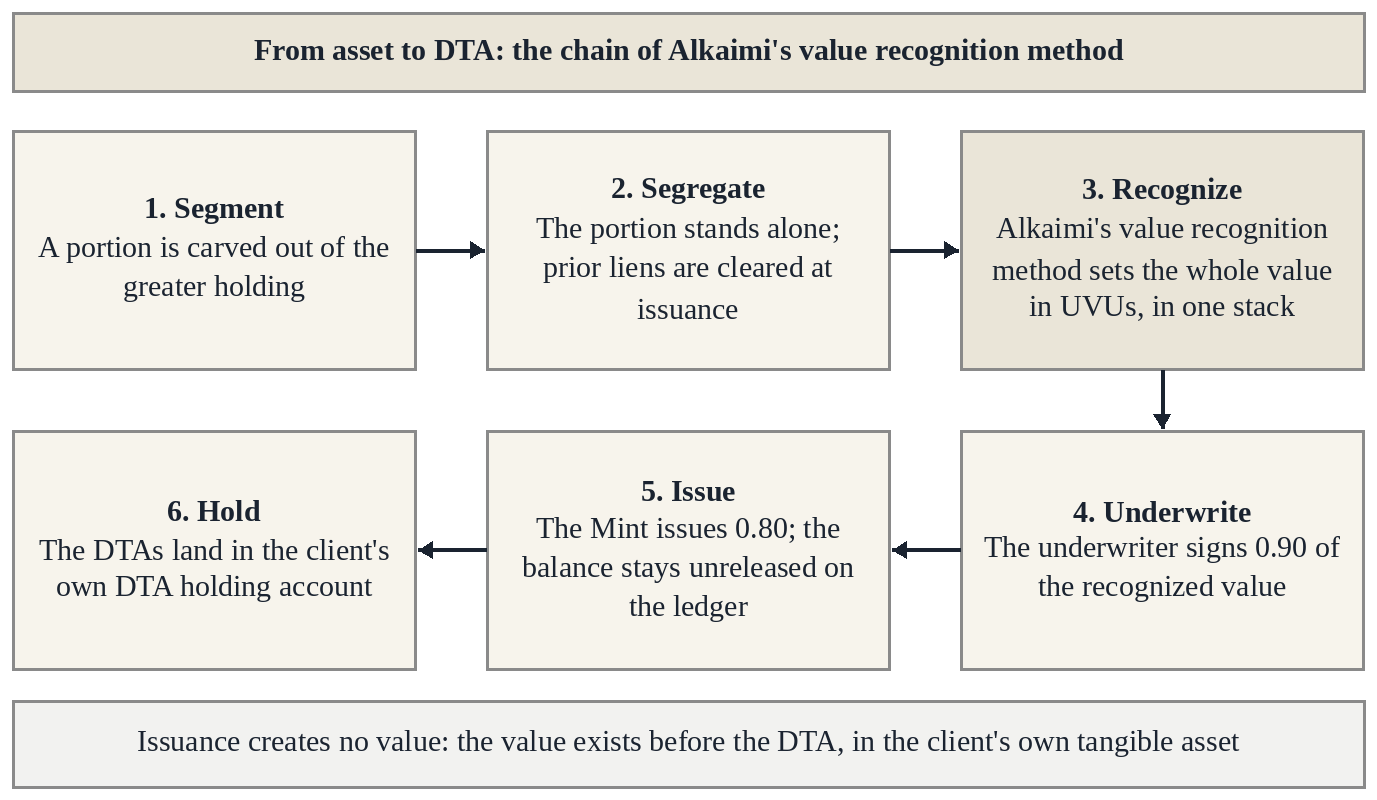
3. Alkaimi's value recognition method. Alkaimi's value recognition method segments a portion of an asset, carving the portion out of the greater holding, and segregates the portion so the portion stands alone and is recognized on the portion's own facts. Prior liens on the asset are cleared at issuance, so the asset comes onto the Alkaimi ledger unencumbered or the asset stays off the Alkaimi ledger (pegisai.com, Part 2). Alkaimi's value recognition method then sets the value, assembles UVUs and creates individual DTAs (pegisai.com, Ecosystem). The underwriter signs 0.90 of the recognized value of a stack, and the Mint issues 0.80 (pegisai.com, Underwriting on the platform, in depth). Whole Value Recognition™ is the service the member financial institutions conduct with Alkaimi's value recognition method (alkaimi.com).
4. The Universal Value Unit™ (UVU™). The UVU is the unit in which recognized value is held and moved: a fixed quantity of value grains, the same for every asset, so a UVU of one asset equals a UVU of any other (The Alkaimi Financial Ecosystem in Function, Terms). Each UVU carries an encoded title package, the DTA™'s internal title file. The title package tracks and retains, in real time, the ownership, the holder, the asset, the usage and the other information regulators require, and the title package is AI monitored (Section 2, item 2.1).
5. The Digitized Tangible Asset™ (DTA). The DTA is a bearer instrument in electronic form and the ecosystem's monetary mechanism. Alkaimi's value recognition method places one segregated portion of an asset into a stack, and the stack is segmented into a series of individually issued DTAs; each DTA within the stack settles a payment independently (pegisai.com, The Model). A DTA holds recognized value that no one owes: neither a bank's promise nor a nation's note (pegisai.com, Ecosystem). A DTA moves in whole or in fractional portions from one client's DTA holding account to another, and the movement is a final settlement. No DTA is listed, quoted or traded on any exchange or open market, and no DTA is offered to the public (pegisai.com, Ecosystem). The DTA and Granular Value are different things: the DTA is the bearer instrument that moves, and Granular Value is what the DTA carries.
6. The Alkaimi ledger and the walled garden. The Alkaimi ledger is one custodial ledger operated under bank supervision, with no blockchain and no distributed ledger (pegisai.com, Platform). The Alkaimi ledger holds every DTA in a client's own DTA holding account, and nothing on the Alkaimi ledger is a bank's asset or a bank's liability (pegisai.com, Platform and Ecosystem). The walled garden is the closed environment around the Alkaimi ledger: every client enters through a member institution’s walled garden gateway, currency never enters the walled garden, and a DTA never leaves the Alkaimi ledger (pegisai.com, Ecosystem and The Model). The walled garden and the Alkaimi ledger operate on air-gapped systems (pegisai.com, About).
Attributes
7. Currency neutrality. The Alkaimi Platform is currency neutral: the recognized value carries no price and no currency, every DTA transacts in the UVU, and no DTA, or portion of a DTA, is priced in a currency (pegisai.com, Platform and Ecosystem). Alkaimi's value recognition method reads a holder's currency-stated valuation across all known currencies at the same instant, dissolving any single issuer's measure, and the recognized value references no currency: not the entry currency, not the entry amount and not the reference read (The Alkaimi Financial Ecosystem in Function, Overview). Currency meets value at one point only, a member institution's desk: a holder transmutes a DTA into currency there, and a client's currency purchases an existing DTA there by exchange. A reading of a DTA in a currency moves nothing on the Alkaimi ledger (pegisai.com, Part 4 and About).
8. Value no one owes, and final settlement. No bank, no nation and no company stands behind a DTA with a promise (pegisai.com, Part 2). When a DTA moves, the payment obligation is extinguished by that movement, and nothing is left owed when the movement ends (pegisai.com, The Model). Every DTA is underwritten: on an issuer's default, the holders are paid from the DTAs the issuer took in payment first, then by the underwriter as surety, to the full issued value (pegisai.com, Underwriting on the platform).
9. The whole reserve. Under the 100% Whole Reserve™ model, no member institution borrows against a client's held value, and the whole reserve belongs to the client, the member institution’s own account. The member institution holds the client's DTAs in custody, places no lien on the DTAs, pledges none of the DTAs for the member institution's own account and creates no claim against the DTAs (pegisai.com, The Model). Held value is not a currency deposit (Pegisai™, 1 October 2026).
Capabilities
10. Rating currencies, and reading currencies at the desk. The Alkaimi Currency Value Index™ (ACVI™) and the Alkaimi Government Solvency Index™ (AGSI™) rate the intrinsic value of each nation's scrip currency, the note and coin a government issues, on one standard, from named public sources, on published dates (pegisai.com, About; The ACVI and the AGSI explained). The Alkaimi Transmutation Standard (ATS) is the reading at which a member institution converts value to currency and currency to value at the member institution's desk, in real time, at a reading rather than a bid (pegisai.com, About). The ACVI and the AGSI rate intrinsic value; the ATS reads the currency markets in real time.
11. The Charter and the License. Every financial institution that holds a license issued by Pegisai Global Holdings, of either class, is an Alkaimi Ecosystem Member financial institution (hereinafter “member institutions” or “AMI”) and a regionally chartered financial institution.
An AMI holds two separate permissions.
The banking charter comes from the AMI's own regulator, and every bank an AMI operates stays under the bank's own regulator and the bank's own banking license (pegisai.com, Licensing).
The Alkaimi model operating license comes from Pegisai Global Holdings and grants the right to operate the 100% Whole Reserve model, to use the DTA and to operate inside the walled garden (pegisai.com, Licensing).
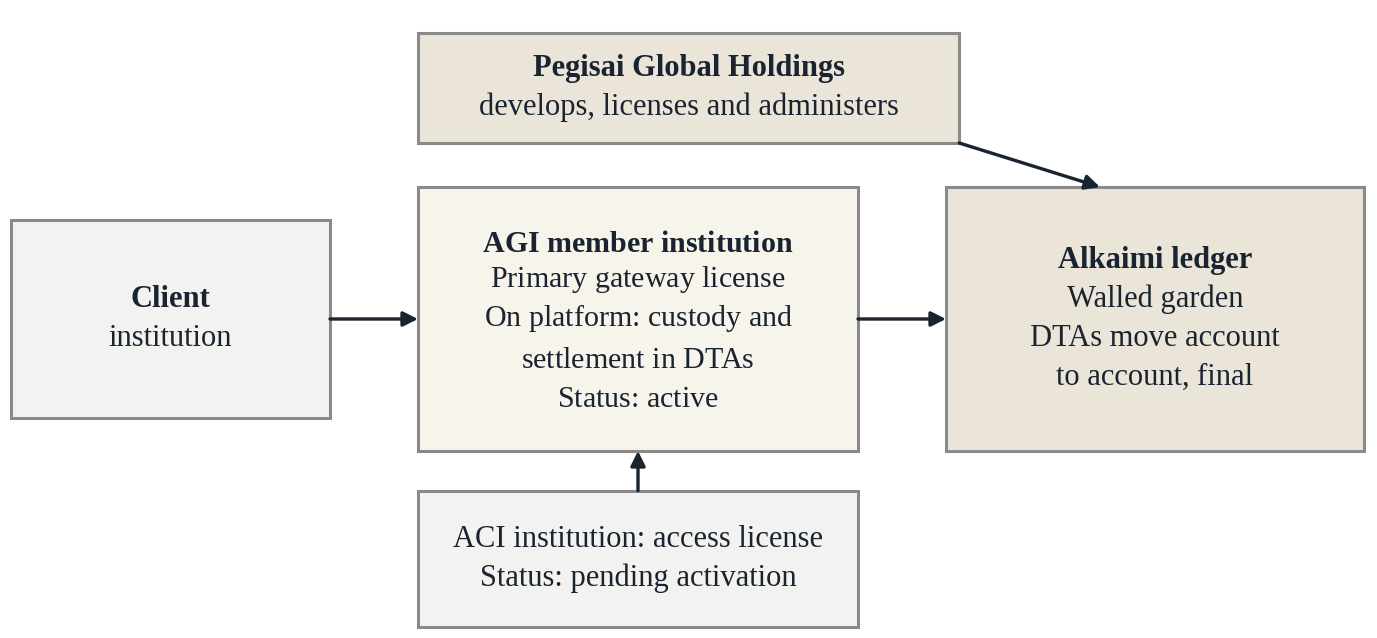
The license comes in two classes: the primary gateway license (AGI), which places an AMI on platform, and the access license (ACI), which an AMI holds as a correspondent access institution working directly through an AMI that holds the AGI.
How these are put into operation
Pegisai Global Holdings offers three products: one model, one platform and one licensed banking ecosystem (pegisai.com, Home). The three products work jointly, and no single part of the three products can operate, or lawfully function, without the other two. The model needs the platform, because the Alkaimi ledger is where the DTAs are held and settled. The platform needs the member institutions, because only a member institution holds a DTA for a client, settles in a DTA, or posts a DTA as Level 1 HQLA (pegisai.com, Platform). The member institutions need the model, because the model is what the license grants (pegisai.com, Licensing).
Each of the three products answers one question. The 100% Whole Reserve model answers how a member institution operates. The Alkaimi Platform answers what carries the value. The Alkaimi Financial Ecosystem™ answers who takes part. The three are set out below in that order, starting with the model, because the model is what a bank licenses.
The 100% Whole Reserve model: how a member institution operates. In the deposit model, a client's asset or currency becomes a deposit, the deposit becomes the bank's reserve, and the bank lends against the deposit. Under the 100% Whole Reserve model, a client brings an asset to the member institution’s desk. Alkaimi's value recognition method recognizes the asset, and the resulting DTAs land in the client's own DTA holding account. The member institution holds the client's DTAs in custody, settles the DTAs on the client's instruction, and transmutes DTAs into any currency or any recognized asset class at the desk when the client asks (pegisai.com, The Model). The member institution earns five service fees, for Alkaimi's value recognition method, custody, settlement, transmutation at the desk and the administration of rent agreements, and creates no credit to earn the fees (pegisai.com, The Model).
The Alkaimi Platform: the neutral settlement rail. The Alkaimi ledger carries the value. Each client's DTAs sit in the client's own DTA holding account, and a settlement moves DTAs, whole or in fractional portions, from one holding account to another, final when the DTAs move (pegisai.com, Platform and Ecosystem). Pegisai Global Holdings issues the licenses and administers the platform under contract, and the Pegisai group runs the global network under the license (pegisai.com, Platform).
The Alkaimi Financial Ecosystem: who takes part. The ecosystem has three parts: the administration, the ring of member institutions and the Alkaimi ledger (pegisai.com, Ecosystem). Pegisai Global Holdings issues the licenses and administers the Alkaimi ledger, and the Pegisai group companies audit, administer, fact check and certify the ledger (pegisai.com, Ecosystem and Part 2). Each member institution in the ring is licensed to run four operations inside the ecosystem: custody, wholesale settlement, the rent agreement and the product book, each within the powers of the banking license the member institution already holds (pegisai.com, Ecosystem). Today the member institutions conduct wholesale settlement only, by the members' own embargo (alkaimi.com, Current Operations). Clients take part through the ring: every client of the ecosystem is a client of a member institution.
The Alkaimi Ecosystem in operation
The Alkaimi Financial Ecosystem, also called the Alkaimi Ecosystem, is a collaborative global network of chartered financial institutions engaged in Whole Value Recognition and settlement (alkaimi.com). Each member is a regulated bank holding company that holds the Alkaimi model operating license from Pegisai Global Holdings and operates through the member's regional retail banking structure, each under the bank's own charter and regulator (pegisai.com, Licensing; Overview, item 11).
The path to operation ran through testing: confirmation tests of the operating systems and of Alkaimi's value recognition method since 2021; the DTA meeting the Bank for International Settlements' absolute payment standard in 2022, on Pegisai Global Holdings' own statement; preliminary in-house network testing in 2023; and further testing by Pegisai with the partner institutions that became member institutions, from 2023 through 2025 (The Alkaimi Financial Ecosystem in Function; pegisai.com, Licensing).
Two classes of license. The two license classes defined in the Overview, item 11, stand at different stages: on the pegisai.com status board, primary (AGI) operations are active and secondary (ACI) operations are pending activation (pegisai.com, Home). Figure 2 shows how an ACI institution reaches the Alkaimi ledger through an AGI bank
Current status. The status board reads: wholesale settlement active, liquidity operations active, value recognition active, ledger active, consumer operations planned (pegisai.com, Home). Since 1 September 2026, members have conducted six wholesale operations: large-value settlement between members; settlement between institutional client holding accounts; custody transfers between members; settlement of trade and commercial obligations for institutional clients; currency exchange at member desks on institutional instruction; and the onboarding of the institutional asset positions from which those settlements are made (alkaimi.com, Current Operations).
Seventeen first-phase asset classes. Members recognize value in 17 asset classes: gold, silver, platinum, palladium, oil, natural gas, wheat, corn, rice, soybeans, coffee, cocoa, steel, copper, aluminum, iron ore and coal, with further classes to follow (Pegisai, 30 September 2026).
Who does what. Pegisai Global Holdings develops, licenses and administers the technology supporting the Alkaimi Financial Ecosystem. Pegisai does not provide banking services, accept deposits, hold client value or execute client settlements. Banking operations are conducted by member chartered financial institutions. Value held on the ecosystem's ledger is held under a custodial agreement. Held value is not a currency deposit and is not insured by deposit insurance or by a government agency such as the FDIC. The settlement mechanisms used in the licensed model are themselves individually insured (Pegisai, 30 September and 1 October 2026).
Granular Value: pricing in grains
Granular Value does five things.
1. Granular Value fixes the value at creation. No new grain is created against the grains already held inside a DTA, so a value unit in a DTA does not shrink (pegisai.com, Part 1). Across Alkaimi's reported testing and validation periods, over 1,953 days the dollar lost 27.86 percent of purchasing power on the United States government's own index, and a DTA holding lost 0.00 (pegisai.com, Platform).
2. Granular Value brings every value into parity. Every DTA transacts in the UVU, and each UVU within a DTA enables equal transaction of values between accounts in settlement (pegisai.com, Ecosystem).
3. Granular Value makes the rail currency neutral. Value is not derived from currencies but from the asset's whole value, counted, so the Alkaimi rail itself remains neutral (The Alkaimi Financial Ecosystem in Function, Overview).
4. Granular Value isolates value from outside forces. Alkaimi's value recognition method locks in value and removes currency pressure and other speculative measurement forces from the value (pegisai.com, Ecosystem).
5. Granular Value prices what the existing order cannot. Before the platform, an asset reserve produced usable value only when the owner sold the reserve or pledged the reserve, and those two pathways leave idle a reserve of under-utilized and non-utilized assets estimated at about 4 quadrillion dollars (pegisai.com, Platform).
Two promises, and the backing behind each
The money a nation uses is two promises: the scrip the nation issues, and the new money a bank creates when the bank lends.
The Bank of England names three types of money in the modern economy: currency, bank deposits and central bank reserves. Most of that money is bank deposits, and commercial banks create the deposits when the banks make loans (McLeay, Radia and Thomas, Bank of England Quarterly Bulletin, 14 March 2014). Scrip is the note and coin a nation issues: the nation's own promise. New money is a bank's promise to pay scrip on demand.
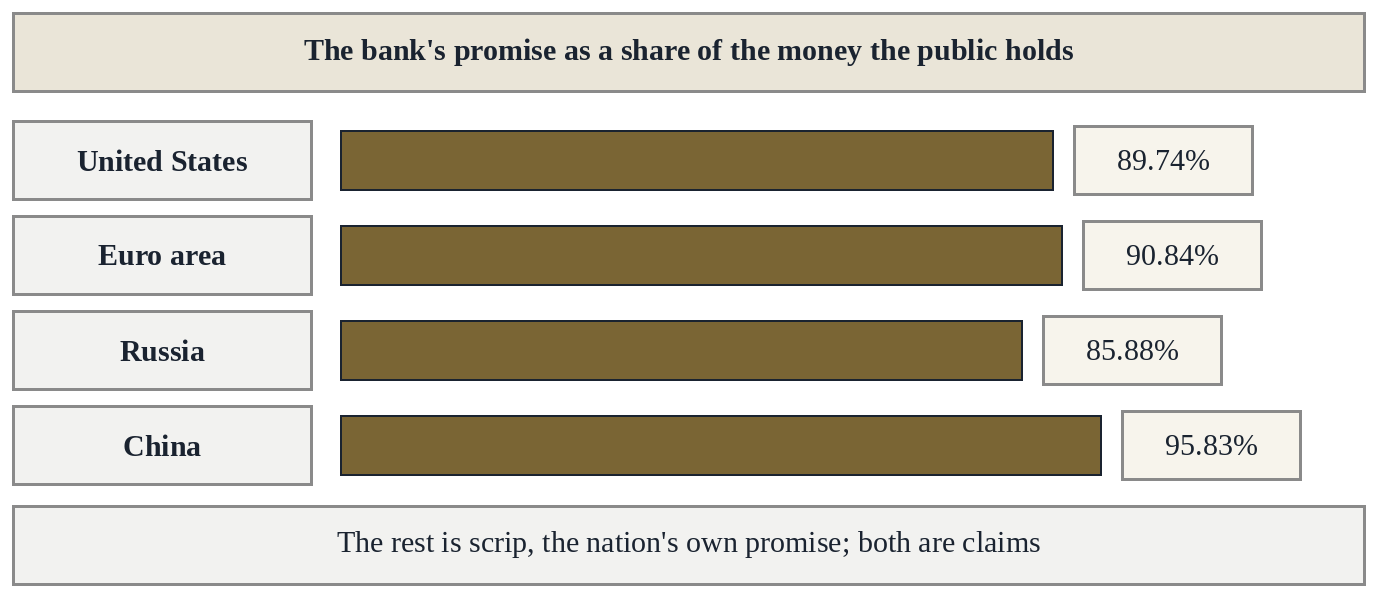
New money dwarfs scrip. On each central bank's own aggregates, the bank's promise is 89.74 percent of the money the public holds in the United States, 90.84 percent in the euro area, 85.88 percent in Russia and 95.83 percent in China (pegisai.com, Part 1).
No rule requires scrip behind new money. In the United States the reserve requirement has been zero percent since 26 March 2020 (Federal Reserve Board, Reserve Requirements). The Basel standard sets capital as a fraction of a bank's risk-weighted assets, not of the bank's deposits: common equity tier 1 of at least 4.5 percent, total capital of at least 8 percent and a conservation buffer of 2.5 percent, with high-quality liquid assets sized to 30 days of stressed outflows (Basel Framework, RBC20 and the liquidity coverage ratio). The United States deposit insurance fund held 1.48 percent of estimated insured deposits at mid-2026, against the FDIC's own designated target of 2 percent, a level the fund has never reached (FDIC, 25 August 2026; FDIC, Designated Reserve Ratio for 2026). The capital standard itself is applied on different timetables, set out in item 1.1.
A global currency outgrows the issuing nation. In 1960 Robert Triffin set out the dilemma of a reserve currency: the issuing nation must supply the world with the currency, and the deficits that supply the currency erode confidence in the currency's backing (Triffin, Gold and the Dollar Crisis, 1960; IMF, Money Matters). A BIS address of 2011 restated the dilemma for the system that followed gold convertibility (Bini Smaghi, “The Triffin dilemma revisited”, BIS, 2011). The scale today: dollar credit to borrowers outside the United States reached 14.7 trillion dollars at end-March 2026 (BIS global liquidity indicators, 31 July 2026). Obligations to pay dollars in FX swaps, forwards and currency swaps exceed 80 trillion dollars, more than the stocks of Treasury bills, repo and commercial paper combined, and central banks backstopped those obligations in 2008 and 2020 (Borio, McCauley and McGuire, BIS Quarterly Review, December 2022). The Federal Reserve's dollar swap lines with foreign central banks peaked at 583 billion dollars in December 2008 and at 449 billion dollars in the week of 27 May 2020 (Congressional Research Service, IF11498; Yale Program on Financial Stability).
The backstop's own position. At 30 June 2026 the Federal Reserve Banks carried a deferred asset of 235.5 billion dollars, the earnings the Reserve Banks must realize before remittances to the Treasury resume, against Reserve Bank capital of 47.7 billion dollars (Federal Reserve Banks, Combined Quarterly Financial Report, 30 June 2026). The European Central Bank reported a loss of 1.3 billion euros for 2025, after 7.9 billion euros for 2024, carried forward against future profits. The ECB attributes the losses to the interest rate increases of 2022 and 2023, and states that the ECB can fulfill the ECB's mandate regardless of losses, with capital and revaluation accounts of 71 billion euros (European Central Bank, 26 February 2026).
Two kinds of value, and why the ACVI and AGSI exist. Every currency's price carries two kinds of value. Intrinsic value is what the nation holds in the nation's own name behind the nation's promise, set against everything the nation owes. Extrinsic value is demand that exists because others must accept the currency: reserve holdings at other central banks, the settlement rails, commodity invoicing, capital market issuance and military reach (pegisai.com, The ACVI and the AGSI explained). A credit rating grades whether a nation's promise will be paid; the ACVI and the AGSI grade what stands behind the promise. The United States holds an Aa1 rating, while the ACVI reads 0.3 for the dollar and the Productive Coverage Ratio reads 0.019: two cents of assets for every dollar the United States owes (same source).
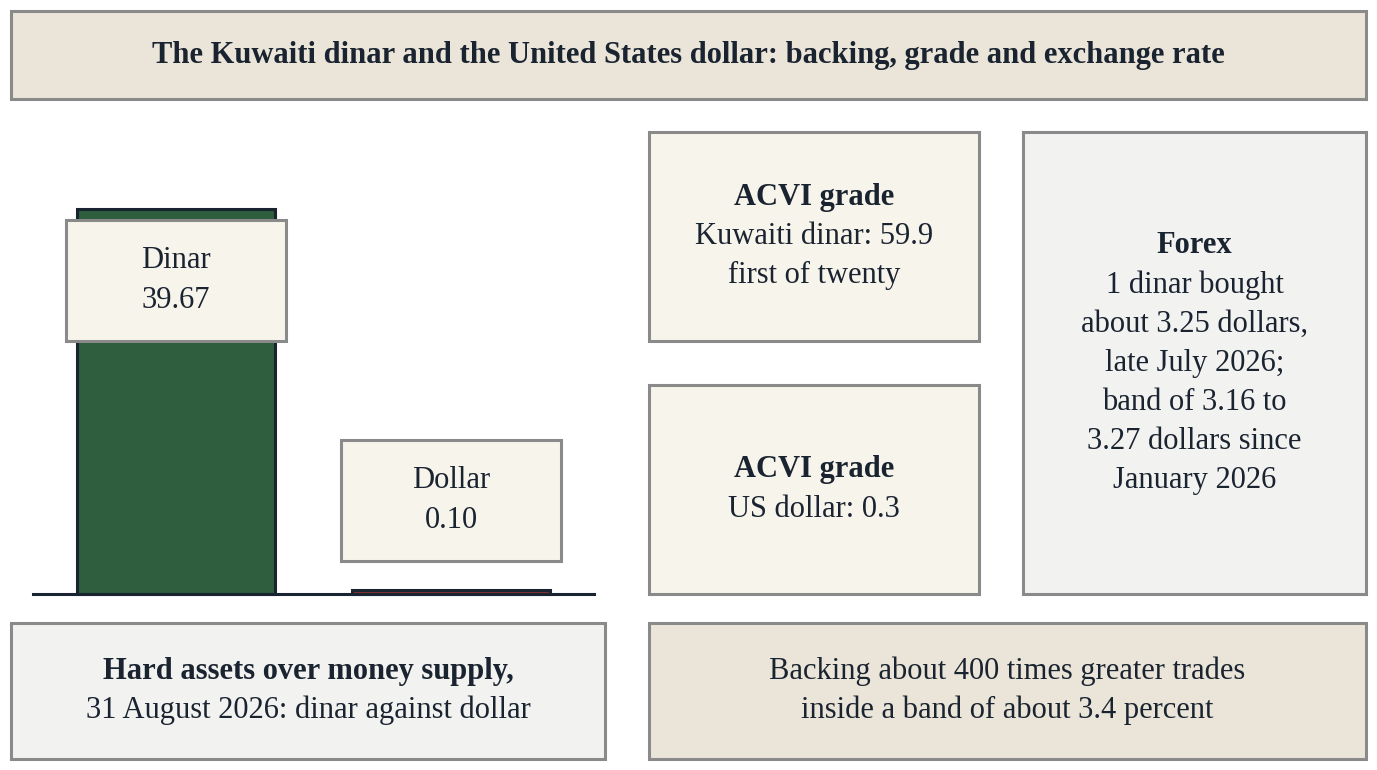
The Kuwaiti dinar and the United States dollar. The exchange rate between two currencies reads each currency's extrinsic value, not the value that stands behind each currency, and the dinar and the dollar show the gap. Behind the dinar, Kuwait holds verified hard assets equal to 39.67 times Kuwait's money supply. Behind the dollar, the United States holds verified hard assets equal to 0.10 times the United States' money supply. Both ratios are measured in dollars at 31 August 2026 rates, after the index's discounts (pegisai.com, The ACVI at 1 September 2026, Table 2b). Per unit of money supply, the dinar carries about 400 times the hard-asset backing of the dollar (39.67 ÷ 0.10 = 396.7). The ACVI, which grades the government behind each currency on seven counts, reads 59.9 for the dinar, first of twenty currencies, and 0.3 for the dollar (same source). On the forex market one dinar bought about 3.25 dollars in late July 2026, inside a band of 3.16 to 3.27 dollars since January 2026. The Central Bank of Kuwait holds the dinar to an undisclosed weighted basket of the currencies of Kuwait's major trade and financial partners, so the rate follows the basket, not Kuwait's backing (Central Bank of Kuwait, Exchange Rate Policy). Backing about 400 times greater trades inside a band of about 3.4 percent. The exchange rate prices the extrinsic value: the compulsion to use the dollar.
Where the hedges sit. Credit default swaps hedge claims. Of the 11.00 trillion dollars of credit default swaps outstanding at end-December 2025, 9.99 trillion dollars, 90.8 percent, hedged claims on private borrowers and portfolios: financial firms, non-financial firms, and portfolios or structured products. The remaining 1.02 trillion dollars, 9.2 percent, hedged the promises of nations (BIS OTC derivatives statistics, end-December 2025). Item 1.1 sets out the scale and the cost of those hedges. The next subsection sets out what the Alkaimi model does for the central banks that stand behind both promises.
Why central banks have reason to support the Alkaimi Ecosystem’s deployment
No central bank is structured to adopt the Alkaimi model today. Five operations give a central bank reason to support the model's deployment.
1.Fewer uncollateralized claims. A settlement between two members on the Alkaimi ledger is a ledger entry, final when the value moves, with no chain of correspondent financial institutions between the members and no interval in which one member holds the other member's promise (alkaimi.com, Current Operations).
2.Final settlement. When a DTA moves, the payment obligation is extinguished by that movement (pegisai.com, The Model). Nothing is left owed when the movement ends.
3.Stability. Client value held in custody sits outside the member's liabilities, outside the deposits on which deposit insurance is assessed and outside any run, because the member never owed the value (alkaimi.com, Claims versus value).
4.Surety in payment. Every DTA is underwritten. On an issuer's default, the ledger liquidates the issuer's estate in days, against a defined estate: holders are paid from the DTAs the issuer took in payment first, then by the underwriter as surety, to the full issued value (pegisai.com, Underwriting on the platform).
5.Less need for credit default swaps, over time. A claim the settlement never opens needs no hedge (pegisai.com, The Model and Part 4). As business moves to the Alkaimi ledger, the need for credit default swaps written against those claims is expected to fall.
Each central bank's own charter. Each central bank's charter names the objectives the five operations serve. The Federal Reserve Act directs the Federal Reserve Board and the Federal Open Market Committee to promote effectively the goals of maximum employment, stable prices and moderate long-term interest rates (Federal Reserve Act, section 2A). The Treaty on the Functioning of the European Union makes price stability the primary objective of the European System of Central Banks, and directs the System to contribute to the policies of the competent authorities on the stability of the financial system (Treaty on the Functioning of the European Union, Article 127(1) and 127(5)). The Bank of England Act gives the Bank of England the objective to protect and enhance the stability of the financial system of the United Kingdom (Bank of England Act 1998, section 2A).
| Charter objective | The published figures | What the Alkaimi model does |
|---|---|---|
| Financial stability | New money is 89.74 percent of the money the United States public holds, and no rule requires scrip behind a deposit. More than 80 trillion dollars of obligations to pay dollars sit in FX swaps and forwards, backstopped by central banks in 2008 and 2020. | A settlement between members leaves no claim open. Client value in custody sits outside any run, because the member never owed the value. |
| Price stability | Over 1,953 days the dollar lost 27.86 percent of purchasing power on the United States government's own index. | A DTA holding lost 0.00 over the same 1,953 days. Value is counted in grains, not in a currency. |
| Safe settlement, within financial stability | More than 1.4 trillion dollars a day of foreign exchange settled gross and bilateral, fully exposed, in April 2025. | Settlement is final when the DTA moves, and nothing is left owed. |
Sources for the table: pegisai.com, Part 1 and Platform; Borio, McCauley and McGuire, BIS Quarterly Review, December 2022; Conway, Drehmann, Lovell, McGuire and Shirakami, BIS Quarterly Review, June 2026.
A regulated bank's route onto the Alkaimi ledger. A regulated bank that is not yet a member institution can join through the access license (ACI), working directly through a member institution that holds the AGI (Overview, item 11). The access license opens once the Alkaimi ledger reaches a set operational mass and each petitioning institution has completed the due diligence process and accepted the terms to join the ecosystem. On the FDIC's community bank aggregate at 30 June 2026, about 28 percent of an access member institution’s liabilities can work down in two years, on the loan book's own repayment pace; the figure is Alkaimi's projection on stated assumptions, not a bank's number (pegisai.com, The platform in depth).
The central bank keeps every power the central bank holds today: the central bank issues and manages the nation's currency, runs the settlement system in that currency and sets the policy rate. Through the advances the central bank makes against pledged DTAs, the central bank also gains direct control of the price and the funding of new credit (pegisai.com, Part 4; Section 4, item 4.8). No central bank, supervisor, government or other authority has reviewed, approved or endorsed Alkaimi, and the central bank's acceptance of the pledge is an approval in process (pegisai.com, Home and The platform in depth).
Why the ecosystem holds to wholesale settlement
The markets still price currencies by extrinsic value, so the model is metered by sequence and the members hold to wholesale settlement by the members' own decision.
The platform's capacity is not the limit; the shock is. Recognized value near a quadrillion dollars released into the system at once would break currencies, and the break runs either way: hyperinflation, or the deflation in which people walk away from a currency altogether. No reserve currency has ever collapsed in a single event (pegisai.com, The platform in depth).
The model is therefore metered by sequence: wholesale settlement first; then nation debt shifted into DTAs the nation can move; consumer products in a later phase, with recognized value sufficient to reach 130 trillion dollars projected across approximately a decade (pegisai.com, The platform in depth).
The members hold a self-imposed embargo that limits operations to the six wholesale operations until three conditions are met at each member: capital to the standard the member's license sets, people trained, and the infrastructure of the ecosystem's private network deployed (alkaimi.com, Current Operations).
The plan for retail use is set by sequence, not by market pressure. The members have determined, in common, to carry the 100% Whole Reserve model from wholesale settlement into consumer banking at the members' own branches, under the members' own names and regulators (alkaimi.com, Future Operations). Consumer retail operations are targeted for 2028 (pegisai.com, The Model and Licensing). Each consumer product will be offered, when the product is offered, under the member's own regulator.
The publication at a glance
| Subject | The statement | Shown in |
|---|---|---|
| Terms | A DTA is digital in form, not a digital asset. An asset holds value in itself and is a claim on no one. | Position on Cryptocurrency Era terms |
| Credit default swaps | Banks buy credit default swaps to hedge the claims settlement leaves open. The Alkaimi Ecosystem settles without opening the claim. | 1.1, 3.2 |
| Claims | Every currency rail ends in a promise. Settlement on the Alkaimi ledger ends in value no one owes. | 1.1, 1.2 |
| Two promises | Money is two promises: the scrip a nation issues and the new money a bank creates. Nine-tenths of the credit default swap market hedges private claims, and one-tenth hedges the promises of nations. | Overview |
| Capital standard | Every member institution meets Basel III+ from the member's first DTA engagement date. The agreed date was 1 January 2023, and the largest market has applied no element of the final reforms. | 1.1 |
| Finality | A DTA’s movement extinguishes the obligation. Nothing is left on either member institution’s books. | 1.2, 3.1 |
| Granular Value | A pricing method in grains, never in a currency. The rail is currency neutral. | Overview |
| Compliance | Three layers and two AI monitoring systems of real-time KYC and AML. Every final decision is made by a person. | 2.1 |
| Level 1 HQLA | A member institution posts the DTA as Level 1 on Pegisai’s published position. Classification rests with each supervisor. | 2.2 |
| Not a cryptoasset | One custodial ledger, no distributed ledger, no public market. | 2.3 |
| Failure containment | A failure stays with the party that fails, by item and by system. | 2.3 |
| Member institutions | Every license holder is an AMI. A regulated bank joins under the AGI or the ACI. | Overview, item 11; Section 3 |
| Leverage | Custody sits off the balance sheet, and a settled DTA leaves no claim to measure. | 3.1 |
| Credit books | Borrower risk stays with the member institution and is carried inside the book’s own loss order. Settlement and holdings open no claim to hedge. | 3.2 |
| Output floor | Custody and settlement add nothing to the standardized base on which capital is set. | 3.3 |
| Questions and concerns | Fourteen common concerns, answered from the law, the standards and the economics that already govern banking. | Section 4 |
| Price risk | Issued at 0.80 against the underwriter’s 0.90. The holder is paid to the full issued value. | 4.2 |
| Monetary policy | Each channel holds; the credit channel tightens. | 4.7 |
| Policy rules | The central bank keeps the rule and sets the rate; the model steadies the rule’s inputs and adds tools. | 4.8 |
| Governing law | England and Wales. The asset is the client’s property; the DTA is the contract. | 4.6 |
| Pace | Wholesale only, by the members' own embargo. Consumer retail targeted for 2028. Metered so no currency breaks. | Overview |
| Central banks | Fewer uncollateralized claims inside the banks a central bank supervises, and direct control of the price and funding of new credit. | Overview, 4.8, closing |
| Next steps | One step each for the central bank, the supervisor, the member institution and the regulated bank considering membership. | Closing |