This online copy is presented for educational purposes only. For all official purposes, the formal publication in PDF format prevails.
Pegisai™'s technology is an operational engine for balance-sheet de-risking and the mitigation of systemic credit exposure. The engine works on the open claim every payment leaves.
1.1 The Problem Statement: the Credit Default Swap Issue
The current global financial grid is choking on the Credit Default Swap Issue: the multi-trillion-dollar web of overlapping bank claims, and the risk-weight hedges written against those claims, that amplify systemic counterparty risk.
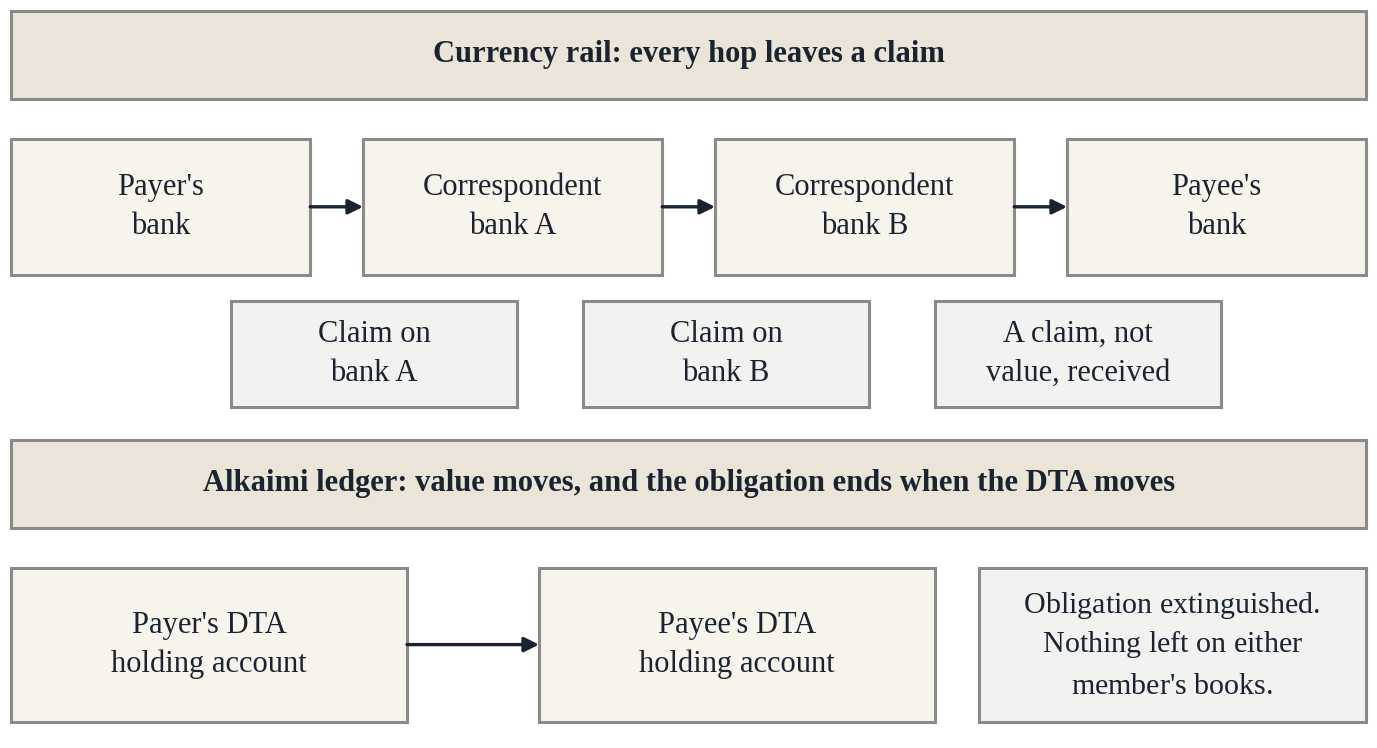
Every settlement ends in a promise. A deposit at a financial institution is a claim on that institution, and the institution pays the claim in a currency that is a claim on the nation. One financial institution settles the institution's obligations to another institution by transferring claims, so at no point in the chain does a settlement end in anything that is not a promise (alkaimi.com, Claims versus value). A payment between banks over a central bank's real-time gross settlement (RTGS) system is final in law, and the receiving bank then holds a balance on the central bank's books, which is the central bank's promise to the bank (pegisai.com, Part 1). Payments that cross banks and borders run through correspondent accounts, where each bank in the chain holds a claim on the next bank.
Every time a bank uses a standard currency rail, the bank records a cascading chain of interbank claims, adding another layer of debt to the balance sheet.
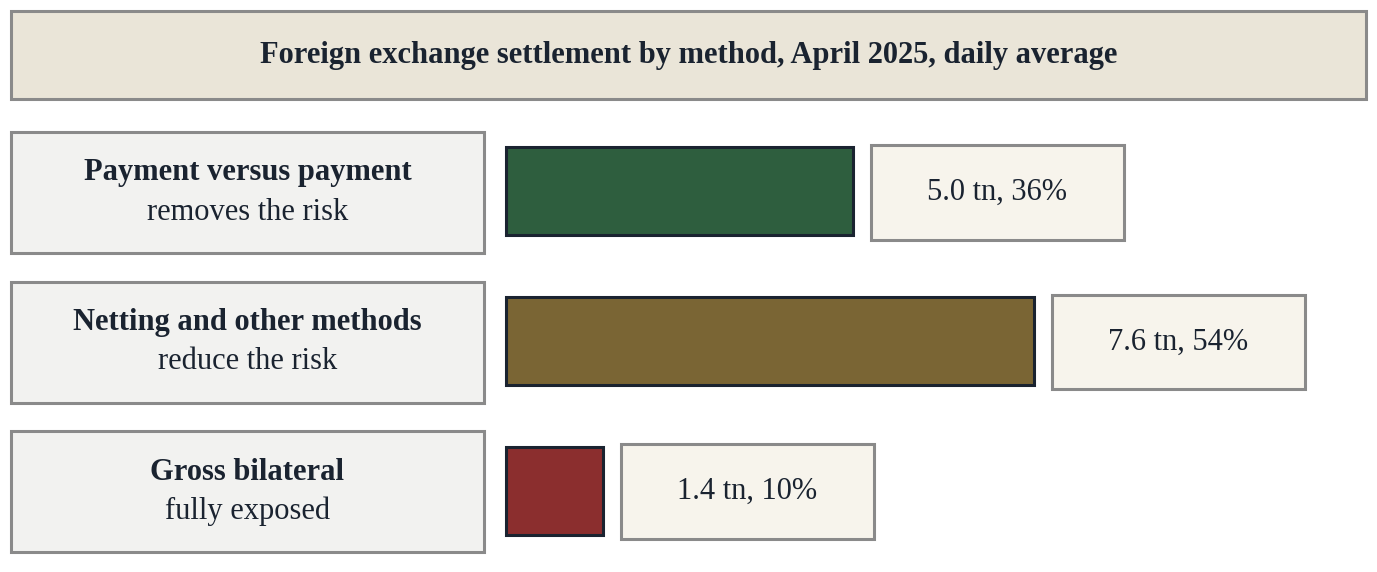
The claims do not settle together. In April 2025, just over 5 trillion dollars a day of foreign exchange settled payment versus payment, 36 percent of average daily settlement, the one method that removes the risk that one side pays and the other side does not. A further 7.6 trillion dollars, 54 percent, settled by methods such as pre-settlement netting, which reduce that risk without removing the risk. More than 1.4 trillion dollars a day, 10 percent, settled gross and bilateral, fully exposed (BIS Quarterly Review, June 2026). Fifty years after the Herstatt failure of 1974, the risk of paying without being paid remains in the system every day.
The claims concentrate. The number of active correspondent banks worldwide fell by about 22 percent between 2011 and 2019, while payment message volumes rose (CPMI, 2020). The same flow of claims now runs through fewer banks, so each surviving correspondent carries a larger share of the network's open claims.
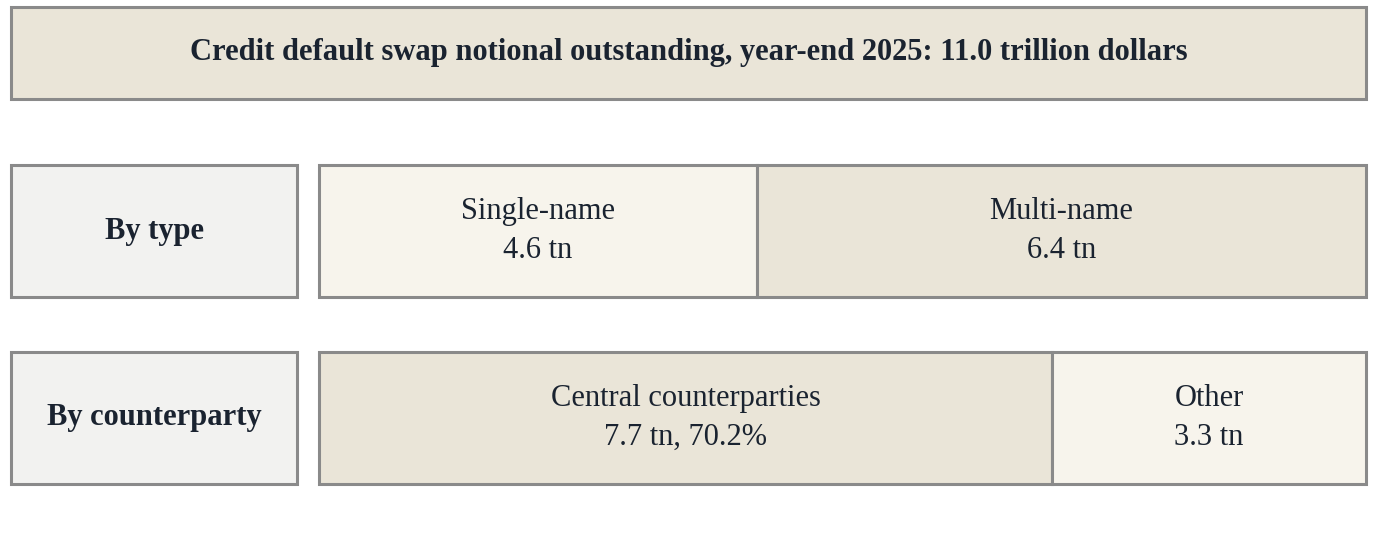
The hedges are promises too. Banks hedge the exposure with further promises. A credit default swap is protection one institution buys from another, so each hedge adds a claim on the protection seller. At year-end 2025, global credit default swap notional outstanding stood at 11.0 trillion dollars, 4.6 trillion single-name and 6.4 trillion multiple-name, with a gross market value of 273.7 billion dollars. Central counterparties carried 70.2 percent of the notional, 7.7 trillion dollars. Across all over-the-counter derivatives, notional outstanding reached 844.6 trillion dollars, and gross credit exposure after netting reached 3.4 trillion dollars, which ISDA describes as the more accurate measure of counterparty credit risk. Initial margin required for cleared interest rate swaps and credit default swaps at major central counterparties reached 423.5 billion dollars (ISDA, July 2026, on BIS OTC derivatives statistics). With 70.2 percent of the notional facing central counterparties, the market's credit claims meet at those counterparties.
The hedges failed where the hedges were needed. A hedge is only as good as the seller of the hedge. In September 2008, downgrades of AIG's credit rating triggered collateral calls on the credit default swaps AIG Financial Products had written on collateralized debt obligations. The Federal Reserve and the Treasury committed about 182.3 billion dollars to AIG, the largest rescue of the crisis, and part of the assistance bought securities from AIG Financial Products' counterparties in connection with terminating those swaps (GAO-09-975, September 2009; Congressional Research Service, R42953). The protection the market had bought became a claim the nation honored.
The price of the claim cost more than the defaults. The Basel Committee found that roughly two-thirds of the losses attributed to counterparty credit risk during the financial crisis came from credit valuation adjustment (CVA) losses, the mark-to-market cost of counterparties' falling credit quality, and only about one-third came from actual defaults. With the CVA capital charge added in Basel III, the Committee estimated that capital requirements for counterparty credit risk would double the Basel II level (BCBS, 1 June 2011). Under the basic approach of the Basel CVA framework, the default approach a bank must use unless the bank's supervisor approves the standardized approach, the only instruments eligible as CVA hedges are single-name credit default swaps, single-name contingent credit default swaps and index credit default swaps (Basel Framework MAR50, as carried in the SAMA Rulebook).
The claims between institutions therefore cost a bank twice: once in the capital charge and again in the credit default swaps bought to reduce the charge.
The multi-trillion-dollar credit default swap market is a protective symptom of a broken settlement layer.
The capital standard arrives late, and in the largest market not at all. The Basel Committee set 1 January 2023 for the final Basel III reforms. At end-September 2025 the revised credit risk and operational risk standards and the output floor were in effect in around 80 percent of the Committee's 27 member jurisdictions, the CVA standard in nearly 70 percent and the revised market risk standards in nearly 40 percent (BCBS, 3 October 2025). India and Turkey had none of the revised rules in full effect (Risk.net, October 2025). The United States has implemented no element of the final reforms. The 2023 proposal, with an estimated 16 percent increase in common equity tier 1 requirements, was never finalized (federal banking agencies, July 2023). The re-proposal of 19 March 2026 would lower common equity tier 1 requirements by 4.8 percent for the largest banks, 5.2 percent for midsize banks and 7.8 percent for smaller banks, counting the proposed stress-test changes; comments closed on 18 June 2026, and no final rule is in force (Federal Reserve Board, memo of 19 March 2026). The United Kingdom set 1 January 2027 (Prudential Regulation Authority, PS1/26, 20 January 2026). The European Union postponed the market risk rules twice, to 1 January 2027, citing the level playing field and uncertainty over the timing in other major jurisdictions (European Commission, 12 June 2025). JPMorgan Chase, Bank of America, Citigroup, Wells Fargo, Goldman Sachs and Morgan Stanley operate under none of the final reforms, and the six remain under capitalization formulas set more than thirteen years ago (The Alkaimi Financial Ecosystem in Function).
The member institutions meet the standard now. The published record states the members' position: “Every Alkaimi™ licensed financial institution meets Basel III+ compliance standards from its first DTA™ engagement date: the output floor at 72.5 percent of the standardized calculation, operational risk capitalized on the standardized approach and the trading book under the Fundamental Review of the Trading Book; and it meets the Basel III standards those complete, liquidity coverage across a 30-day stress window and stable funding across one year” (The Alkaimi Financial Ecosystem in Function). The statement is Pegisai Global Holdings' own and is made by no authority.
Counterargument. A credit default swap hedges the default of a borrower or a bond issuer, not a settlement.
Answer. Part of the credit risk banks hedge sits between financial institutions themselves. The Basel CVA charge exists because the counterparties to banks' own contracts lose credit quality, and under the framework's basic approach, the default approach, only credit default swaps are eligible hedges of that risk. The claims settlement leaves open between institutions are the part of the credit default swap book the Alkaimi model reaches first. A member
1.2 The Systemic Solution
The Alkaimi model is a structural paradigm shift from net-debt settlement to gross-asset settlement: value moves, no claim is created, and the credit relationship between the two banks never forms.
Value moves, not a promise. Settlement on the Alkaimi ledger is a DTA moving from one client DTA holding account to another, final when the DTA moves (pegisai.com, Part 2). The underlying asset remains in place under the applicable custody arrangements, while the asset's recognized value moves between accounts. Settlement occurs when that value transfers on the ledger, rather than through a sequence of correspondent-bank payment promises (Pegisai, 1 October 2026). The settlement does not create a temporary credit promise: the settlement delivers claim-free recognized value, and the real-world asset stays in custody.
The value moves in individual units. Alkaimi's value recognition method moves physical value down into individual Universal Value Units: value is set, UVUs are assembled and individual DTAs are created, and each UVU™ within a DTA enables equal transaction of values between accounts in settlement (pegisai.com, Ecosystem). Every UVU carries an encoded title package, and every title package is AI monitored in real time (Section 2, item 2.1).
The credit relationship leaves with the claim. Each DTA within each DTA stack acts as the DTA's own independent settlement item: when the DTA moves, the payment obligation is extinguished by that movement (pegisai.com, The Model). No claim is left between the paying bank and the receiving bank, so the settlement strips out the credit relationship between the two banks entirely, and nothing remains for a collateralized derivative hedge to cover. The transaction is final the moment the DTA moves, and every settlement made on the Alkaimi ledger instead of a currency rail is one less open claim in the gross volume of bank claims.
Two lanes, and a rule at the desk. A member does not leave the payments system to leave the claims system. A claim from a non-member financial institution is taken at the member's desk, on the currency side, and nothing is released against the claim until the claim has settled in central bank money. Between two members there are two lanes: currency settles through correspondent relationships as the currency does today, and value settles on the Alkaimi ledger, final when the value moves. As the members' business moves from the currency lane to the value lane, each member's exposure to the other members' promises falls (alkaimi.com, From claims to whole settlement).
The holder's protection travels inside the DTA. No one owes a DTA to the holder, so the holder carries no credit liability for anyone to insure. Every DTA is underwritten: the underwriter signs 0.90 of the recognized value of a stack and the Mint issues 0.80, and the signature warrants the existence, title, quantity and recoverability of the asset at the floor at which the value was recognized (pegisai.com, Underwriting on the platform, in depth).
Finality, not speed. Mike Rogers, a Pegisai spokesman, stated the point in the 1 October 2026 release.
“The true evolution of institutional treasury operations is not about moving tokenized versions of existing fiat liabilities faster. True efficiency requires structural finality.”
The statement draws the line between speed and settlement. A tokenized fiat liability moved faster is still a liability: the holder receives a claim on an issuer, and the obligation behind the claim stays open. A stablecoin's issuer is obligated by law to redeem the stablecoin for a fixed amount of monetary value (GENIUS Act of 2025, section 2(22)). A DTA's movement extinguishes the obligation the movement pays. Structural finality means nothing is left owed when the movement ends.
For the Chief Financial Officer: “real-time gross settlement in recognized asset value, final when the DTA moves, opens no bank-to-bank credit claim.”
Counterargument. RTGS systems already settle gross and final.
Answer. The Federal Reserve's Fedwire Funds Service settles each transfer individually in central bank money, and the credit is final and irrevocable (Federal Reserve Financial Services). The difference sits in what the receiver holds after settlement: in RTGS, a balance on the central bank's books, which is the central bank's promise to the bank; on the Alkaimi ledger, recognized asset value that no one owes (pegisai.com, Part 2). The interbank claims arise in the correspondent chains around RTGS. Alkaimi settlement between members runs without that chain, and a member uses RTGS for exactly the job RTGS does well: settling a non-member's claim in central bank money before the member releases anything (alkaimi.com, From claims to whole settlement).
Exhibit: Systemic Settlement Layer: Risk & Structural Comparison
The table contrasts a traditional fiat RTGS loop with the Alkaimi DTA bearer transfer, on the four measures a Chief Risk Officer and a central bank supervisor read first: the settlement medium, counterparty and credit risk, derivative exposure, and liquidity and asset efficiency.
The Alkaimi model does not compete with central bank sovereign issuance. Pegisai issues no currency, licenses no currency and prices nothing in any currency, and a currency never enters the walled garden (pegisai.com, Part 3). The members do not compete with the currency a nation issues: the 100% Whole Reserve™ model settles beside that currency, and the members hold, by consensus among the members, that the issue of a nation's currency is the sovereign's right (alkaimi.com, From claims to whole settlement). The model optimizes the internal plumbing of commercial bank treasuries: settlement in recognized asset value is a direct mechanism to deflate the uncollateralized interbank claim market, one settlement at a time.
| Risk Vector / Structural Metric | Traditional Central Bank RTGS Fiat Loop | Alkaimi DTA Bearer Transfer Model |
|---|---|---|
| Settlement Medium | Central Bank Fiat Liabilities (Sovereign currency debt claims) | Digitized Tangible Assets (DTAs) (Recognized asset value held whole under the 100% Whole Reserve model) |
| Counterparty / Credit Risk | High (Deferred Multi-Bank Linkages) | Zero (Instant Gross Finality) on each settlement on the Alkaimi ledger |
| RTGS settles final in central bank money; the payment chains around RTGS rely on intermediate credit accounts and matching interbank claims. | Value is held in the DTA, a bearer instrument in electronic form; no one “owes” the asset. | |
| Derivative Exposure (The CDS Factor) | Heavy Reliance on CDS Books | Eliminated on claims the Alkaimi ledger never opens |
| Banks hold credit default swap books against the counterparty exposure that accumulates across bank networks. | Immediate transfer means there is no lingering credit relationship to insure. | |
| Liquidity & Asset Efficiency | Dormant / Low-Yield | Active / High Velocity |
| Physical assets in bank custody sit idle while fiat transactions strain liquidity ratios. | Recognizes physical feedstock (gold, energy, grains) as DTAs that settle account to account, and transmutes at the desk on the holder's instruction. |
The Basel references behind the table. Five parts of the Basel framework bear on the table. The liquidity coverage ratio defines Level 1 high-quality liquid assets (Basel liquidity standard, as carried in the SAMA Rulebook, paragraph 49). The leverage ratio measures Tier 1 capital against total exposure, with a 3 percent minimum that banks must meet at all times (Basel Framework LEV20 and LEV30). The CVA framework capitalizes counterparty credit spread risk and, under the basic approach, the default approach, admits only credit default swaps as eligible hedges (Basel Framework MAR50).The output floor holds risk-weighted assets from internal models at no less than 72.5 percent of the standardized calculation (BCBS, December 2017). The cryptoasset chapter sets the treatment of exposures that depend on distributed ledger technology (Basel Framework SCO60, in force 1 January 2026).