This online copy is presented for educational purposes only. For all official purposes, the formal publication in PDF format prevails.
Three parties, three sets of issues
A central bank, a member institution and a regulated bank considering membership each meet the Alkaimi Ecosystem™ at a different point, and each carries a different set of issues.
We, Pegisai Global Holdings, built the products by looking at banking from four perspectives: how a payment settles, how an asset is classified, how assets and capital are used, and how each is treated on the books and under the rules.
We studied the two earlier models of whole-reserve banking for what each got right, where each fell short and why each failed. The Bank of Amsterdam opened in 1609 and held coin and bullion against every deposit. The bank's operators broke the full-reserve rule in secret, lending to the City of Amsterdam and the Dutch East India Company; the City took control of the bank in 1791, and the bank was liquidated in 1819. Full-reserve banking could not create liquidity. Fractional banking could create liquidity, and made solvency a probability. The Chicago Plan of 1933 proposed one hundred percent reserves in central bank money and failed on one clause: the government had to supply the reserve, and Congress refused (The Alkaimi Financial Ecosystem in Function, Section 7).
We applied technology to each failure. The Alkaimi™ ledger enforces the whole-reserve rule on every entry, so no operator can break the rule in secret: no member institution can lend the ledgered reserve out or issue a claim against a DTA™ in the member institution's custody. Liquidity comes from recognizing more assets onto the Alkaimi ledger, not from lending the same asset several times. No central bank supplies the reserve, so the Chicago Plan's obstacle does not arise: no central bank is asked to create anything, no treasury is asked to guarantee anything and no legislature is asked to pass anything (The Alkaimi Financial Ecosystem in Function, Section 7).
The finished products answer each party's issues on the same four perspectives.
The central bank. The central bank issues and manages the nation's currency, runs the national settlement system, and advances currency against pledged DTAs (pegisai.com, Part 4). The central bank's issue is whether to accept the DTA pledge under the central bank's own collateral rules, an approval in process (pegisai.com, Platform). Section 2, item 2.2, answers the issue.
The member institution. Every member institution today is a regionally chartered financial institution, conducting wholesale settlement only, under the members' own embargo until capital, trained people and the network infrastructure are in place at each member (alkaimi.com, Current Operations). The member institution's issues are the member institution's own balance sheet and capital, which items 3.1 to 3.3 answer.
The regulated bank considering membership. A regulated bank outside the ecosystem asks why the bank would join, and under which license. The next part answers the question.
What the finished products do, by party
| Party | Settlement | Asset classification | Use of assets and capital | Treatment |
|---|---|---|---|---|
| Central bank | Fewer uncollateralized claims inside the banks the central bank supervises | A DTA pledge the central bank can accept under the central bank's own collateral rules; acceptance is an approval in process | Asked to create no reserve and to guarantee nothing | Keeps every power; gains direct pricing and funding of new credit (4.8) |
| Member institution | Final settlement with every other member institution; no correspondent balance and no open claim | Client value held in custody, not a currency deposit; DTAs posted as Level 1 on the published position | The old deposit book runs off as the old loans repay; lending from rented DTAs, when offered, creates no deposit | Client DTAs off the member institution's balance sheet and outside the member institution's estate |
| Regulated bank considering membership | Final settlement through a member institution that holds the AGI, without a correspondent chain | The standing every member institution holds, once licensed | The same run-off of the deposit book, on the bank's own loan book's pace | No new banking license; custody, settlement and the rent agreement are ordinary bank powers |
Sources for the table: pegisai.com, Part 4, Platform, Ecosystem and The Model; alkaimi.com, Current Operations and Future Operations; Section 2, item 2.2.
Why a bank joins, and under which license
A regulated bank joins the Alkaimi Ecosystem as a member institution under one of two licenses, and the reasons to join differ by license.
The gateway license. A bank that takes the AGI is placed on platform. The bank settles with every other member institution, finally, with no interbank claim left open (item 3.1). The bank earns five service fees, for Alkaimi's value recognition method, custody, settlement, transmutation at the desk and the administration of rent agreements, and creates no credit to earn the fees (Overview). The bank also serves the member institutions that reach the Alkaimi ledger through the bank under the access license, without carrying those institutions' claims (Overview, item 11; Figure 2).
The access license. A smaller regulated bank that takes the ACI reaches the Alkaimi ledger through a member institution that holds the AGI. The number of active correspondent banks worldwide fell by about 22 percent between 2011 and 2019 (CPMI, 2020), and the smaller bank is the bank losing the correspondents. The ACI gives the smaller bank final settlement without a correspondent chain. About 28 percent of a community bank's liabilities can work down in two years, on the bank's own loan book's repayment pace (item 3.1). DTAs posted as Level 1 on the published position open the pledge route at the bank's own central bank (Section 2, item 2.2). The access license opens once the Alkaimi ledger reaches a set operational mass and each petitioning institution has completed the due diligence process and accepted the terms to join the ecosystem.
The model gives the smaller banks in a central bank's jurisdiction a route to final settlement and to Level 1 collateral, through a member institution that holds the AGI, without asking the central bank to create anything.
3.1 Dismantling Interbank Exposures
Transferring a DTA creates immediate transactional finality. No open debt is left on either member institution's books, so settlement on the Alkaimi ledger adds nothing to a member institution's leverage ratio exposure measure.
The mechanics run in four steps.
1. The paying client instructs the client's member institution.
2. The member institution moves the DTA, whole or in a fractional portion, from the paying client's DTA holding account to the receiving client's DTA holding account on the Alkaimi ledger.
3. The movement extinguishes the payment obligation (pegisai.com, The Model).
4. Nothing remains on either member institution's books: no correspondent balance, and no interval in which one member institution holds the other member institution's promise (alkaimi.com, Current Operations).
The walled garden connection does what SWIFT does, in that every connected bank can settle with every other bank, and does what SWIFT cannot: the network carries the value itself, not a message about a payment to be made later, and the settlement is final when the DTA moves (pegisai.com, Licensing).
From moving value faster to eliminating balance sheet bloat.
The leverage ratio. The Basel leverage ratio divides Tier 1 capital by the exposure measure, and banks must meet a 3 percent minimum at all times (Basel Framework, LEV20). The exposure measure is the sum of on-balance sheet exposures, derivative exposures, securities financing transaction exposures and off-balance sheet items, generally at gross accounting value, and liability items may not be deducted (Basel Framework, LEV20 and LEV30). An open interbank claim is an on-balance sheet asset and sits in the measure until the claim is paid. A DTA settlement leaves no claim to measure.
Client value adds nothing to the measure. The member institution holds client DTAs in custody, off the member institution's balance sheet, and nothing on the Alkaimi ledger is a member institution's asset or a member institution's liability (pegisai.com, Ecosystem and Platform). The measure counts the member institution's own balance sheet assets, so client value held in custody stays outside the measure.
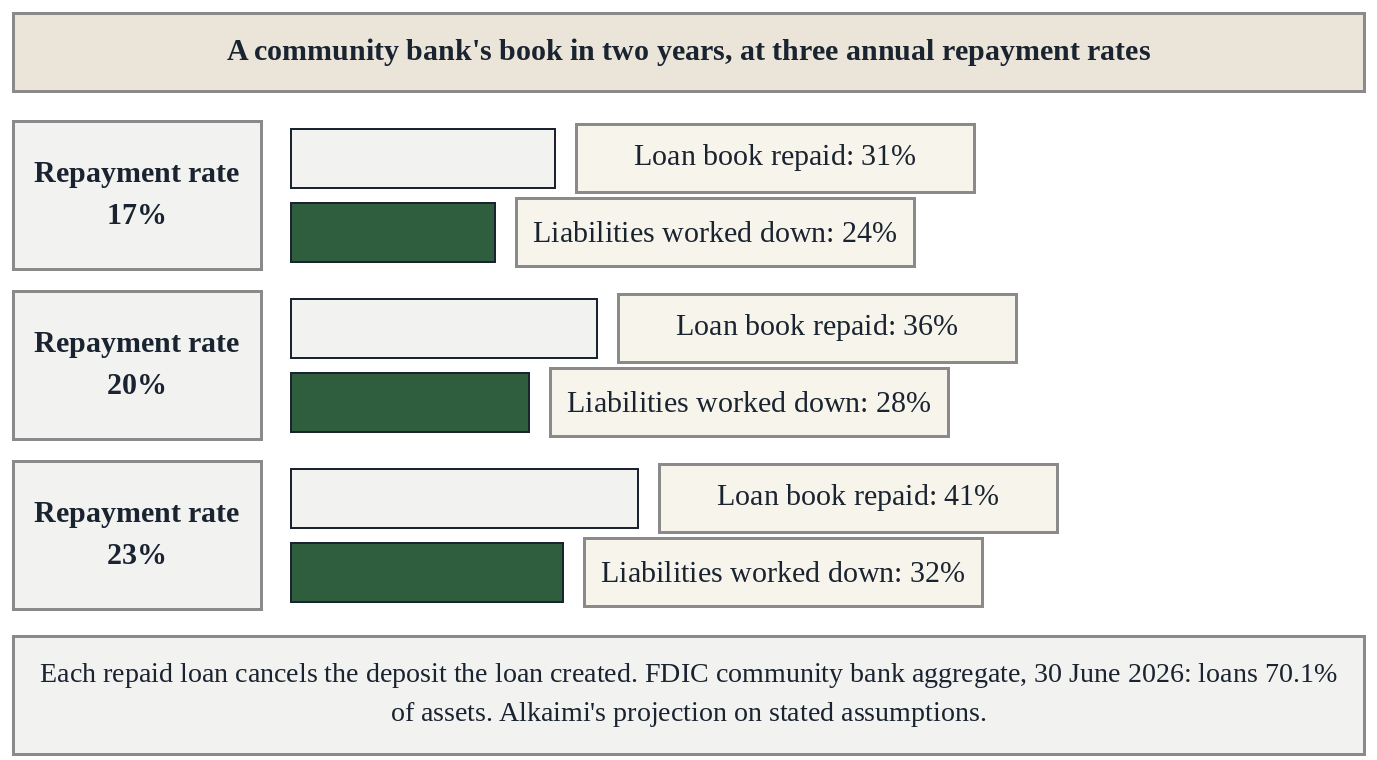
The liabilities work down by run-off. Each of the member institution's old loans that repays cancels the deposit the loan created. Lending funded from rented DTAs, when the member institution offers the lending, creates no deposit (pegisai.com, Part 4). The member institution's deposit liabilities, and the assets those deposits fund, therefore fall on the old book's own repayment pace, without a run, a bail-in or a state guarantee.
A worked illustration. On the FDIC's community bank aggregate at 30 June 2026, loans were 1,943.6 billion dollars, 70.1 percent of assets, and deposits were 94.2 percent of liabilities. At an annual repayment rate of 20 percent, 36 percent of the loan book repays in two years. The deposits those loans created, about 28 percent of the bank's liabilities, cancel with the loans. At repayment rates of 17 and 23 percent, the share is about 24 and 32 percent. The illustration is Alkaimi's projection on stated assumptions, not a bank's number (pegisai.com, The platform in depth).
Counterargument. Interbank payments settle within the day, so the claims never reach a reported leverage ratio.
Answer. The 3 percent minimum applies at all times, not only on reporting dates (Basel Framework, LEV20). Banks report the ratio on a quarter-end basis. In October 2018 the Basel Committee called window-dressing around reporting dates unacceptable, and in June 2019 the Committee added disclosure of the ratio on daily averages of securities financing transactions, effective in 2022 (BCBS, 13 December 2018 and 26 June 2019). The claims a bank works to reduce on reporting dates are the claims the Alkaimi ledger never opens. Custody, DTA settlement and run-off remove the stock the member institution carries, not only the day's flow.
3.2 Eliminating Derivative Drag
Credit default swaps hedge claims. The Alkaimi Ecosystem opens no claim in settlement and none in a DTA holding, so a member institution has no need to enter into agreements to offset the credit risk those two operations would otherwise create.
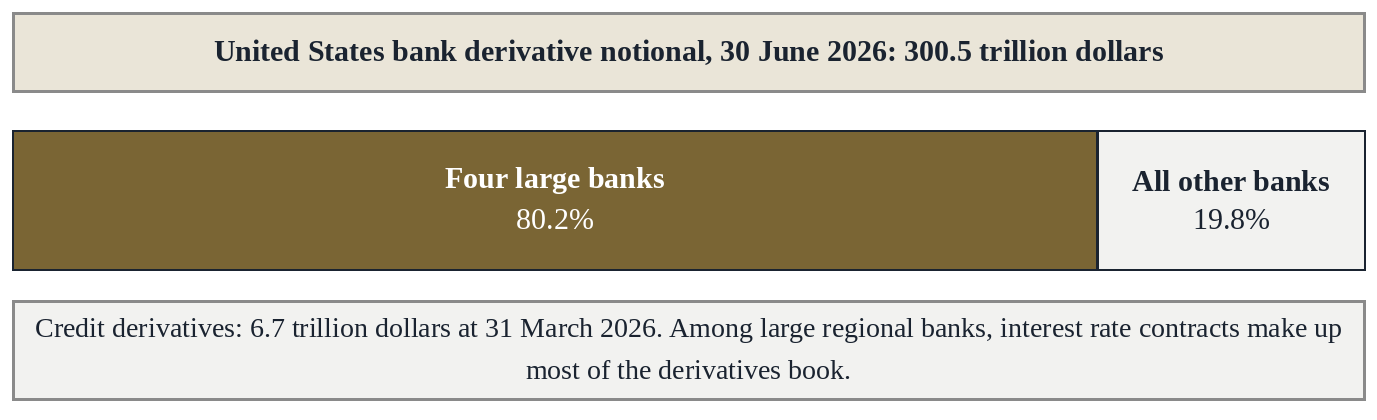
Where the swaps sit. Derivative notional across United States banks stood at 300.5 trillion dollars at 30 June 2026, and four large banks held 80.2 percent of the total (OCC, Quarterly Report on Bank Trading and Derivatives Activities, Second Quarter 2026). Credit derivatives stood at 6.7 trillion dollars at 31 March 2026, and among large regional banks, interest rate contracts make up most of the derivatives book (OCC, First Quarter 2026). The swap points in this item apply to the member institution that carries a derivatives book; the claims points apply to every member institution. The effect on the swap market grows with the settlement volume that moves onto the Alkaimi ledger. Today's member institutions are regional institutions in wholesale settlement, and each institution that settles on the ledger stops opening the claims a swap would hedge.
Why banks hold the swaps. The Basel CVA framework capitalizes the risk that a counterparty's credit quality falls. A bank must use the basic approach unless the bank's supervisor approves the standardized approach, and under the basic approach the only eligible hedges are single-name, single-name contingent and index credit default swaps (Basel Framework, MAR50). The CVA charge roughly doubled the capital banks hold for counterparty credit risk (BCBS, 1 June 2011). A bank buys swaps to reduce the charge, and each swap is itself a claim on the protection seller.
Two sources of hedged exposure leave the book. First, settlement in recognized asset value opens no interbank claim to hedge (item 3.1). Second, a DTA is a claim on no one, and the holder's protection travels inside the DTA as the underwriting, the surety and the holder's drawing right, and a defaulting issuer's estate is liquidated on the Alkaimi ledger, in days, against a defined estate (pegisai.com, Underwriting on the platform).
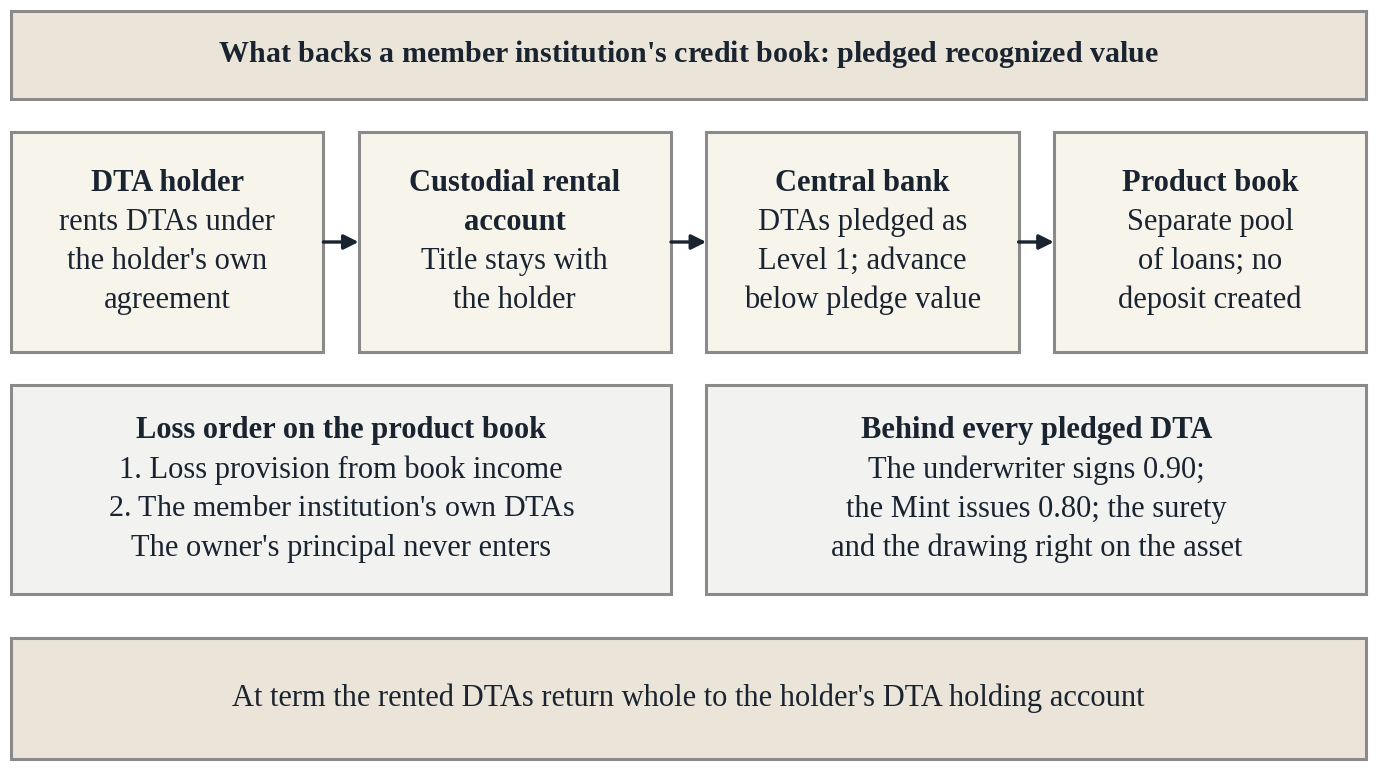
Borrower risk stays with the member institution. The member institution's existing loan book keeps the borrowers' credit risk until the existing loans are repaid. Lending funded from rented DTAs, when the member institution offers the lending, still has borrowers who can default. The losses are carried inside the book's own order: the loss provision from the book's income first, then the member institution's own DTAs, and the DTA owner's principal never enters the book (pegisai.com, The Model). The model eliminates the need to enter into agreements to offset the credit risk that settlement and holdings create, because neither opens a claim. Borrower risk is carried inside the book's loss order, not offset by an outside agreement.
The wind-down runs on two clocks. The settlement clock runs as business moves from currency rails to the Alkaimi ledger, and the claims those rails would have opened are never opened. The repayment clock runs as the old loan book repays. The credit default swaps written against those claims become unnecessary, and the CVA capital held against the same exposure is released with the swaps. The capital released with the swaps returns to the member institution’s own use, so the technology releases capital rather than consuming capital.
The Alkaimi model removes the need for the swaps written against every claim the Alkaimi ledger never opens.
“The model does not hedge counterparty risk on settlement: the model removes the claim that carries the risk.”
For the Chief Risk Officer: settlement that opens no counterparty claim reduces the exposure credit default swaps are bought to hedge.
Counterargument. A member institution's existing loan book still carries credit risk, and the member institution will still hedge that risk.
Answer. Yes, until the existing book is repaid. Every existing loan that repays retires the deposit that created the loan, and lending from rented DTAs, when offered, stands on the book's own loss order (pegisai.com, Part 4; alkaimi.com, Future Operations). The hedge shrinks with the old book, on the old book's own timetable, and no hedge is needed behind settlement or holdings.
3.3 Unlocking the Standardized Output Floor
The output floor binds only a bank that uses internal models, and for every member institution, settlement and custody add nothing to the standardized risk-weighted assets that set capital, so growth in settlement and custody does not raise the floor's base.
The floor. The output floor holds a bank's risk-weighted assets from internal models at no less than 72.5 percent of the risk-weighted assets calculated under the standardized approaches (BCBS, December 2017). Under the Basel phase-in, the floor reaches 72.5 percent on 1 January 2028. The European Union has applied the floor since 1 January 2025, rising to 72.5 percent on 1 January 2030 (Regulation (EU) 2024/1623). The United Kingdom applies the Basel 3.1 rules from 1 January 2027 (PRA, PS1/26, 20 January 2026). In the United States, the proposal of 19 March 2026 omits the output floor, because the proposed requirements are almost completely standardized; comments closed on 18 June 2026, and no final rule has been issued (federal banking agencies, 19 March 2026).
The output floor by jurisdiction
| Jurisdiction | Rule | The floor | Status |
|---|---|---|---|
| Basel Committee | Basel III: Finalising post-crisis reforms, December 2017 | 72.5 percent of the standardized calculation from 1 January 2028, phased in from 50 percent in 2023 | The standard |
| European Union | Regulation (EU) 2024/1623 (CRR3) | Applied from 1 January 2025, rising to 72.5 percent on 1 January 2030 | In force |
| United Kingdom | PRA Policy Statement PS1/26, 20 January 2026 | Basel 3.1 rules apply from 1 January 2027 | Final |
| United States | Proposal of the federal banking agencies, 19 March 2026 | Omitted: the proposed requirements are almost completely standardized | Comments closed 18 June 2026; no final rule |
Sources for the table: BCBS, December 2017; Regulation (EU) 2024/1623; PRA, PS1/26, 20 January 2026; federal banking agencies, 19 March 2026.
Who the floor binds. The floor binds only a bank that calculates risk-weighted assets with internal models. A member institution on the standardized approaches calculates capital on the standardized base directly, and meets the floor at every level, because for that member institution the floor and the base are the same standardized calculation.
Growth that adds nothing to the base. Client value sits in custody, off the member institution's balance sheet, as the client's property and not the member institution's asset (pegisai.com, Ecosystem). Settlement on the Alkaimi ledger opens no exposure (item 3.1). Settlement and custody volume can therefore grow without growing the standardized risk-weighted assets that set capital, whether or not the floor binds.
The product book. Lending funded from rented DTAs is a planned operation of the member institutions (alkaimi.com, Future Operations). The book's treatment on a member institution's own books, and the book's effect on the member institution's risk-weighted assets, rest with that member institution's supervisor under that jurisdiction's law.
Dormant custody becomes a liquidity engine. Physical assets in custody produce no liquidity while the assets sit. Recognized as DTAs, the same value settles account to account. Rented under the holder's own agreement, the DTAs can secure a central bank advance that funds a product book. On the record's figures, an advance at the primary credit rate of 2 September 2026, 3.75 percent, compared with 4.15 percent all-in for a gathered deposit: a 2.40 percent coupon, a 0.10 percent deposit insurance assessment, a 0.15 percent liquidity buffer cost and a 1.50 percent deposit-gathering cost, the last three stated as assumptions (pegisai.com, Part 4). The primary credit rate rose to 4.00 percent on 17 September 2026 (Board of Governors of the Federal Reserve System, 16 September 2026).
“Recognized value held in custody becomes liquidity a member institution can use, inside the regulatory limits the member institution already meets.”
The accounting and regulatory treatment of the custody account, the rent agreement and the product book rests with each member institution's supervisor under that jurisdiction's law.
Counterargument. A supervisor will consolidate the product book onto the member institution's balance sheet.
Answer. The treatment is the supervisor's to set, and the case in this item does not rest on the product book. The case rests on custody and settlement, which add nothing to the member institution's exposures under any treatment of the book.