This online copy is presented for educational purposes only. For all official purposes, the formal publication in PDF format prevails.
(For Central Banks & BIS Supervisors)
Supervisory classification of member operations rests with each member's own regulator (Pegisai™, 1 October 2026). No central bank, supervisor, government or other authority has reviewed, approved or endorsed Alkaimi™, the Alkaimi Ecosystem™, the Alkaimi platform, any member financial institution's participation in the Alkaimi Ecosystem, or this publication. Where this publication states that the Digitized Tangible Asset™ meets a published standard, the statement is Pegisai Global Holdings' own and is made by no authority (pegisai.com).
2.1 Algorithmic Basel III+ Compliance
Know-your-customer and anti-money-laundering control on the Alkaimi Ecosystem runs in three layers and two AI monitoring systems, in real time, and every final report and every final action is made by a person under the law of the jurisdiction with the legal right to act.
Basel IV is the market's name for the Basel Committee's December 2017 standard, Basel III: Finalising post-crisis reforms (BCBS, December 2017), the standard this publication names Basel III+ (Terms Used In This Document).
Layer 1: the member institution. The member institution is the first gate. The member institution performs the know-your-customer vetting of every client at the walled garden gateway, as an obliged institution under FATF Recommendations 10 to 21 as implemented in the member institution's own jurisdiction, so every DTA™ movement sits inside the member institution's existing due diligence, record-keeping and reporting (pegisai.com, The legal position of the DTA).
Layer 2: the Mint, the member institution and the common ledger. At the creation of a DTA, the Mint performs the anti-money-laundering review of the asset, and the member institution performs the anti-money-laundering review on the holder's side. Both records sit in the internal common member ledger: common space for the members, inside the walled garden, and not public.
Layer 3: the title package inside each UVU™. Layer 3 is the encoded title package inside each UVU, the DTA's internal title file, defined in the Overview, item 4. The title package carries the contracts that stand behind the DTA inside the DTA, so the audit record cannot be separated from the value the record audits
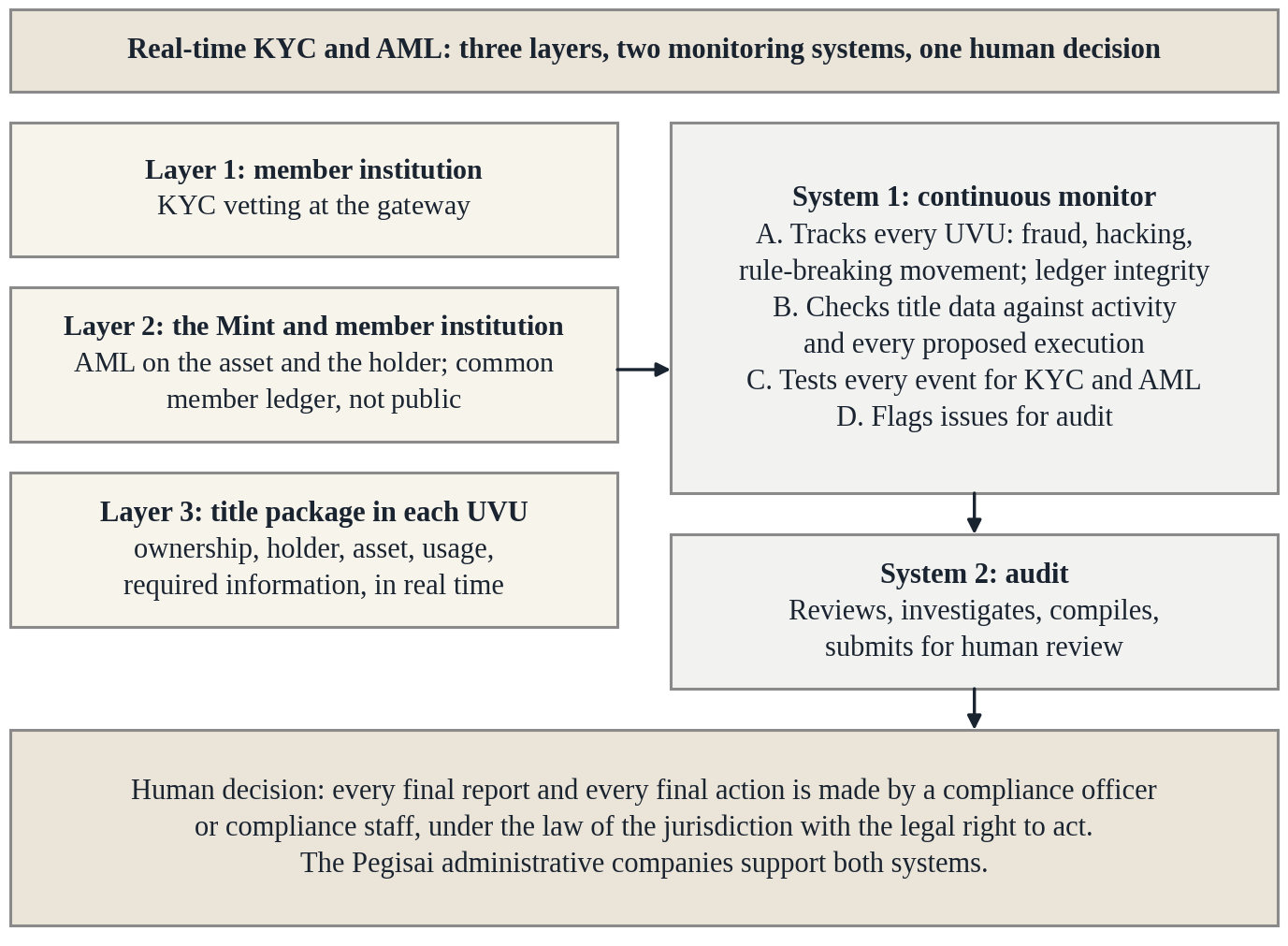
Two monitoring systems. The AI monitoring runs as two systems, and the AI monitoring is the “AI” in the Alkaimi name. System 1 monitors every event in real time, in four parts.
A. System 1 tracks every UVU in the system to prevent fraud, hacking and any movement that breaks the rules of the Alkaimi ledger, and to hold the ledger's stability, surety and integrity.
B. System 1 checks that the data in each title package matches the activity tracked under part A and every activity proposed for execution, so every proposed movement passes one more gate before the movement executes.
C. System 1 tests every event against the know-your-customer and anti-money-laundering requirements set out in the table below.
D. System 1 flags every issue for audit.
System 2 is the audit system. System 2 reviews each flagged issue, investigates the issue, compiles the data and submits the case for human review. Every final report and every final action is made by a compliance officer or compliance staff, under the rules and laws of the jurisdiction with the legal right and claim to act. The Pegisai administrative companies support both systems.
A person decides, not a machine. Under the European Union's Anti-Money Laundering Regulation, a decision resulting from an automated process or an AI system is allowed only with meaningful human intervention, and the customer may obtain an explanation of the decision and challenge the decision (Regulation (EU) 2024/1624, Article 76(5)). Under the General Data Protection Regulation, a person has the right not to be subject to a decision based solely on automated processing that produces legal effects concerning the person or similarly significantly affects the person (Regulation (EU) 2016/679, Article 22(1)). System 2 ends every case in a human decision, so no final report and no final action on the Alkaimi Ecosystem rests on automated processing alone.
The three-tier KYC and AML logic embedded in each DTA’s title package acts as a real-time audit that retains every entry and cannot be altered without trace.
The standards, met layer by layer. The table states each requirement from the standard that sets the requirement, and names the part of the Alkaimi Ecosystem that meets the requirement.
| Requirement | Standard | Where the Alkaimi Ecosystem meets the requirement |
|---|---|---|
| Customer due diligence | FATF Recommendation 10; Regulation (EU) 2024/1624, Chapter III; the Bank Secrecy Act (United States); the Money Laundering Regulations 2017 (United Kingdom) | Layer 1: the member institution vets every client at the walled garden gateway. Layer 2: the Mint reviews the asset at the creation of the DTA. |
| Record-keeping | FATF Recommendation 11; Regulation (EU) 2024/1624, Article 77 | Layer 2: the internal common member ledger holds both records. Layer 3: each title package retains ownership, holder, asset and usage in real time. |
| Politically exposed persons | FATF Recommendation 12 | Layer 1, under the member institution's own due diligence regime. |
| Correspondent relationships | FATF Recommendation 13; the Money Laundering Regulations 2017 (United Kingdom) | Every correspondent relationship on the platform runs under Recommendation 13, and no member may enter or continue a relationship with a shell bank (alkaimi.com, Regulatory position). |
| Payment transparency | FATF Recommendation 16, as revised in June 2025, implementation due by the end of 2030 | Layer 3: payer and payee are known accounts on one ledger, and the record travels inside the title package with the value. |
| Sanctions screening | FATF Recommendations 6 and 7; OFAC programs under the International Emergency Economic Powers Act (United States); the Council's sanctions regulations (European Union); the Sanctions and Anti-Money Laundering Act 2018 (United Kingdom) | Every holder is screened before admission, and every movement is screened again at the instant the movement is instructed (alkaimi.com, Sanctions). |
| Suspicious transaction reporting | FATF Recommendation 20 | System 1 flags the issue. System 2 investigates and compiles the case. The member institution's compliance officer reports to the authority of the member's own jurisdiction. |
| Decisions by automated means | Regulation (EU) 2024/1624, Article 76(5); Regulation (EU) 2016/679, Article 22 | System 2 ends every case in a human decision. |
Identity protection and lawful access. The Alkaimi Ecosystem protects the identity of every holder by design. The member institution is the controller of every client record on the Alkaimi ledger, and the Pegisai group is the processor, acting under the license (pegisai.com, The legal position of the platform). The administration's review works at the level of the UVU in contest, not the account, as an audit of the product. Review at the level of the item builds data minimization into the design, as the General Data Protection Regulation requires of a controller (Regulation (EU) 2016/679, Article 25).
No government, agency or institution obtains a holder's information without a lawful basis and lawful process. In the United States, a federal authority may obtain a customer's financial records from a financial institution only on the customer's authorization, an administrative subpoena or summons, a search warrant, a judicial subpoena or a formal written request (Right to Financial Privacy Act of 1978, 12 U.S.C. 3402). In the European Union, a judgment of a foreign court or a decision of a foreign authority requiring disclosure of personal data is recognized or enforceable only if based on an international agreement, such as a mutual legal assistance treaty (Regulation (EU) 2016/679, Article 48). A request reaches a holder's information only through the member institution, the controller, under the law of the member's own jurisdiction.
The FATF has found that information sharing among private institutions can be conducted in compliance with data protection and privacy rules, subject to key tests (FATF, Partnering in the Fight Against Financial Crime: Data Protection, Technology and Private Sector Information Sharing, July 2022). The internal common member ledger is built as information sharing of that kind.
The audit trail enforces itself. A DTA issuing holder that fails the holder's asset maintenance requirements, or engages in nefarious conduct, has every DTA the holder issued and still holds frozen, and every DTA the holder holds from other sources liquidated to cover the holder's outstanding obligations. The penalties are activated by the rules and not by politics (pegisai.com, Part 2). The Pegisai group companies audit, administer, fact check and certify the ledger, and ensure that proper underwriting and asset maintenance are maintained on every stack (pegisai.com, Part 2). The feedstock from which every DTA is created therefore keeps auditable and unencumbered provenance for as long as the DTA exists.
Disputes. Each stage of the system runs under the system's agreements, and every agreement carries a separate arbitration clause. The agreement created with the value governs matters of the recognized value, and the licensing agreements govern matters of the ecosystem. A dispute is resolved under the clause of the agreement that governs the stage at which the dispute arises. The Pegisai administrative companies act as arbitrator within the system only in extremis, as those agreements provide.
For the Chief Compliance Officer: “Algorithmic Basel III+ compliance checks run on every underlying asset before a DTA exists, and every DTA is posted as Level 1 HQLA on Pegisai's published position.”
Counterargument. Compliance is the supervisor's judgment, not the platform's.
Answer. The platform supplies the record in real time; the supervisor makes the judgment. The Level 1 classification of the DTA and the central bank's acceptance of the DTA as collateral follow each supervisor's and each central bank's existing rules, and a supervisor may ask for reporting (pegisai.com, Ecosystem).
Counterargument. A real-time, AI-monitored system exposes every holder's identity to the administrator and to any government that asks.
Answer. The design runs the other way. The member institution holds the identity as controller. The administration reviews the item in contest, not the account. Every disclosure requires a lawful basis and lawful process in the jurisdiction with the legal right to ask (12 U.S.C. 3402; Regulation (EU) 2016/679, Article 48).
2.2 The Level 1 HQLA Standard
A member institution posts the DTA as a Level 1 high-quality liquid asset on Pegisai's published position, and the feedstock from which every DTA is created, gold, energy or other, is verified before the DTA exists.
What Level 1 means. The Basel test of a high-quality liquid asset is that the asset's liquidity-generating capacity, by way of sale or repo, remains intact even in periods of severe idiosyncratic and market stress (Basel Framework, LCR30.3). Level 1 assets hold the top standing in the stock of high-quality liquid assets and enter the stock without limit and without a haircut. The Level 1 list is closed: coins and banknotes; central bank reserves, to the extent the central bank allows the reserves to be drawn down in times of stress; and qualifying marketable securities issued or guaranteed by sovereigns, central banks and certain public bodies (Basel Framework, LCR30.40 and LCR30.41). Central bank eligibility is the ideal for every high-quality liquid asset, and central bank eligibility alone does not make an asset high quality (Basel Framework, LCR30.4 and LCR30.5).
The published position. A member institution posts a DTA as a Level 1 high-quality liquid asset under Basel III+ without a discount (pegisai.com, Ecosystem). A DTA exceeds central bank money on the asset standard and on liquidity: value that no one owes, where central bank money is the central bank's liability (pegisai.com, Platform). The Level 1 classification of the DTA and the central bank's acceptance of the DTA as collateral follow each supervisor's and each central bank's existing rules (pegisai.com, Ecosystem), and the central bank's acceptance of the pledge is an approval in process (pegisai.com, The platform in depth). Level 1 standing attaches to the DTA on a member institution’s books; the feedstock is what Alkaimi's value recognition method and the underwriting verify. Level 1 standing in a bank's stock of high-quality liquid assets applies to the DTAs the member institution holds unencumbered: a DTA pledged against a currency line the member institution has drawn leaves the stock for as long as the line is drawn, as any Level 1 asset would (Basel Framework, LCR30.16).
The two currency exits. A DTA reaches currency by the two routes the Basel test names. The first is the sale route: transmutation at the member institution’s desk, on the holder's instruction, where the holder gives up the DTA and takes currency (pegisai.com, The Model). The second is the repo route: the member institution pledges the DTA to the central bank, the DTA stays whole, and the central bank advances currency below the value pledged (pegisai.com, The Model and Part 4). Neither route waits for a buyer, so neither route meets the fire-sale discount the Basel test is built to catch (Basel Framework, LCR30.3).
The figure in the ratio. A member institution reports the stock of high-quality liquid assets in currency, at fair value on the calculation date. In the United States, the Level 1 amount is the fair value of the Level 1 assets the bank holds as of the calculation date (12 C.F.R. 249.21(b)(1)). Fair value is the exit price: the price that would be received to sell an asset in an orderly transaction between market participants at the measurement date (IFRS 13, paragraph 9; ASC 820). A DTA's exit price is the reading under the Alkaimi Transmutation Standard (ATS) at the member institution’s desk on the calculation date. Under the ATS, a member institution converts value to currency at the member institution's desk, in real time, at a reading rather than a bid (pegisai.com, About). The ATS computes the reading from named public data at the instant of the desk event: the published reference rates and the published measures of purchasing power of the currency concerned. The weights and the construction of the calculation are proprietary. The reading is the same at every licensed desk at the same instant, with no bid and no spread. Every reading is recorded on the Alkaimi ledger with the reading's inputs and time, inside the audit trail set out in item 2.1, so a supervisor or an auditor can recompute the figure. The reading holds the recognized value whole and moves with the currency: over 1,953 days the dollar lost 27.86 percent of purchasing power on the United States government's own index, and a DTA holding lost 0.00 (pegisai.com, Platform). A stress that weakens the reporting currency therefore raises a DTA's figure in the ratio. The pledge route is a monetization channel, not a valuation basis: the central bank's advance sits below the value pledged, as a repo haircut does. The fair value hierarchy level of the reading is each member institution’s auditor's determination, and acceptance of the figure is each supervisor's.
A third route, outside the ratio. A holder may transmute a DTA at the desk into any recognized asset class and take delivery of an asset of that class (pegisai.com, The Model). The route is the DTA's drawing right on recognized value, not a currency exit: any later sale of that asset takes place in the asset's own market, outside the Alkaimi Ecosystem, on that market's terms. A member institution therefore counts the route as no monetization channel in the liquidity coverage ratio. The route anchors the recognized value instead, because the underwriter warrants the existence, title, quantity and recoverability of the asset from which the DTA was created at the floor at which the value was recognized (pegisai.com, Underwriting on the platform, in depth).
The tests, criterion by criterion. The table sets each Basel criterion for a high-quality liquid asset against the DTA's design. Where a criterion is not met by design, the table says so and gives the answer.
| Criterion | Reference | How the DTA's design meets the criterion | Status |
|---|---|---|---|
| Liquidity by sale or repo, intact in stress | LCR30.3 | Both routes the test names exist without a market: transmutation at the desk, the sale route, and the pledge at the central bank, the repo route. Neither route waits for a buyer. | Met by design |
| Low risk | LCR30.6 | The DTA is no one's obligation, so no issuer's credit standing or subordination applies. Every DTA is underwritten, carries a surety and carries a drawing right on recognized value into any recognized asset class. The DTA is priced in no currency and reaches any currency at the desk. | Met by design |
| Ease and certainty of valuation | LCR30.7 | The recognized value is fixed at creation, warranted by the underwriter and transmutable at the desk into a recognized asset class. The figure in the ratio is the ATS reading, computed from named public data and recorded on the Alkaimi ledger with the reading's inputs and time. | Met by design; the fair value level is the auditor's |
| Low correlation with risky assets | LCR30.8; LCR30.41(3) | The DTA is no obligation of any financial institution, the condition the Level 1 list applies to marketable securities. | Met by design |
| Listed on a developed and recognized exchange | LCR30.9 | No DTA is listed, quoted or traded on any exchange, by design. The transparency a listing supplies comes from the Alkaimi ledger's audited record of every movement (item 2.1). | Not met, by design; answered |
| Active and sizable market | LCR30.10 | No market exists, by design. Liquidity comes through the two currency exits, as central bank reserves hold Level 1 standing without a market (LCR30.41). | Not met, by design; answered |
| Low volatility | LCR30.11 | The recognized value never moves. Over 1,953 days a DTA holding lost 0.00 while the dollar lost 27.86 percent of purchasing power. | Met |
| Flight to quality | LCR30.12 | The route in is Alkaimi's value recognition method, applied to asset owners' own assets. A flight would show as the volume of assets brought for Alkaimi's value recognition method, not as price, bounded by the assets brought and by underwriting capacity, and metered by the members. | Permitted by design; not yet evidenced |
| Central bank eligibility | LCR30.4; LCR30.5 | The central bank's acceptance of the pledge is an approval in process. Eligibility alone is not the basis for Level 1 standing. | In process |
| Unencumbered | LCR30.16 | Prior liens are cleared at issuance, so the asset comes onto the Alkaimi ledger unencumbered. A DTA pledged against a drawn currency line leaves the stock while the line is drawn. | Met at creation |
| Monetization within the standard settlement period | LCR30.17 | Settlement is final when the DTA moves, and transmutation at the desk takes place in real time. | Met by design |
| Control by the liquidity function; periodic monetization | LCR30.15; LCR30.18 | The bank's treasury holds the bank's own DTAs in the bank's own DTA holding account and can monetize through either currency exit in the normal course of business. | Each member institution’s operational fact |
The status column states how the DTA's design meets each criterion. The determination is each supervisor's under that jurisdiction's rules, and the statements are Pegisai Global Holdings' own, made by no authority.
The custodial parameters. The feedstock is verified before any DTA exists. Alkaimi's value recognition method segments and segregates the asset and clears prior liens at issuance, as set out in the Overview, item 3, so the asset comes onto the Alkaimi ledger unencumbered or the asset stays off the Alkaimi ledger (pegisai.com, Part 2). The underwriter's signature warrants the existence, title, quantity and recoverability of the asset at the floor at which the value was recognized, and warrants no price, no rate, no currency and no counterparty, because the recognized value never moves (pegisai.com, Underwriting on the platform, in depth). Each DTA stack is segregated from every other stack in risk and in lien (pegisai.com, Platform).
The security parameters. Each UVU's title package is encoded, carries security features, and is AI monitored in real time (item 2.1). Some aspects of the construction of the DTA and the UVU are proprietary and are not released in this publication.
Gold as the reference case. The Basel framework has long allowed, at national discretion, gold bullion held in a bank's own vaults or on an allocated basis, to the extent backed by bullion liabilities, to be treated as cash and risk-weighted at 0 percent (Norton Rose Fulbright, The Basel Framework and regulatory status of gold, 2025; SAMA Rulebook, section 4.1.10). The treatment belongs to the credit risk framework; gold is not on the liquidity coverage ratio's Level 1 list.
A standing set by convention. The Basel framework assigns a sovereign's own-currency bonds a zero risk weight by convention rather than by analysis, and the AGSI™ performs the analysis the convention omits (pegisai.com, The ACVI™ and the AGSI explained). A sovereign bond is the nation's promise. A DTA is value no one owes.
Counterargument. The Basel Level 1 list names no DTA.
Answer. The Level 1 classification of the DTA rests with each member institution’s supervisor and each central bank under existing rules. Where this publication states that the DTA meets a published standard, the statement is Pegisai Global Holdings' own and is made by no authority (pegisai.com).
Counterargument. An asset with no market cannot be a high-quality liquid asset.
Answer. Central bank reserves hold Level 1 standing without trading in any market (Basel Framework, LCR30.41). The DTA's liquidity rests likewise on final settlement and on the two currency exits the Basel test names: transmutation at the desk, the sale route, and the pledge at the central bank, the repo route.
2.3 Risk Isolation
The DTA exists only inside a closed, walled garden banking environment, so value cannot leave unmonitored, value does not swing with a market, a failure stays with the party that fails, and the DTA sits outside the Basel cryptoasset standard.
A closed banking environment. The walled garden defined in the Overview, item 6, is a closed banking environment: the only thing that moves inside the walled garden is the DTA, every client enters through a member institution’s gateway, and currency is met only at a member institution’s desk (pegisai.com, Ecosystem).
No unmonitored value flight. Value leaves the Alkaimi ledger at one point only: a member institution’s desk. A holder who wants currency for value asks a member institution. The holder's DTA moves into the member institution’s ledger account, segmented for transmutation, and the member institution’s ring operations pay the holder in the chosen currency, outside the wall (pegisai.com, Part 4). Every holder entered through a member institution's know-your-customer gate, and every movement is recorded in the title package (item 2.1). A sanction attaches to a person or an entity, and the member institution honors a lawful sanction against the holder under the member institution’s own regulator (The Alkaimi Financial Ecosystem in Function, Section 10.15). The desk is the member institution’s own currency operation, regulated as the member institution's currency operations are regulated today, outside the walled garden (pegisai.com, The Model). The nation's exchange and reporting rules therefore apply at the desk.
No market volatility. The recognized value inside a DTA is fixed in UVUs, and no DTA is listed, quoted or traded on any exchange or open market (pegisai.com, Ecosystem). A reading of a DTA in a currency moves nothing on the Alkaimi ledger (pegisai.com, Part 4). The figure a supervisor reads in a reporting currency moves with that currency, not with the DTA, and a weaker reporting currency raises the DTA's figure (item 2.2). Over 1,953 days of Alkaimi's reported testing and validation periods, the dollar lost 27.86 percent of purchasing power on the United States government's own index, and a DTA holding lost 0.00 (pegisai.com, Platform).
Outside the cryptoasset standard. The Basel cryptoasset chapter, SCO60, in force from 1 January 2026, defines cryptoassets as private digital assets that depend on cryptography and distributed ledger technologies or similar technologies (Basel Framework, SCO60.1). Both limbs of the definition tie the technology to the ledger on which ownership is recorded and transferred. For tokenized traditional assets, the chapter names the technology used to record ownership (Basel Framework, SCO60). A DTA's ownership is recorded and changed only on the Alkaimi ledger, which Pegisai Global Holdings administers centrally under bank supervision, with no distributed ledger and no blockchain (The Alkaimi Financial Ecosystem in Function, Section 10.15). The encoding in a UVU's title package protects the documents the package holds, including the title registration, the drawing right and the surety, as every bank protects the bank's own records (item 2.2). Document security does not make ownership of a DTA depend on cryptography. The chapter's scope note draws the same line at the ledger: dematerialized securities issued through distributed ledger or similar technologies are in scope, and dematerialized securities kept on electronic versions of traditional registers and databases, centrally administered, are out of scope (Basel Framework, SCO60). The European Union's crypto-asset turns on the same ledger limb: a value transferred and stored electronically using distributed ledger technology or similar technology (Regulation (EU) 2023/1114, Article 3(1)(5)). The terms are fixed in The Alkaimi Ecosystem's position on terms.
The FATF position. The FATF definition of a virtual asset turns on use, not technology (pegisai.com, The legal position of the DTA). A virtual asset is a digital representation of value that can be digitally traded or transferred and used for payment or investment purposes, and the definition excludes digital representations of fiat currencies, securities and other financial assets already covered elsewhere in the FATF Recommendations (FATF Glossary). The DTA is not a speculative item, and the record answers the asset test on two grounds (The Alkaimi Financial Ecosystem in Function, Section 10.15). First, the DTA is not a representation of value held elsewhere: the DTA is a bearer instrument holding whole recognized value. Second, the DTA is used as a payment and settlement item only inside the banking space, under the financial institution regime, by member institutions already covered under that regime. The service-provider test gives the same answer. Every DTA is held and moved by a member institution, an obliged institution under FATF Recommendations 10 to 21 as implemented in the member institution's own jurisdiction, so no virtual asset service provider question arises (pegisai.com, The legal position of the DTA). One FATF duty stays with each member institution: Recommendation 15 requires a financial institution to assess the money laundering and terrorist financing risks of a new product or a new technology before launch (FATF Recommendation 15).
A failure stays with the party that fails. Failure is contained at two levels: by item, through the DTA stack and the parties behind the stack, and by system, through the member institutions and the administration.
By item. Each DTA stack is segregated from every other stack in risk and in lien (pegisai.com, Platform), and nothing is pooled (pegisai.com, The legal position of the DTA). A DTA issuer's default is liquidated on the Alkaimi ledger, in days, against a defined estate. The DTAs the issuer took in payment are seized and applied to the holders, the issuer's unused issuance is frozen, and the drawing right on the asset passes to the underwriter, as the surety's recourse. The holders rank first: the holders are paid from the seized DTAs, then by the underwriter as surety, to the full issued value (pegisai.com, Underwriting on the platform). Nothing owed by the issuer reaches the value a holder holds (pegisai.com, The legal position of the DTA).
The underwriting contract is suretyship, a non-life class any authorized insurer may write (Directive 2009/138/EC, Annex I, classes 14 and 15). A surety that pays is subrogated to the rights of the party paid, to the extent of payment, and the underwriter's recourse is the drawing right on the recognized asset (pegisai.com, The legal position of the DTA). The liquidation regime is contract, under a chosen law and an arbitral forum. Arbitral awards are enforceable under the 1958 New York Convention, and a state's commercial acts carry no immunity from suit (28 U.S.C. 1605(a)(2); State Immunity Act 1978, section 3). A rented DTA cannot be defaulted: a renter's failure is the renter's default, liquidated on the ledger, and recourse runs against the renter, never the holder (pegisai.com, The legal position of the DTA).
By system. A member institution holds client DTAs in custody, off the member institution's balance sheet, outside the member institution's estate (pegisai.com, The legal position of the DTA). In the European Union, a resolution authority may not write down or convert any liability that arises from a bank's holding of client assets, where the client is protected under the applicable insolvency law (Directive 2014/59/EU, Article 44(2)(c)). In United States receivership practice, assets a failed bank holds in custody do not become part of the failed bank's estate, and the assets are returned to the owner or transferred at the owner's direction, where the bank held the assets apart from the bank's general assets (Seward & Kissel, 2023; White & Case, 2023). The Alkaimi ledger holds every DTA in the client's own DTA holding account (pegisai.com, Platform), so the separation the law requires exists by design.
Pegisai Global Holdings holds no client value and executes no client settlements (Pegisai Global Holdings, 30 September and 1 October 2026), so a failure of the administration places no holder's DTA in the administrator's estate. Settlement on the Alkaimi ledger leaves no claim between the paying bank and the receiving bank (item 1.2), so a member's failure leaves no unsettled settlement claim on any other member through which the failure could spread.
The tests, criterion by criterion.
| Test | Source | The DTA's position | Result |
|---|---|---|---|
| Cryptoasset: dependence on cryptography for ownership and transfer | Basel Framework, SCO60.1 | Ownership is recorded on one centrally administered ledger; the encoding protects documents | Not met, by design |
| Cryptoasset: distributed ledger or similar technology | Basel Framework, SCO60.1 and the scope note | One ledger, centrally administered, under bank supervision; no distributed ledger, no blockchain | Not met, by design |
| Crypto-asset | Regulation (EU) 2023/1114, Article 3(1)(5) | No distributed ledger or similar technology | Not met, by design |
| Virtual asset | FATF Glossary | Not a speculative item; not a representation of value held elsewhere; held and moved only inside the banking space by covered member institutions | Answered; classification rests with each supervisor |
| Virtual asset service provider | FATF Glossary; Recommendations 10 to 21 | Only member institutions, obliged institutions, hold or move a DTA | No service provider question arises |
| Risk assessment of a new technology before launch | FATF Recommendation 15 | A duty of each member institution | The member institution’s obligation |
| One exit for value | pegisai.com, The Model and Part 4 | Value leaves the Alkaimi ledger only at a member institution’s desk | Met by design |
| Customer due diligence and monitoring of every movement | Item 2.1 | Every holder vetted at the gateway; every movement recorded in the title package | Met by design |
| Sanctions | The Alkaimi Financial Ecosystem in Function, Section 10.15 | The member institution honors a lawful sanction against the holder | Met by design |
| Exchange and reporting rules | The nation's own law | The desk is a regulated currency operation | Applies at the desk |
| Market volatility | pegisai.com, Ecosystem and Platform | Value fixed in UVUs; no listing, quote or trade; the currency reading moves with the currency | Met by design |
| Issuer default | Directive 2009/138/EC, Annex I; the 1958 New York Convention | Liquidation on the ledger in days; holders rank first; the surety pays to the full issued value | Contained by contract and surety law |
| Member institution failure | Directive 2014/59/EU, Article 44(2)(c); United States receivership practice | Client DTAs in custody, off the balance sheet, outside the bank's estate | Contained by custody and resolution law |
Counterargument. A supervisor will read any digitized settlement item as a cryptoasset.
Answer. The cryptoasset tests turn on the ledger that records ownership and on public trading, not on whether a record is digital. The DTA meets neither test: ownership is recorded on one centrally administered ledger under bank supervision, with no distributed ledger, and no DTA is traded on any market. The terms are fixed in The Alkaimi Ecosystem's position on terms. In each jurisdiction the classification rests with the member institution’s supervisor under that jurisdiction's law, confirmed by the member institution’s counsel (pegisai.com, The legal position of the DTA).