Building a global recognized asset platform.
The twenty seats are building a global recognized asset platform: the Alkaimi™ ledger, on which the recognized value of national assets and large-block asset holdings is held in client DTA™ holding accounts and settled account to account, one segmented and segregated stack at a time. What the platform holds is the recognized asset reserve of DTAs, and the holders own that reserve. The goal of the platform is to rationally recognize nearly 4 quadrillion dollars equivalent of the world's viable tangible assets. The platform will use this ample and adequate in ground asset reserve, over a period of time, to create DTAs sufficient to absorb a majority of the world's broad money of about 130 trillion dollar equivalent. That amount should be sufficient to rationally restore the purchasing power of currencies while transitioning the power of currency back to national governments.
Global debt of every kind currently stands at about 348 trillion dollars.
Absorbing the broad money would leave approximately 218 trillion dollars of that debt outstanding. That debt remains a market for the parties that still borrow. Operating companies still borrow to build and to trade. Households still borrow. Investors who want a return on debt still buy the paper of borrowers they trust. Governments with DTAs in their treasuries do not need to issue bonds, because their treasuries are liquid.
For scaled reference, all the gold ever mined is valued at approximately 12.2 trillion dollars. The platform's goal is to restore asset bases to currency and to government treasuries, while restoring wealth to all asset holders who are burdened by the ever-shifting measure of debased currencies. The currency absorption is a cycle that must be decoupled from the new money deflation process.
The currency absorption cycle runs on the platform.
Recognized value goes onto the Alkaimi ledger as DTAs, and the asset stays where the asset is. National treasuries hold those DTAs in their client DTA holding accounts. The treasuries settle wholesale obligations in DTAs, take pressure off their own currencies, and reduce their foreign exchange exposure. The pace is controlled by design, so that no currency is destabilized while the platform fills.
The new money deflation process is slightly more complicated, but aided by the efficiency of using DTAs in the new loan funding process. First, it must be recognized that new money has expanded the total money supply, with actual currency being a smaller portion of the total M1 and M2 supply. What must be incentivized is for fractional reserve banks to cancel claims against the retail banks as they move to become more solvent in competition against Alkaimi licensed consumer banking operations.
The incentive is economic.
A DTA is a cheaper source of collateral, so a central bank loan secured by rented DTAs costs the retail bank less than any deposit the bank could gather. A rented DTA places no liability on the retail bank's books beyond the rent agreement itself: no claim runs against the bank, because the claim runs against the newly created debt, which the central bank loan funded. A central bank tied retail bank reaches that collateral through a correspondent relationship with an Alkaimi licensed regional retail bank, in joint venture, at the consumer level.
The retail bank's revenue model changes with the move: the bank splits the profit on each book with the DTA owners and the licensee, and the bank earns on managing debt accounts, managing currency accounts, and currency exchange. A loan funded that way creates no deposit, and the retail bank's old deposits cancel as the retail bank's old loans repay, so the retail bank moves from the fractional reserve model to the 100% Whole Reserve™ model on the bank's own timetable, because the move pays while the move reduces liabilities.
The remaining 218 trillion dollars of existing debt retires over a period of time. Each loan and each bond retires on the loan's or the bond's own terms, and the new money behind each retiring debt is absorbed as the debt retires. No debt is cancelled by fiat and no creditor is written down by the platform.
As the new money runs off and the purchasing power of currencies is restored, a government issues new currency, through the government's central bank, when the government judges’ new currency is needed. A national currency becomes the predominant item within the nation that issues that currency. Settlement between nations moves to DTAs, because a DTA settles finally, with no counterparty risk and no exchange loss, and the treasuries prefer the efficient instrument. Where a consumer needs foreign exchange, value moves around the ring at the consumer level, through the licensee, and the consumer receives the currency the consumer chose.
The absorption is a cycle, run at a controlled pace so that no economy is damaged. As the DTA value recognition reserve fills, the whole-reserve position of the world re-emerges. Nations using DTAs restore their liquid and near-liquid treasury holdings to a level sufficient to tangibly back their paper currency issuances, a position stated below. Bank new money gets deflated, slowly, and central banks and central bank tied retail banks reduce their liabilities. In all aspects promises to pay are replaced by whole-settlement in value, and the balance of value is restored to the asset holder. Substance is restored to the world's economy and exchange systems.
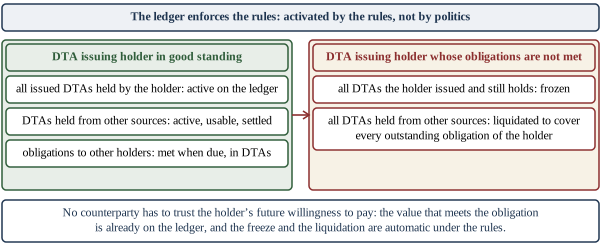
Figure 13. The recognized asset reserve of DTAs at both lines, beside the figures the market accepts. Sources: the Alkaimi record; Institute of International Finance global debt; World Gold Council; central bank aggregates.
Alkaimi’s stance on currency: detailed. By law, the issuance of currency and money is a national security issue.
Alkaimi's position on currency and currency issuance is easy to understand. By law, and by authority, the issuance of currency is a national (sovereign) right, power, and authority. Also, currency is a national security issue. In our designer's opinion the private issuance of any monetary item, in this case fractional reserve created "new money" as defined in part 1, is detrimental to national stability, undermines the sanctity and stability of individual citizens, and erodes consumer confidence due to currency debasing conduct.
Alkaimi's team diligently applied technology to existing law and regulations while reviewing globally accepted rules on value, settlement, asset certification, and rules testing measures, to design a rational system that provides a reasonable pathway to restore intrinsic value back into the world's exchange and trade matrices. The fractional reserve system is obviously flawed, outdated, antiquated, and abhorrently punitive when considered against the option of regulated use of tangible value to stabilize the global settlement and currency systems.
Our statement legally defined:
The power of a currency comes from law, and the right to issue a currency belongs to the national sovereign alone, exercised by the treasury or delegated to the central bank and revocable by the state. A bank's deposits, which are claims against the bank and are new money; cryptocurrencies; and stablecoins circulate solely at the sovereign's tolerance and carry none of the sovereign's power. Yet the sovereign and its citizens pay an irrationally heavy toll for that sovereign tolerance.
Pegisai issues no currency, licenses no currency and prices nothing in any currency.
A currency never enters the walled garden. A currency meets recognized value at only one point, the licensed ring of regulated banks. This is where the lawful transmutation of lawfully retained value is moved into a demanded currency as a normal exchange desk process. The Alkaimi walled garden is not a proposal. These operations are already lawful and already operating under existing law, through licensed banks operating in multiple countries since 1 September 2026. See also Alkaimi Ecosystem, Current Operations.
A national treasury's DTAs stand beside the state's currency, not behind the currency.
The DTAs take over the work of holding and settling value, the demand for currency in that work falls, and the currency's purchasing power is restored by that displacement. The state's currency remains the state's, issued by the state alone, and no DTA is pledged to redeem a note.
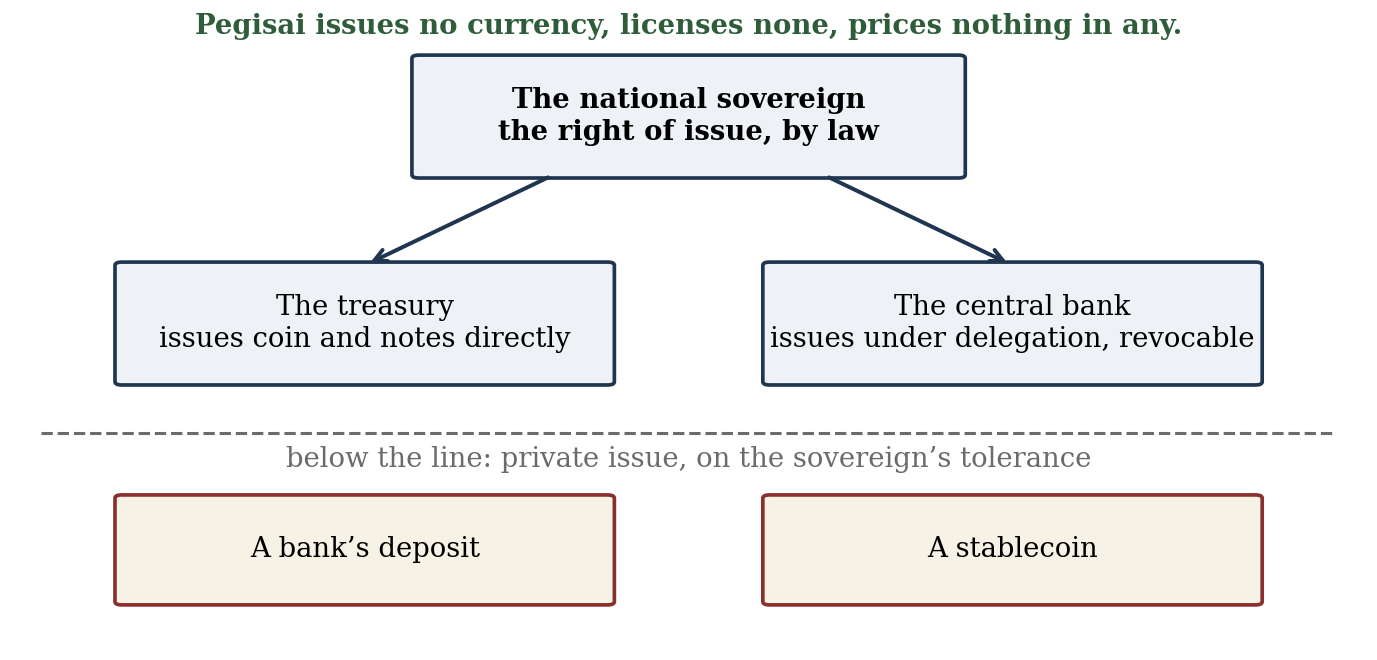
Figure 14. The right of issue.
Part 3 sources
1. The Alkaimi record: the four-quadrillion estimate of assets viable for use and the 120 trillion dollar bottom line.
2. Institute of International Finance, Global Debt Monitor: global debt of every kind, about 348 trillion dollars; pinned to the dated release before publication.
3. Central bank aggregates for global broad money, about 130 trillion dollars: Federal Reserve H.6, European Central Bank, Bank of Japan, Bank of England, People’s Bank of China; pinned by series and date before publication.
4. World Gold Council: all the gold ever mined, about 12.2 trillion dollars; pinned to the release and the price date before publication.
5. Basel Committee on Banking Supervision, SCO60 Cryptoasset exposures, in force 1 January 2026; GENIUS Act, United States, July 2025.
6. Federal Reserve Statistical Release H.15, primary credit rate, 2 September 2026.
7. United States Treasury, U.S. International Reserve Position, 28 August 2026; LBMA Gold Price PM, 1 September 2026.
8. Federal Reserve Act, section 16; 12 U.S.C. section 411; the Constitution of the United States, Article I, sections 8 and 10.
The nation gains a holding that is not a promise
A nation that brings recognizable national assets onto the Alkaimi ledger holds DTAs in the national treasury’s client DTA holding account at a licensee: held in custody off the licensee’s balance sheet, Level 1 high-quality liquid assets on the treasury’s own books, liquid on any day, not sold and not pledged. From that account the treasury has globally recognized liquidity. The treasury can settle wholesale obligations directly in DTAs, with no currency in the settlement; the treasury can use those DTAs to take pressure off the state’s own currency; and the treasury can make currency exchanges and asset movements that reduce the state’s foreign exchange exposure. The treasury does this, not the central bank, and without a government or presidential approval for each act. A nation with DTAs in the nation’s treasury does not need to issue bonds, because the treasury is liquid, and a nation whose central bank holds the state’s own debt has DTAs to set against that debt. The treasury’s DTAs stand beside the state’s currency, not behind the currency, as stated in Alkaimi’s stance on currency in part 2, and over time the currency’s purchasing power rises and the cost-of-living falls. As the wholesale settlement ledger expands, the treasuries gain the better pathway to asset acceptance and recognition, and the central bank’s role narrows to the currency.
The same rules that give the treasury liquidity bind the treasury. A nation that breaks the ledger’s rules has the DTAs the nation issued and still holds frozen, and the DTAs the nation holds from other sources liquidated to cover the nation’s outstanding obligations, and that rule, applied to every nation alike, is what makes the ledger neutral and the treasury’s DTAs safe from any other nation’s politics
| The Treasury’s official reserve assets, 28 August 2026 | The treasury’s DTAs | |
|---|---|---|
| Foreign currency securities, 19.5 billion dollars | debt notes of the euro area states and Japan | none held; nothing needed |
| Deposits at foreign central banks, BIS, IMF, 18.8 billion | balances on those institutions’ books, their promises | none held; nothing needed |
| IMF reserve position, 31.7 billion | the paid-in quota, drawable on demand from the Fund | none held; nothing needed |
| Special drawing rights, 172.7 billion | an allocation exchangeable for other states’ currencies | none held; nothing needed |
| Gold, 11.0 billion at statute, 1,138.3 billion at 1 September 2026 | the only asset on the line; vaulted; priced in dollars | the DTAs: recognized national assets, recognized once, liquid on any day, no price |
| Obligor | other states, the Fund, or none (gold) | none |
| Can be frozen by | the issuing state, the Fund | no one |
| Settles | by transfer of another state’s promise | account to account, final |
Table 3. The Treasury’s official reserve assets of 28 August 2026 beside the treasury’s DTAs. Sources: United States Treasury; LBMA Gold Price PM, 1 September 2026.
Retail banking: The availability of more efficient and cost-effective collateral
For retail banks, a DTA is the more efficient collateral, and the more efficient collateral is what brings currency, not new money, into the ring. A central bank loan secured by rented DTAs costs a licensed bank 3.75 percent at the primary credit rate of 2 September 2026, against 4.15 percent all-in for a gathered deposit, and the rented DTA places no liability on the bank’s books beyond the rent agreement, because the claim runs against the newly funded debt and not against the bank.
On that collateral the Alkaimi licensed regional retail banks can develop consumer products: loans funded first from rented DTAs and written second, savings held as value on the Alkaimi ledger, payments settled in value, and currency exchange at the desk. Every one of those products meets the consumer in currency. A paycheck arrives as currency. A receipt arrives as currency. A loan is paid out in currency.
So, the consumer products bring currency into the ring, where the licensee’s ring operations hold that currency, pay out that currency, and, on the consumer’s instruction, transmute that currency into value on the ledger or value back into currency. Nothing in that path creates money.
The retail bank’s liabilities become the currency the bank holds and the earned deposits customers bring, and the new money the bank once created runs off with the old book. That is the deflation of new money at the retail level, and the currency that replaces the new money is the state’s own, restored in purchasing power as the platform absorbs the broad money.
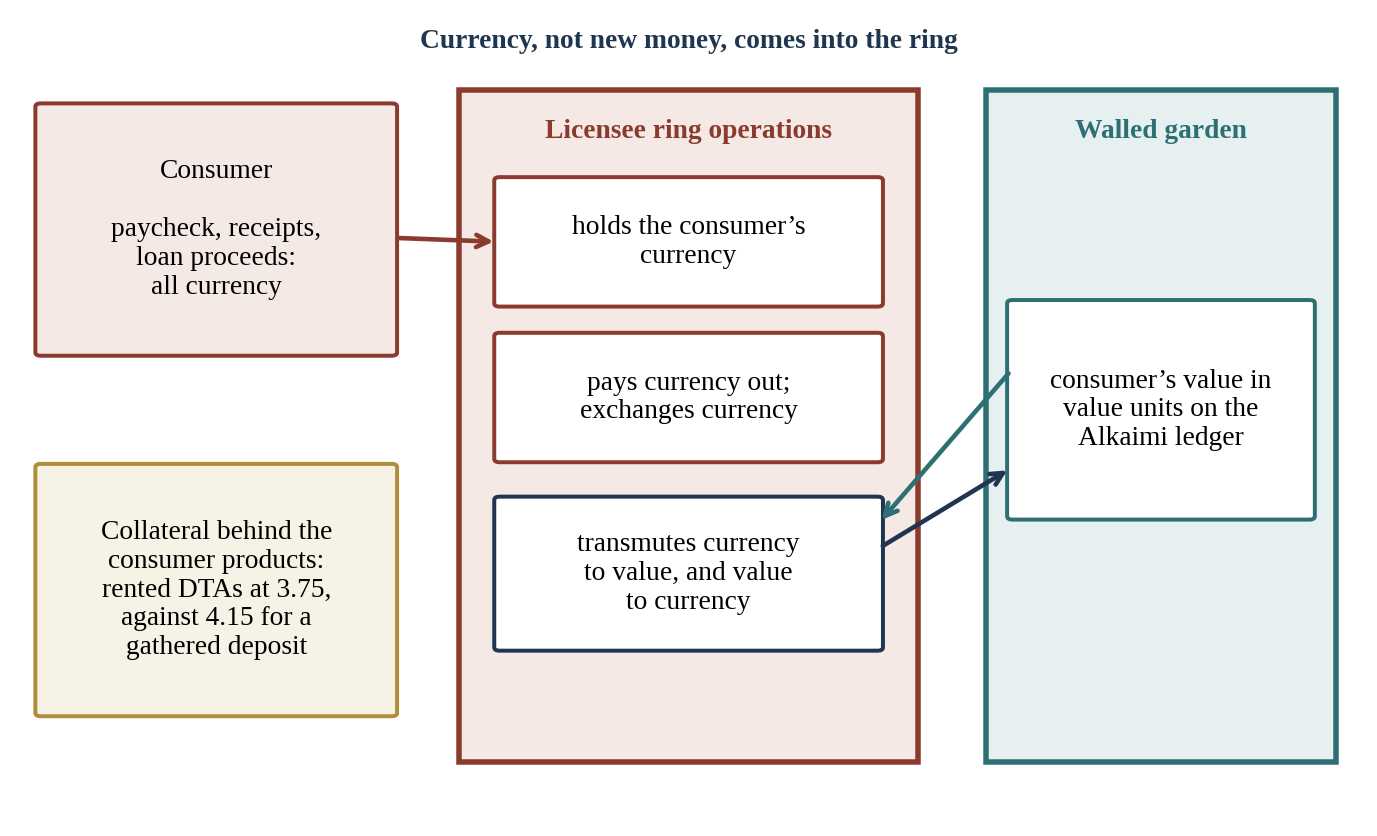
Figure 20. Currency, not new money, comes into the ring: the consumer’s currency, the licensee’s ring operations, and the consumer’s value on the Alkaimi ledger. Sources: Federal Reserve H.15, 2 September 2026; stated assumptions for the deposit cost.
This page contains some forward-looking statements. Read Pegisai’s statement on forward-looking statements.