Substance returns to settlement
Alkaimi™ establishes absolute value, payment and settlement through recognized, segmented and segregated assets, the Digitized Tangible Asset™, on a global network of regulated institutions. A DTA is settlement once moved, value locked and currency neutral. Every other statement in this part derives from that one, and every-one is recorded. Part 1 ended with the United States holding 2.84 percent of the United States’ debt in the one line of the Treasury’s official reserve assets that is not a claim. What follows is the asset that is not a claim.
A DTA is value, not a claim
A Digitized Tangible Asset contains the recognized value of a segmented, segregated asset, counted once at creation and stated in value units, owned outright by the holder and custodial held, by Alkaimi Financial Ecosystem members only, as property, as a digitized bearer instrument, on the Alkaimi Financial Ecosystem ledger. The DTA is custodial held, by Alkaimi Financial Ecosystem members only, as property, as a digitized bearer instrument, on the Alkaimi Financial Ecosystem ledger: the holder of the DTA on the Alkaimi ledger owns the value the DTA contains, and the value does not rest on a promise from any bank, state or company, because the holder holds the value itself. The asset behind the DTA never moves, and nothing is lent against the DTA. Settlement on the Alkaimi ledger is a DTA moving from one client DTA holding account to another, final when the DTA moves.
| DTA | Note | Deposit | Central bank balance | Gold | Sovereign bond | |
|---|---|---|---|---|---|---|
| Obligor | none; held as property | the state, in form | one bank | the central bank | none | the state |
| What settles the item | delivery of the DTA | acceptance | currency, on demand | another balance | moving metal, or a vault claim | currency at maturity |
| Can the count move | no | no, the purchasing power does | no, the purchasing power does | no, the purchasing power does | no, the price does | no, the price does |
| Can the item be run | no | no | yes | no | no | yes, by sale |
| Can the item be frozen | no | no | yes, by the bank or the state | yes | yes, in a foreign vault | yes, by the issuing state or a custodian |
Table 1. The DTA against the note, the deposit, the central bank balance, gold and a sovereign bond.
The value unit, and why fractional reserve banking’s new money cannot be valued
Alkaimi's value recognition method assigns value to commodities, to sovereign issued currencies, and to viably usable assets. The Alkaimi ledger states that value in value units. A value unit is the measure a reader can set beside a dollar or an ounce of gold: a fixed quantity of recognized value, the same value every day the specific DTA exists.
Bank created new money has no such measure, as a loan created deposit is a promise to pay, and every layer behind the promise is uncountable, and largely no matter the collateral or security, it remains largely uncertain, unstable, and uncommon.
The first layer behind the promise is the bank's assets, and the bank's assets cannot be counted. Banks carry securities at book value, and on 30 June 2026 the market value of those securities sat 326.7 billion dollars below the book value. Banks carry loans at book value too, 13.7 trillion dollars of loans, and no market prices a loan at all.
The second layer behind the promise is the insurance fund, and the fund is a fraction: 157.4 billion dollars on 31 March 2026, 1.43 percent of insured deposits.
The third layer is the queue, and the queue pays in full only to the depositor who calls first; the last depositor in line holds a receivership certificate.
The fourth layer is the currency in which the bank's promise is paid, and that currency is the state's own promise: a debt-note, secured by nothing since 15 August 1971, paid only with another note and what the note buys fell 27.86 percent between July 2016 and July 2026.
So, bank created money is a promise to deliver a promise, and no layer beneath the deposit ends in anything that can be counted as value. A deposit has a face and no value.
A DTA has the opposite property: the asset is identified, the value is set at recognition, and that value never fluctuates due to speculative conduct, fiat lending, or currency debasement.
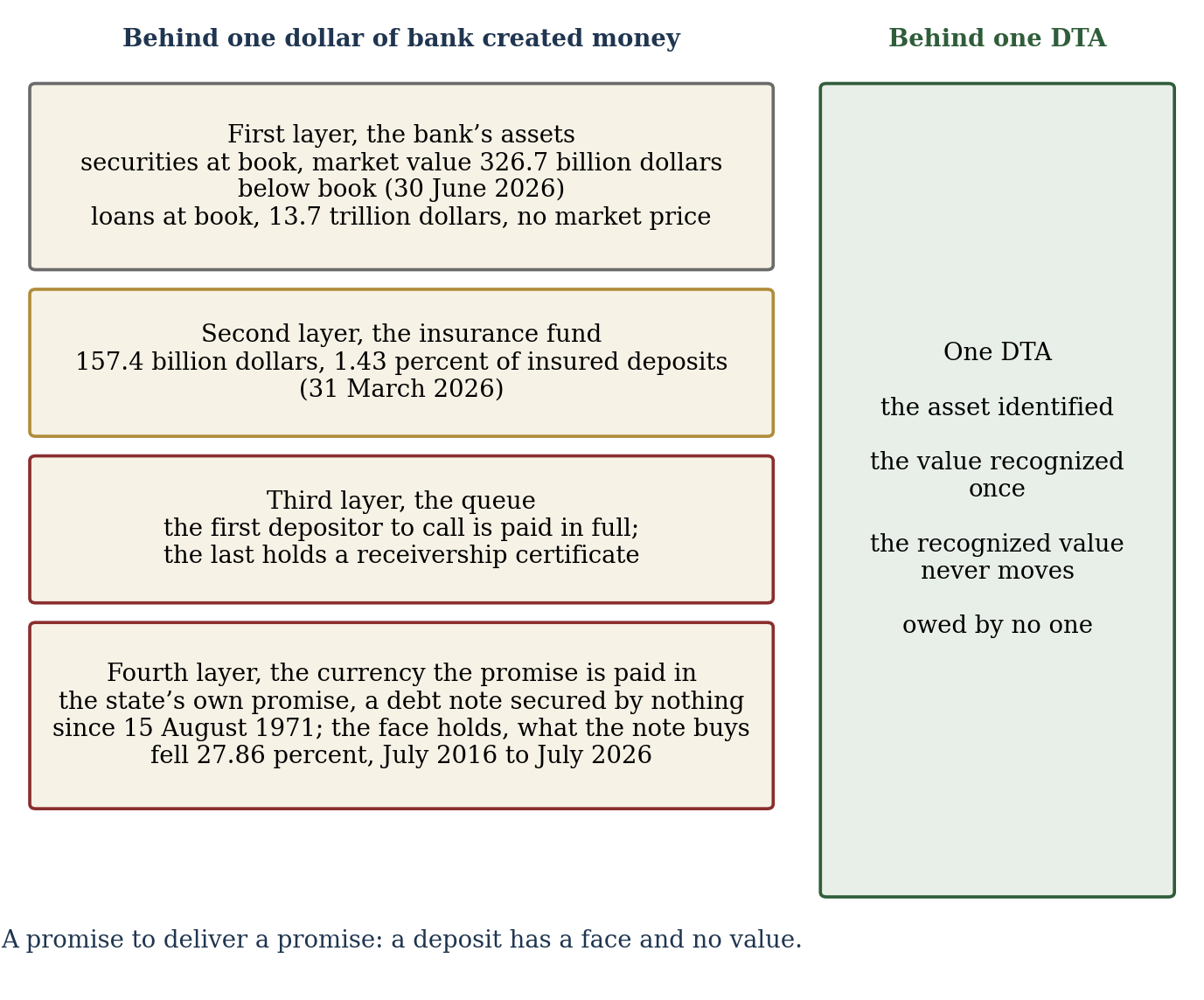
Figure 9. The four layers behind one dollar of bank created money, and what stands behind one DTA. Sources: FDIC Quarterly Banking Profile, second quarter 2026 and first quarter 2026; BLS CPI-U.
Value comes onto the Alkaimi ledger by recognition, not by lending
A nation or a large asset holder brings a segmented, segregated portion of a national asset or a commodity position to Alkaimi’s value recognition method, through a licensee. Segmentation carves the portion out of the greater holding. Segregation isolates the portion so the portion stands alone and is recognized on the portion’s own facts. Alkaimi’s value recognition method establishes the wholly recognized portion’s value, and the DTAs issued against that value land in the holder’s client DTA holding account at the licensee. Prior liens on the asset are cleared at issuance, so the asset comes onto the ledger unencumbered or the asset stays off the ledger. The rate of entry is controlled by design, so that no currency is destabilized while national asset bases are brought onto the ledger.
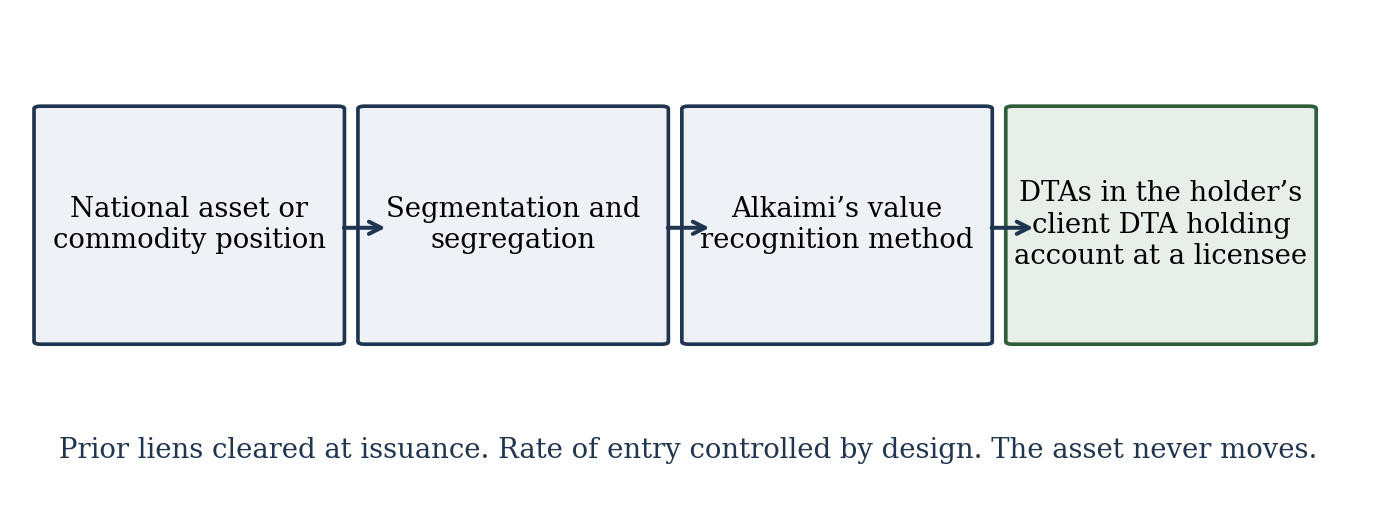
Figure 10. From asset to ledger account.
The DTA holds value better than any holding on a central bank’s balance sheet
Foreign exchange, sovereign debt, monetary gold and special drawing rights each fail on an axis the DTA does not. Foreign exchange is a claim on a foreign state, loses value with that state’s currency, and can be frozen by that state, as Russia’s holdings were in February 2022. Sovereign debt adds a counterparty who must pay. Monetary gold is property, not a promise, and shares that one quality with the DTA, and gold fails on the rest: gold must be vaulted, settles by moving metal or by a paper claim on a vault, and is read by marking against a currency price. Special drawing rights are a basket of five currencies and a claim on the members of the International Monetary Fund. A DTA is held as property rather than as a claim, sits in no currency, settles account to account with finality, and holds a count set at creation.
| DTA | Foreign exchange | Sovereign debt | Monetary gold | Special drawing rights | |
|---|---|---|---|---|---|
| Obligor | none; held as property | a foreign state | a foreign state | none | IMF member states |
| Loses value with | nothing | that state’s currency | that state’s currency | the marking currency | five currencies |
| Can be frozen by | no one | the issuing state | the issuing state | the vault’s state | the Fund |
| Settles how | account to account, final | a foreign bank transfer | sale or maturity | moving metal or a vault claim | through the Fund |
Table 2. The DTA against every central bank holding.
The walled garden holds value only, and the ring is where currencies meet it
Inside the walled garden there is value and nothing else. The twenty
licensed seats are gateways: each seat is a licensed institution
managing client DTA holding accounts on the Alkaimi ledger, hundreds of
thousands of accounts as the ledger fills. 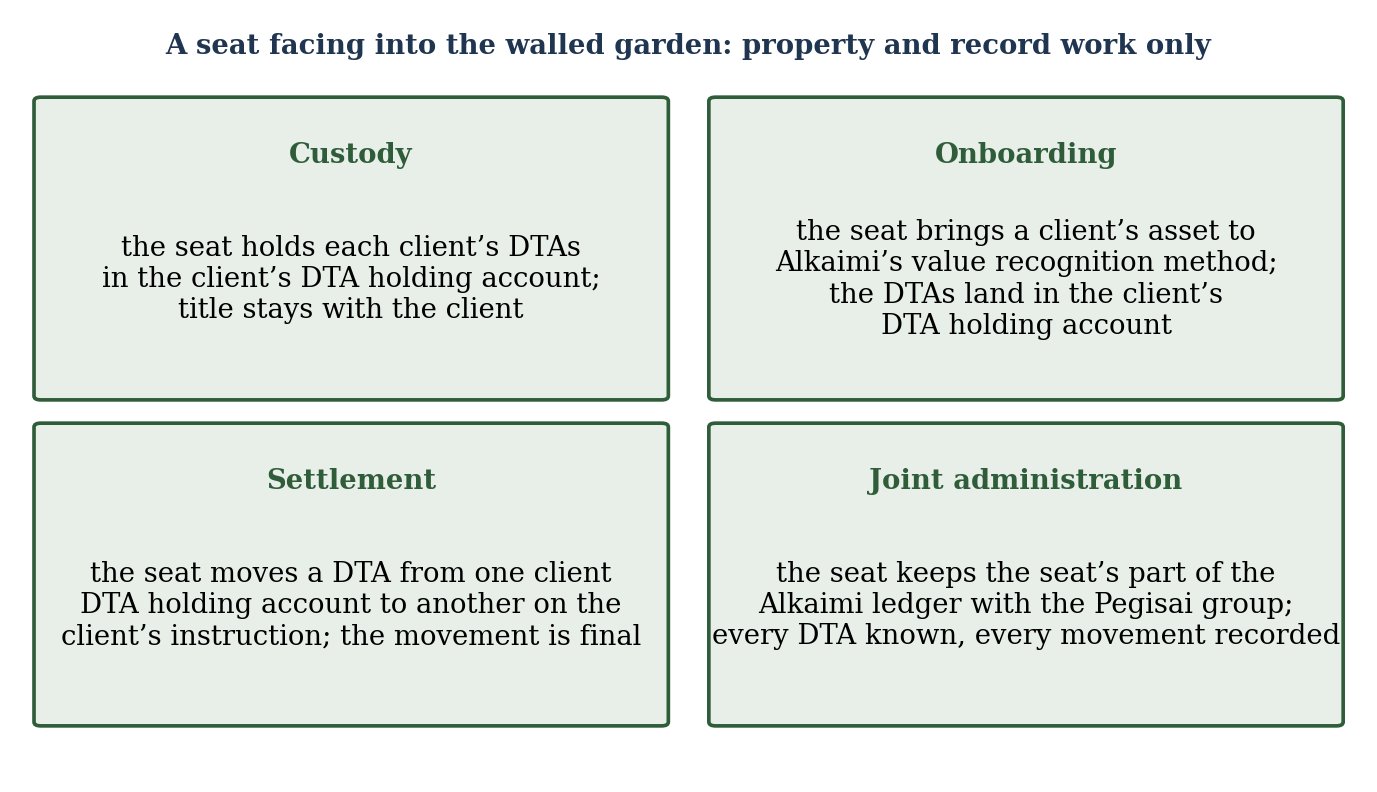 Figure 11. The four roles
a seat performs facing into the walled garden.
The Pegisai group companies audit, administer, fact check and certify the ledger, and ensure that proper underwriting and asset maintenance are maintained on every stack.
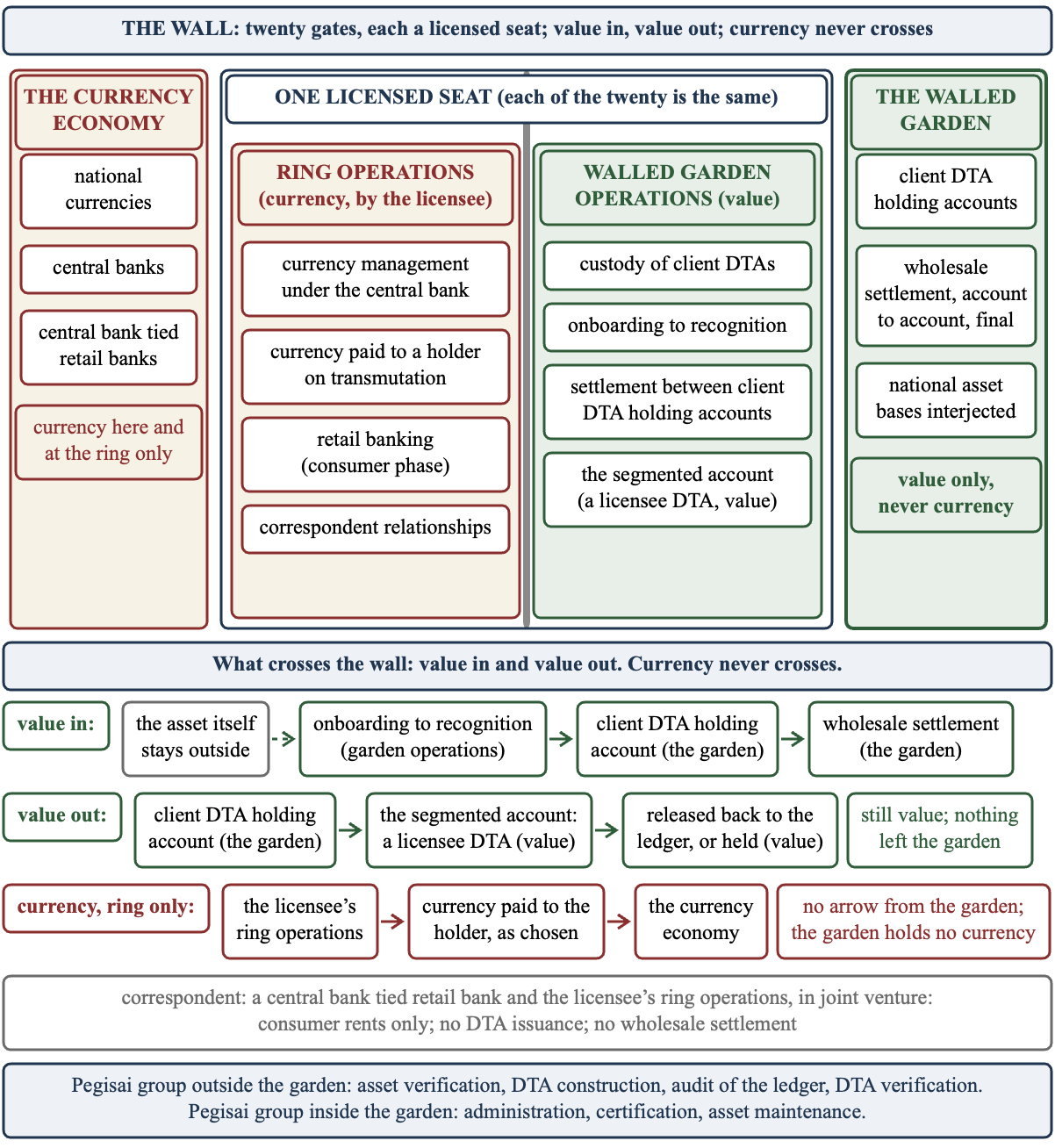
Figure. The walled garden, one licensed seat split into ring operations and walled garden operations, and the currency economy outside; value in and value out across the wall; currency at the ring only.
In this phase the garden carries wholesale settlement between client DTA holding accounts, in national-level DTAs and large-block DTAs, and the interjection of national asset bases, by design.
The garden’s neutrality is enforced by the ledger itself.
A DTA issuing holder that fails the holder’s asset maintenance requirements, or engages in nefarious conduct, meets two consequences under the rules: every DTA the holder issued and still holds is frozen, and every DTA the holder holds from other sources is liquidated to cover the holder’s outstanding obligations to other holders.
No counterparty has to trust a holder’s future willingness to pay, because the payment is already on the ledger. Further the ledger’s asset maintenance criteria are strictly enforced and penalties are activated by the rules and not by politics. The maintenance and surety rules are designed to discourage rogue conduct and the penalties are sufficient in nature that the potential economic injury is a sufficient deterrence.
Alkaimi’s neutrality enforcement protocols resolve the primary reason why other systems fail: lack of trust - no member trusts another member to release gold reserves or currency reserves to pay another member’s obligation.
On the Alkaimi ledger settlement moves on an obligation, and a party that refuses to meet an obligation, or defaults on one, meets the freeze and the liquidation stated above.
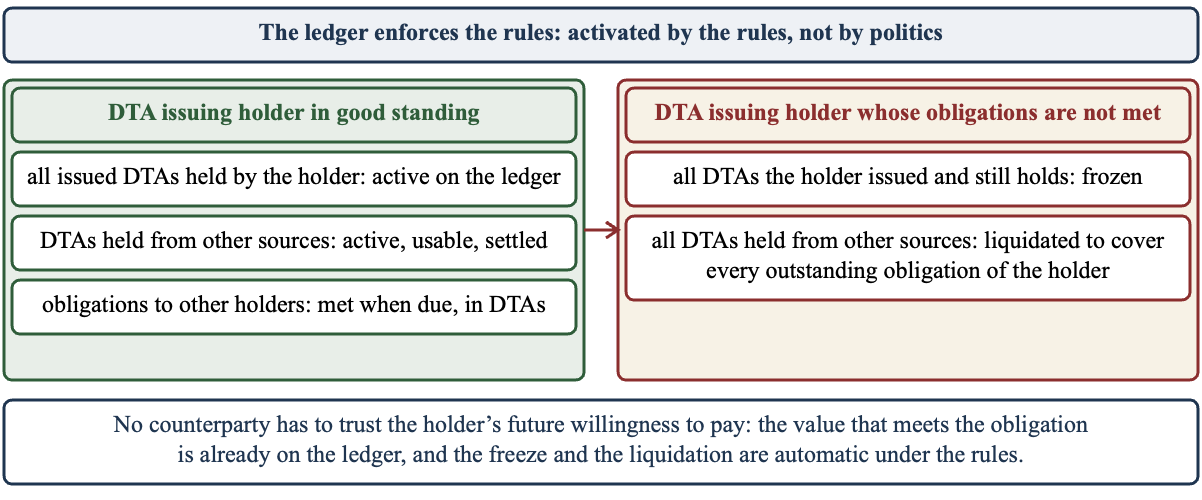
Figure 12. A DTA issuing holder in good standing, and a DTA issuing holder whose obligations are not met: issued DTAs frozen, DTAs held from other sources liquidated to cover the obligations.
Sources:
1. Federal Deposit Insurance Corporation, Quarterly Banking Profile, second quarter 2026 (unrealized losses 326.7 billion dollars; held-to-maturity losses 10.5 percent of amortized cost) and first quarter 2026 (Deposit Insurance Fund 157.4 billion dollars; reserve ratio 1.43 percent; total loans 13.7 trillion dollars).
2. United States Bureau of Labor Statistics, CPI-U, July 2016 and July 2026.
3. Federal Reserve Statistical Release H.4.1, 2 September 2026.
4. Sanctions on the Bank of Russia’s reserves: statements of the United States Treasury, the European Union and the G7, 26 to 28 February 2022.
5. Basel Committee on Banking Supervision, Basel III: The Liquidity Coverage Ratio and liquidity risk monitoring tools, January 2013 (Level 1 assets).
6. The Alkaimi Financial Ecosystem in Function: Granular Value on a Neutral Rail, the published testing record: the DTA, custody, client DTA holding accounts, the walled garden and the licensed ring, the neutrality and asset maintenance rules, the posting of the DTA as a high quality liquid asset.
Link line: Part 3, Building a global recognized asset platform, follows.
This page contains some forward-looking statements. Read Pegisai’s statement on forward-looking statements.