The Alkaimi™ model changes the source of a bank’s lending reserve. Today the reserve is money a bank creates when the bank lends: a deposit, which is the bank's promise to pay the holder government issued currency on demand, backstopped by the central bank. Under the Alkaimi model the reserve is value that asset holders already own, held whole on the Alkaimi ledger, and the bank lends from that value under the holder’s own agreement. Three results follow: pressure comes off the central bank, bank lending stops creating unsecured money, and wealth stays with the holder.
Today a bank lends money the bank creates
Currently, using the fractional reserve model, every loan a deposit bank writes creates a new deposit. The Bank of England stated the mechanism plainly in 2014: when a bank makes a loan, the bank credits the borrower’s account with a deposit that did not exist a moment earlier, and that deposit is new money. Banks do not lend out savers’ deposits, and banks do not multiply central bank reserves. The loan comes first, and the new money comes into existence with the loan. In the United Kingdom, deposits created that way are 97 percent of the money the public holds.
The difference here is important to understand, a bank deposit is not government issued currency, it’s not the state's currency. The state's currency is the note the central bank issues and the coin the treasury mints, and the holder owns that note outright. A bank deposit is the bank's promise to hand the account holder the state's currency on demand, a promise the bank created when the bank wrote a loan. The holder of a deposit owns a claim on the bank, not government currency. Measured on each central bank's own figures, that promise is 89.74 percent of the money the public holds in the United States, 90.84 percent in the euro area, 85.88 percent in Russia and 95.83 percent in China. The rest notes and coin, also known as paper currency.
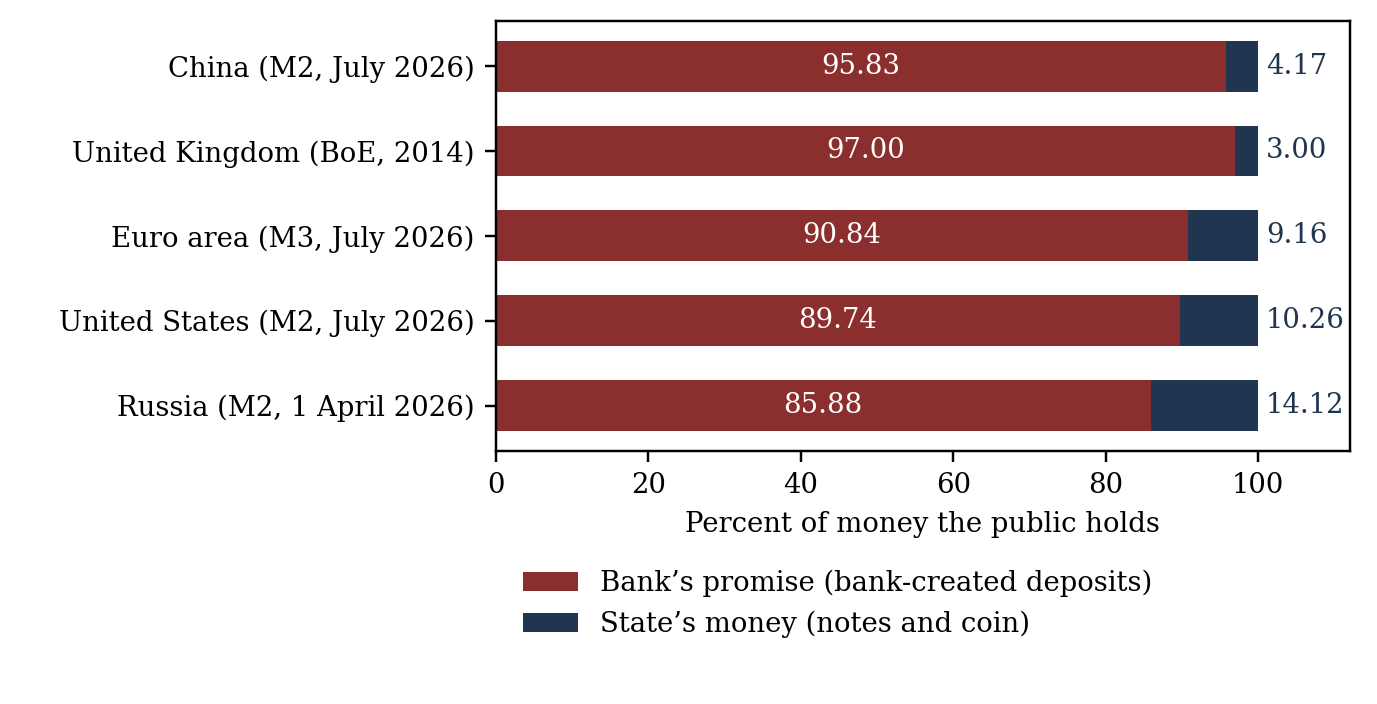
Figure 1. Share of the money the public holds that is a bank’s promise, against notes and coin, on each central bank’s own aggregates. Sources: Federal Reserve H.6, European Central Bank, Bank of Russia, People’s Bank of China, Bank of England.
Every new money a bank creates takes value from the money supply already held
Newly created money buys from the same shelf as the currency a saver already holds. The measure is the consumer price index. One dollar of July 2016 buys 72.14 cents of goods in July 2026, a loss of 27.86 percent in ten years (BLS CPI-U, July 2016 index 240.101, July 2026 index 332.813).
The dollar is not the exception. Across the same ten years the pound lost 29.60 percent of what a pound buys, the euro 24.51 percent, and the yen 14.09 percent, each measured against prices in the currency’s own country. The argument here is not against the dollar; the argument is against every currency as a measure of value, because every currency is a promise whose face holds while what the face buys falls. A value unit in a DTA™ is the one line on the chart that does not fall.
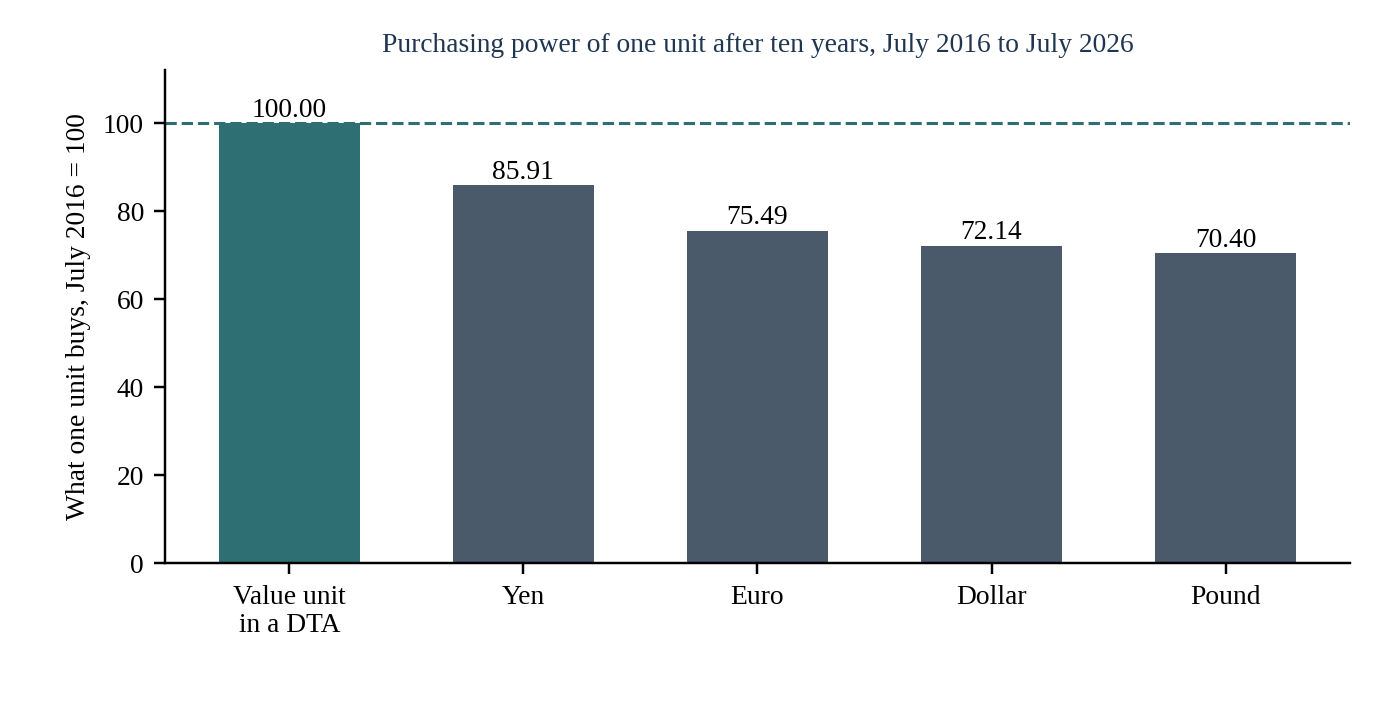
Figure. What one unit of each currency buys after ten years, July 2016 to July 2026, set to 100 at July 2016, beside a value unit in a DTA. Sources: BLS CPI-U (dollar); ONS CPI series D7BT (pound); Eurostat HICP via FRED (euro); Statistics Bureau of Japan CPI, July 2026 on the 2020 base chained to the OECD 2015-base annual series for 2016 (yen).
Derivation, for the record: dollar 240.101 to 332.813, a loss of 27.86 percent; pound 100.6 to 142.9, a loss of 29.60 percent; euro 77.92 to 103.22, a loss of 24.51 percent; yen 99.87 (2016 annual, 2015 base) to 116.26 (July 2026, 114.2 on the 2020 base converted at the 2020 level of 101.80 on the 2015 base), a loss of 14.09 percent. The yen figure uses the 2016 annual index in place of the July 2016 month and is pinned to the Bureau’s monthly table before publication. A saver’s balance shows the same number on the statement while the goods the balance buys shrink. In the Alkaimi 100% reserve model, a recognized asset’s Granular Value™ is set at creation on the Alkaimi ledger, so a value unit in a DTA does not shrink, because no new grain is created against the grains already held inside the DTA.
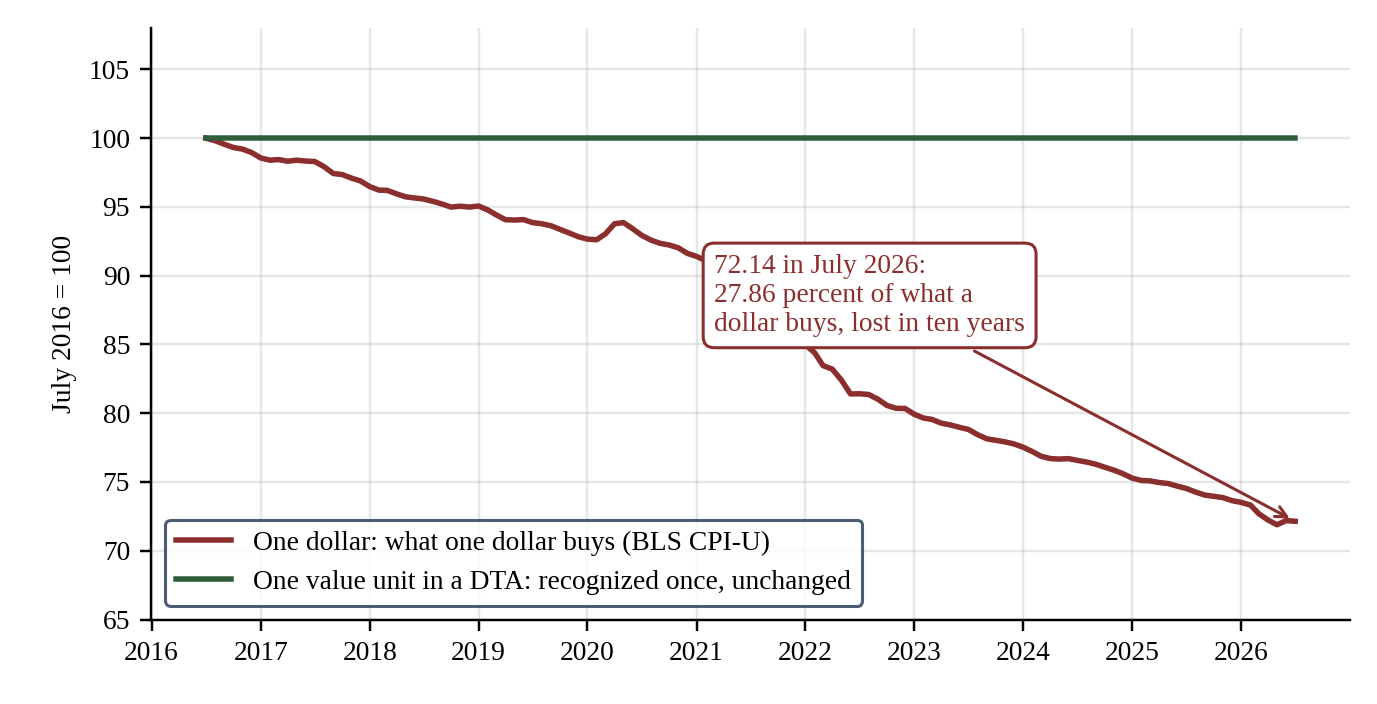
Figure 2. Purchasing power of one dollar, July 2016 to July 2026, against a grain count set at creation. Source: BLS CPI-U.
The difference: bank created money and the government “debt note” (currency)
During Alkaimi's development period, our design team heard a similar story from our focus groups, online and in the room. A depositor had money on deposit from earnings: a paycheck, the receipts of a business, the proceeds of the sale of a car or a house. Not a loan. Earned money, brought to the bank as currency or as a check and left there. The depositor went to the bank to withdraw cash for a purchase. The bank asked what the cash was for. At times the bank refused, and told the depositor to write a check, or to buy a cashier's check. The seller on the other side of the purchase did not want a check, and did not want a cashier's check; the seller wanted currency in hand. The depositor had brought currency or earned money to the bank and could not get currency back out. What the depositor held on the bank's books was the bank's promise to pay currency, and at the counter the bank decided not to honor the demand for currency but instead instructed the depositor to issue a promise to pay. This effectively broke the “currency on demand” aspect of the “new money” promise system.
During Alkaimi’s development period our design team focused on the subject of “claims” in the fractional and full reserve systems. In the fractional system, a bank issuing “new money” promises to pay is supposed to provide government currency against a bank depository account holder’s demand (withdrawal) upon notice. However, what our team realized was that increasingly banks globally were denying depositors access to currency that was deposited into the bank itself. Obliviously this signaled an expanding issue in the promise/ claim and liability system operated within the banking system.
As we have established bank created “new money” is merely a claim on the bank itself. What we must now do is look at the claim factor of government (and central bank) issued currency. State issued currency is a claim on the state for acceptance: the state compels every creditor to take the note in discharge of a debt in that currency, and takes the note itself in tax. Be advised that an electronic transfer between two accounts moves bank created “new money”, a claim on the bank, from one depository account to another; only the settlement between the two banks moves a balance at the central bank, and that balance is the central bank’s promise to the bank, which the public never holds.
The difference between new money and the paper currency is simple. The paper currency is a debt note that the issuing government must accept when the paper currency is presented, in payment of tax and in discharge of any debt in that currency; since 15 August 1971 nothing else is paid against the note. So, in the current model and in most cases, the paper currency in hand is more certain than the deposited money inside the banking system. Especially in times of economic uncertainty.
Understanding the fractional reserve / full reserve break-over.
Western banks, and specifically the US dollar-based banking system is a fractional reserve system and while the western governments managed government spending the fractional system was relatively stable, although expensive to maintain as the system always took wealth away from the users of the system. Bank’s created liquidity, by creating debt and expanding their ability to make more promises to pay (claims) which were distributed as payment items to other financial institutions. In the end the system was supposed to rely on the government to bail the system out in the event that things went wrong at the individual bank itself.
However, history of the early 2000’s presented a series of too-big-too-fail events that disclosed the current fractional reserve model operating banking system in the USA became to consolidated. This consolidation stressed the government’s ability to pay and produced a run of government debt events: the debt ceiling standoff and the Standard and Poor’s downgrade of 2011, the standoffs of 2013 and 2023 with the Fitch downgrade, and the Moody’s downgrade of 2025. The rescues were funded by the central bank buying the state’s debt with balances the central bank creates, the money stock grew faster than output, and the price level followed: a rise in the cost of living and a fall in the purchasing power of the currency, as the CPI records.
Now it must be clearly stated that banks operate on the fractional reserve system and governments allegedly work on the full-reserve system. To understand this the state's currency obligation is a full reserve system based on governmental promises. Section 16 of the Federal Reserve Act requires each Federal Reserve Bank to pledge collateral equal to the full amount of the notes the bank has outstanding. Every dollar of currency has a dollar of collateral against the dollar, by law, today.
What the collateral is: overwhelmingly United States Treasury securities, the state's own debt, plus gold certificates and the other assets the central bank holds.
So, the paper US dollar note is fully reserved, and the reserve is the issuer's own promise to pay in the same US dollar note.
The structure of this promise to pay looks like this:
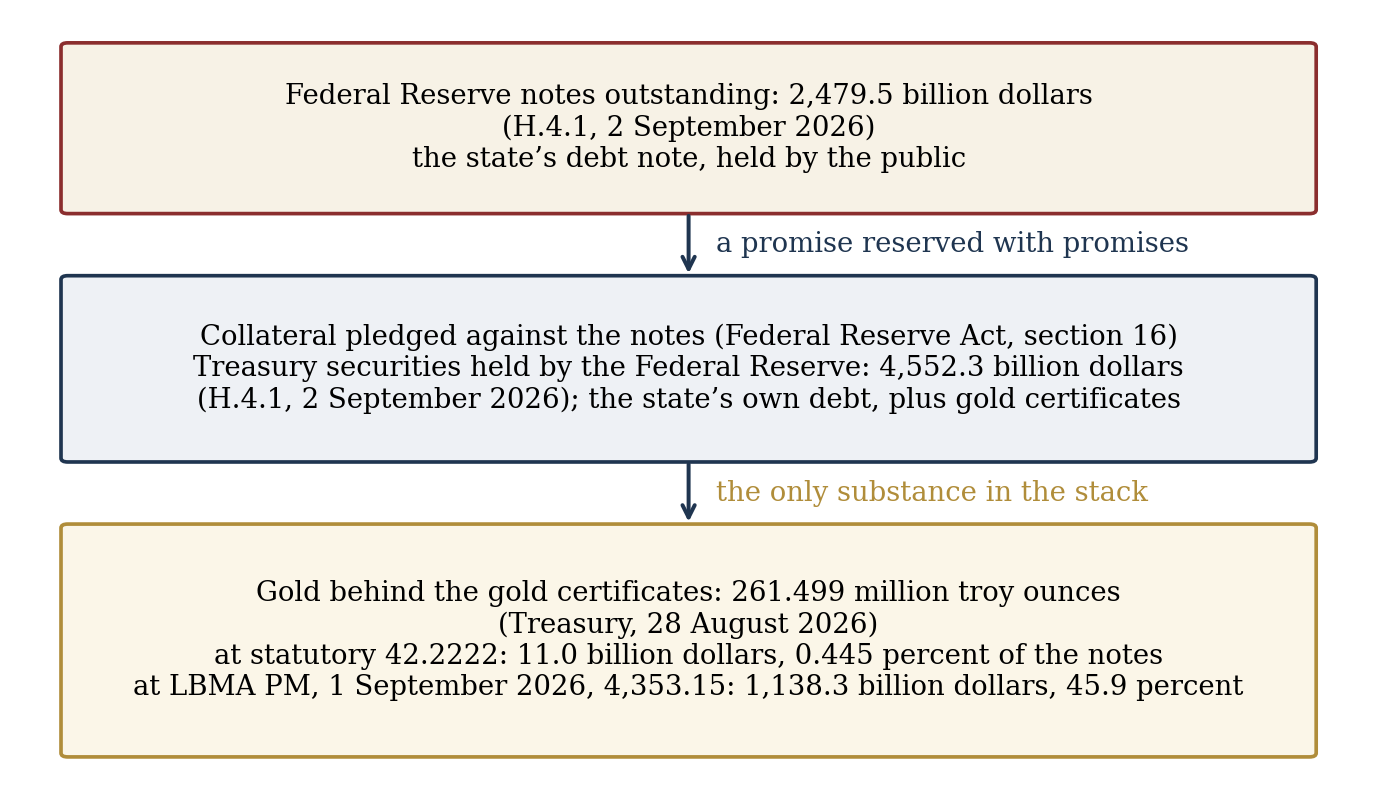
Figure 7. The structure of the promise to pay: the note, the collateral pledged against the note, and the gold beneath. Sources: Federal Reserve H.4.1, 2 September 2026; Treasury reserve release, 28 August 2026; LBMA Gold Price PM, 1 September 2026.
The fraction of substance behind the same notes is the gold: 261.499 million troy ounces, carried at 42.2222 dollars an ounce, 11.0 billion dollars against 2,479.5 billion dollars of notes, 0.445 percent at the statutory value. At the LBMA afternoon price of 4,353.15 dollars an ounce on 1 September 2026 the same gold reads 1,138.3 billion dollars, 45.9 percent of the notes and 2.84 percent of the 40,112.5 billion dollars of federal debt outstanding on that date.
What the United States holds against the claims
What the United States holds against those claims is on the Treasury’s own weekly release. On 28 August 2026 the official reserve assets of the United States were 253.7 billion dollars. Of that, 19.5 billion was securities of the euro area nations and Japan, their debt notes; 18.8 billion was balances at foreign central banks, the Bank for International Settlements and the International Monetary Fund; 31.7 billion was the reserve position at the International Monetary Fund, the paid-in part of the United States quota that the United States may draw back on demand; and 172.7 billion was special drawing rights, an allocation from the International Monetary Fund exchangeable, through the Fund, for the currencies of other member states. Every one of those lines is a claim on another state’s promise or on a fund of other states’ promises. The one line that is not a claim is the gold, 11.0 billion dollars at the statutory value and 1,138.3 billion at the 1 September 2026 price. Against those holdings stand 2,479.5 billion dollars of notes, 20,834.8 billion dollars of bank deposits the insurance fund answers for, and 40,112.5 billion dollars of federal debt.
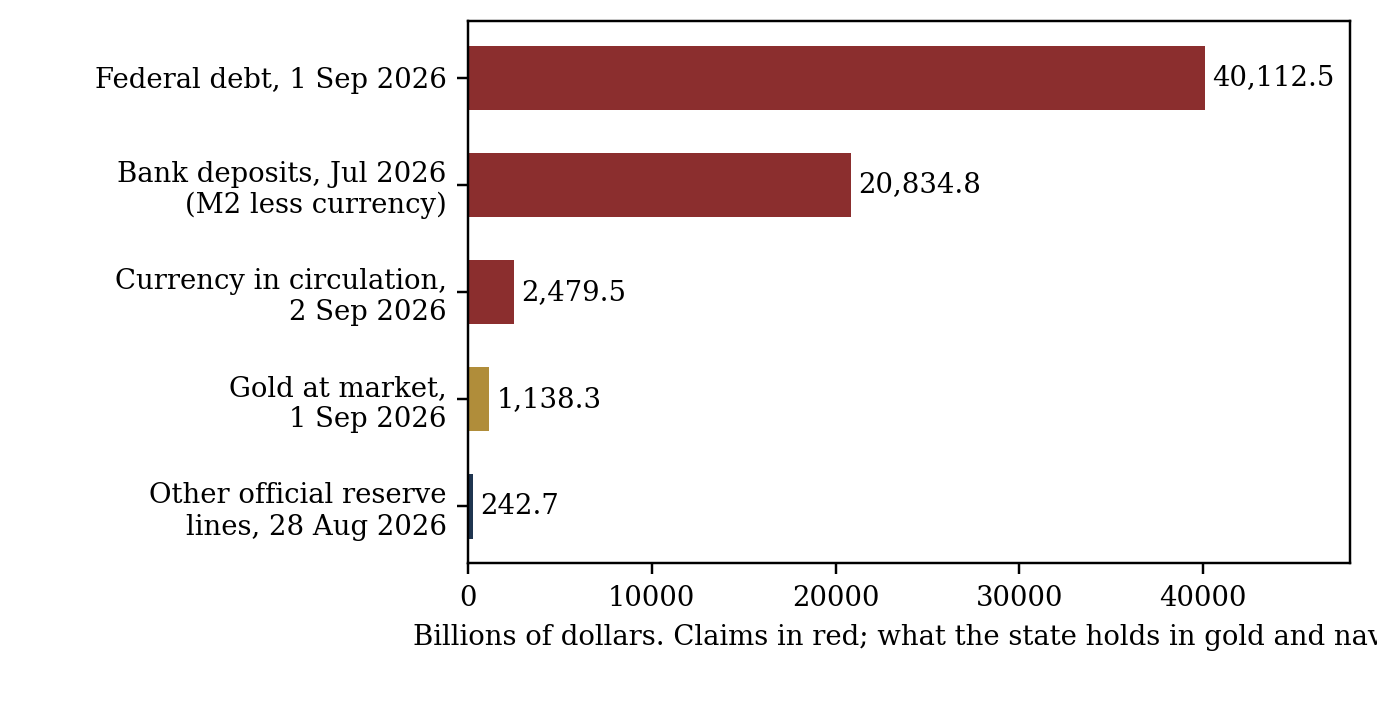
Figure 8. The claims against the United States and what the United States holds, billions of dollars. Sources: Debt to the Penny, 1 September 2026; Federal Reserve H.6, July 2026, and H.4.1, 2 September 2026; LBMA Gold Price PM, 1 September 2026; Treasury reserve release, 28 August 2026.
The same United States owns about 640 million acres of land, 28 percent of the country, and the mineral estate beneath about 700 million acres more, with the timber, the water and the offshore shelf that go with the land. None of that appears on the Treasury’s reserve line, because nothing in the current model can hold land, oil, timber or water as a reserve without selling the asset or pledging the asset.
Under Basel III+ the DTA is posted as a Level 1 high-quality liquid asset, liquid on any day. A nation with resources on state land can bring those resources through Alkaimi’s value recognition method into the national treasury’s reserve without selling a barrel or pledging an acre. And a nation whose central bank holds 4,552.3 billion dollars of the state’s own debt, 11.3 percent of the total, bought with balances the central bank creates, has for the first time since 1971 a reserve to set against that debt that is not a promise. Part 2 is about that reserve.
Part 1 sources
1. Bank of England, Quarterly Bulletin 2014 Q1, Money creation in the modern economy, McLeay, Radia and Thomas, 14 March 2014.
2. United States Bureau of Labor Statistics, CPI-U, all items, seasonally adjusted, July 2016 and July 2026 (FRED series CPIAUCSL).
3. Office for National Statistics, CPI index all items, series D7BT, July 2016 and July 2026; Eurostat, HICP all items, euro area, July 2016 and July 2026 (FRED series CP0000EZ19M086NEST); Statistics Bureau of Japan, CPI all items, 2020 base, July 2026, chained to the OECD 2015-base annual series (FRED JPNCPIALLAINMEI) for 2016.
4. Federal Reserve Statistical Release H.6, M2 and currency component, July 2026; European Central Bank, M3 and currency in circulation, July 2026; Bank of Russia, money supply M2 at 1 April 2026 and M0 for March 2026; People’s Bank of China, financial statistics release of 14 August 2026.
5. Check Clearing for the 21st Century Act, 2003.
6. Federal Reserve Act, section 16; 12 U.S.C. section 411.
7. Federal Reserve Statistical Release H.4.1, 2 September 2026.
8. United States Treasury, U.S. International Reserve Position, 28 August 2026.
9. LBMA Gold Price PM, 1 September 2026 (ICE Benchmark Administration).
10. Bureau of the Fiscal Service, Debt to the Penny, 1 September 2026.
11. Congressional Research Service, Federal Land Ownership: Overview and Data; Bureau of Land Management, federal mineral estate.
12. Standard and Poor’s, 5 August 2011; Fitch Ratings, 1 August 2023; Moody’s, 16 May 2025: sovereign rating actions on the United States.
Link line: Part 2, Substance returns to settlement, follows.
This page contains some forward-looking statements. Read Pegisai’s statement on forward-looking statements.