How the model is metered, what the model unravels, and what a regional bank can expect
The platform page states what the platform does; this page shows the mechanism, the pace and the arithmetic, with a source beside every figure.
Three rungs of promise
Every figure quoted as money today sits on one of three rungs, and each rung is a promise.
The first rung is the deposit, a bank's promise to deliver the state's money on demand; on the central banks' own aggregates, as derived in the four-part series on the Home page, the bank's promise is 89.74 percent of what the public holds as money in the United States, 90.84 in the euro area, 85.88 in Russia, 95.83 in China and 97 in the United Kingdom.
The second rung is the central bank balance, the central bank's promise to banks, created when the central bank buys the state's debt or lends against that debt.
The third rung is the note, the state's debt note, issued against collateral that is overwhelmingly the state's own debt. The monetary aggregates, M1 to M4, cut across the rungs by liquidity and not by rung: a deposit created by a mortgage and a deposit created by the Treasury spending a monetized bond sit in the same aggregate and cannot be told apart there.
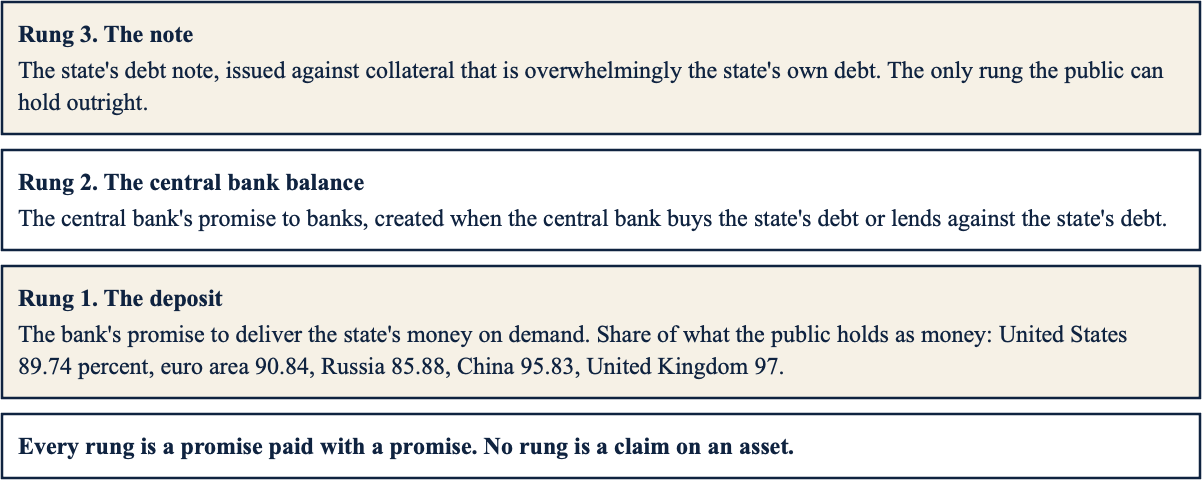
Figure 5. Three rungs of promise.
Two channels, two exits
The model reaches the ladder by two channels, and each channel has a definite exit even though the aggregates cannot show the exit.
The bank channel: a licensed bank writes new loans from DTAs rented under the client's own agreement, and those loans create no deposit; the bank's existing loans repay, and each repayment destroys the deposit that the loan created. The exit is the deposit, and the pace is the loan book's own repayment: card balances in months, commercial lines in a year or two, mortgages over decades.
The state channel: a treasury petitions a licensee for DTAs and then retires issued debt with DTA™ liquidity, or meets a deficit with DTA liquidity instead of a new issue. No aggregate moves on the day. What moves is the stock of state debt, the collateral behind the second and third rungs: every bond retired or never issued is a bond the central bank never buys and against which the central bank never lends, so the central bank's promise to banks is not created and the collateral behind the note stops growing. The state's note and coin are untouched by both channels: currency is the state's issue by law, Pegisai™ creates none, and what falls is demand for the note in holding and settling value.
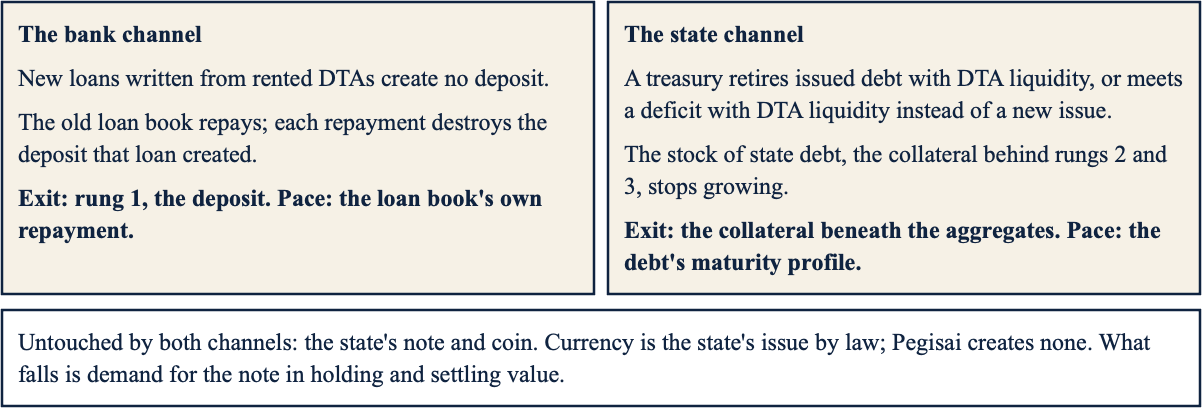
Figure 6. Two channels, two exits.
Why the model is metered
The platform's capacity is not the limit; the shock is. Recognized value near a quadrillion dollars released into the system at once would break currencies, and the break runs either way: hyperinflation, or the deflation in which people walk away from a currency altogether. No reserve currency has ever collapsed in a single event.
The dollar overtook sterling in the 1920s across a decade, after a war, as the issuing power's standing changed (Eichengreen, Exorbitant Privilege, Oxford University Press, 2011; Eichengreen and Flandreau, The rise and fall of the dollar, European Review of Economic History 13(3), 2009).
The one currency that did break, the German mark, ended in the hyperinflation of 1923 and the Rentenmark of 15 November 1923 (Bresciani-Turroni, The Economics of Inflation, 1937).
The model is therefore metered by sequence: wholesale settlement first; then state debt shifted into DTAs the nation can move, which underpins the national treasury and separates the nation’s currency from the banks inside the nation; consumer products in a later phase. Alkaimi™ projects that recognizing asset value sufficient to reach 130 trillion dollars will take many years, a change measured across approximately a decade.
What the treasury's DTAs change
A treasury holding DTAs stands a reserve beside the currency, not behind the currency.
The treasury sells fewer bonds, because the deficit and the debt can be met with ledgered recognized value the nation already owns.
The currency is separated from the banks inside the nation, because the banks' liquidity no longer runs through the state's debt.
The central bank's reach outside the nation shrinks a little, because a foreign owner of value no longer needs the nation's currency to hold value.
A false economy run on a foreign currency loses the advantage the foreign currency gave, because the extrinsic value of a currency's usage is nearly nothing once intrinsic value is what settles.
The measure
The measure of the model's effect is the bank's promise share of what the public holds as money, per country and per year, from the central bank's own aggregates. The share is measurable each year in every country, and the model's effect shows as the share falling. The state channel has a separate official measure: gross state debt outstanding and the central bank's holdings of that debt.
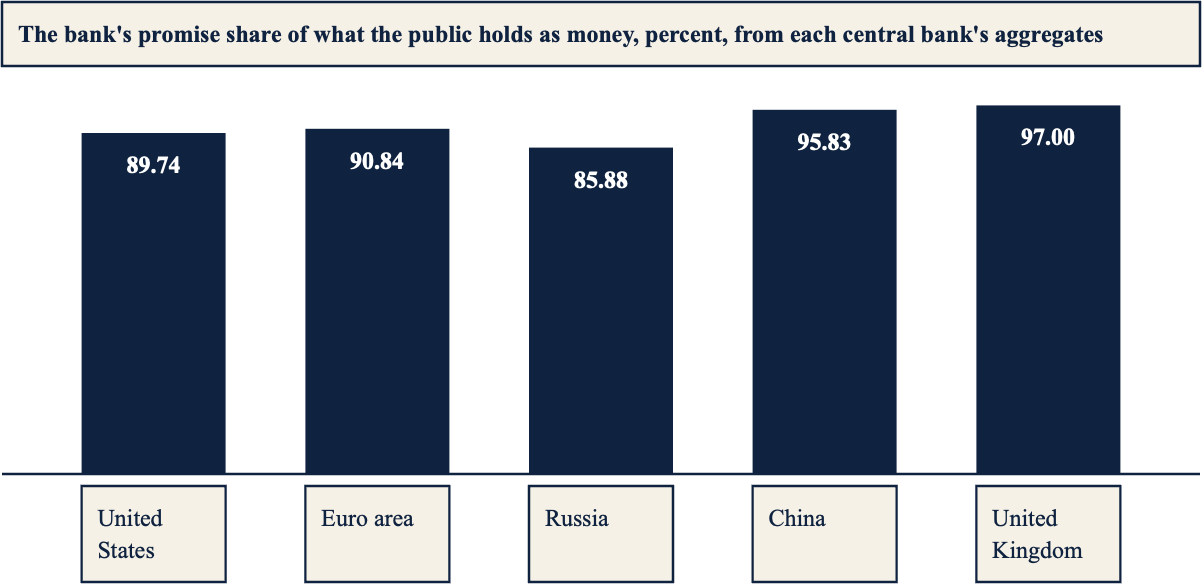
Figure 7. The bank's promise share of money in five countries, as derived in the four-part series from each central bank's aggregates.
What a regional bank can expect
An access licensee can replace about a quarter to a third of the bank's unsecured liabilities in two years, on the loan book's own repayment pace. The illustration uses the FDIC's aggregate for community banks at 30 June 2026 (Quarterly Banking Profile, second quarter 2026, Table II-B, 3,818 banks): loans 1,943.6 billion dollars, 70.1 percent of assets; deposits 94.2 percent of liabilities, of which brokered deposits 4.4 percent; other borrowed funds 4.7 percent. The one assumption is the annual repayment rate per loan category, which on that mix weights to about 20 percent a year.
The arithmetic:
Loans repaid in two years = Loans × (1 − (1 − r)²), where r is the annual repayment rate
Replaceable share = Loans repaid in two years ÷ Total liabilities
r = 17 percent: 24 percent of liabilities; r = 20 percent: 28 percent; r = 23 percent: 32 percent
Other borrowed funds and brokered deposits go first, 9.1 percent of liabilities together; the remainder comes from maturing time deposits and rate-sensitive deposits; core transaction deposits last.
Two limits sit on the result: the supply of DTAs the gateway licensee can rent to the access licensee, and the central bank's acceptance of the pledge, an approval in process.
The illustration is Alkaimi's projection on stated assumptions, not a bank's number.
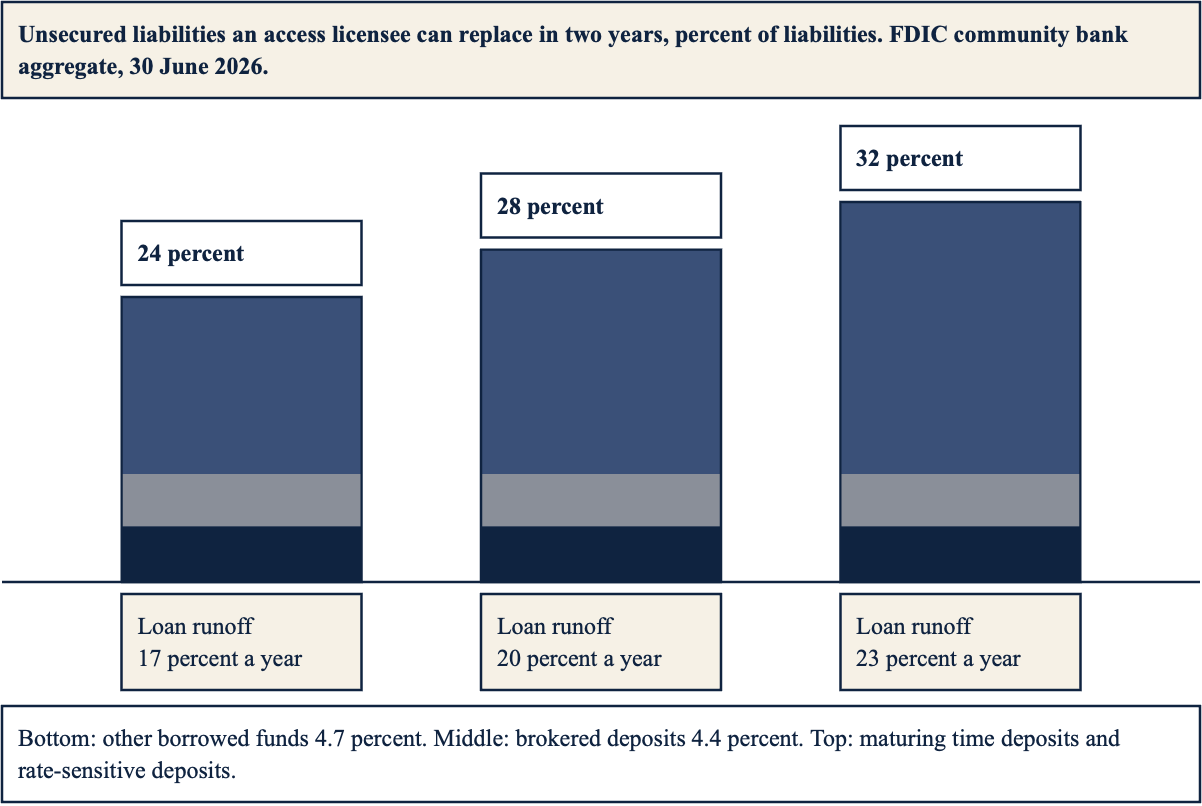
Figure 8. Unsecured liabilities replaceable in two years, three repayment rates, on the FDIC community bank aggregate at 30 June 2026.
Who invented and administers the platform
Pegisai Global Holdings invented the granular value recognition™ and DTA technologies and issues every license. The technologies carry a priority date of April 1997 and protection restored at the USPTO in 2019; Pegisai stated publicly in June 2022 that the design met the Bank for International Settlements criteria for frictionless money and instant payment.
The platform uses no blockchain and no distributed ledger; the Alkaimi ledger is one custodial ledger operated under bank supervision.
Two classes of license exist: the walled garden license, held by a bank with the capacity to operate a gateway to a global asset network at that scale; and an access license, open ahead of the consumer phase, for regional retail banks that engage in parts of the model through a walled garden licensee.
Pegisai Global Holdings administers the platform under contract, and Pegisai Network Services runs the network under the issued license.
Sources
Federal Deposit Insurance Corporation, Quarterly Banking Profile, Second Quarter 2026, Table II-B, Aggregate Condition and Income Data, FDIC-Insured Community Banks. People's Bank of China, European Central Bank, Federal Reserve Board and Bank of Japan, monetary aggregates, latest releases at mid-2026. Barry Eichengreen, Exorbitant Privilege: The Rise and Fall of the Dollar and the Future of the International Monetary System, Oxford University Press, 2011. Barry Eichengreen and Marc Flandreau, The rise and fall of the dollar (or when did the dollar replace sterling as the leading reserve currency?), European Review of Economic History 13(3), 2009. Costantino Bresciani-Turroni, The Economics of Inflation, 1937. Pegisai Global Holdings, The Alkaimi Financial Ecosystem in Function: Granular Value on a Neutral Rail.
Nothing on this page is an offer, a solicitation or a public offering, or legal, financial or investment advice.
This page contains some forward-looking statements. Read Pegisai’s statement on forward-looking statements.